This was the final third of our journey from Irun to Santiago, over 2 years.
This part was 260 kilometers over 13 days, starting in the town of Laredo in Cantabria, and ending at the city of Oviedo in Asturias. The total figure for the Camino del Norte depends on the route variants taken, but is commonly given as about 820 kilometers.
The walk from Irun to Laredo was documented in posts like this: and the section from Oviedo to Santiago is described here.
Regarding the actual path that we walk on, the Camino del Norte has relatively more asphalt and concrete surfaces than the Camino Frances does. Exact numbers are not available , but estimates are 80%/20% paved / unpaved for the Camino del Norte vs. 60%/40% for the Camino Frances. Where ‘paved’ may include some gravel paths.
Refs: Ride with GPS, et. al.
I think that it is fair to say that on the Camino del Norte there are not as many of the smooth, wide, dirt or gravel paths such as shown here near Llanes:
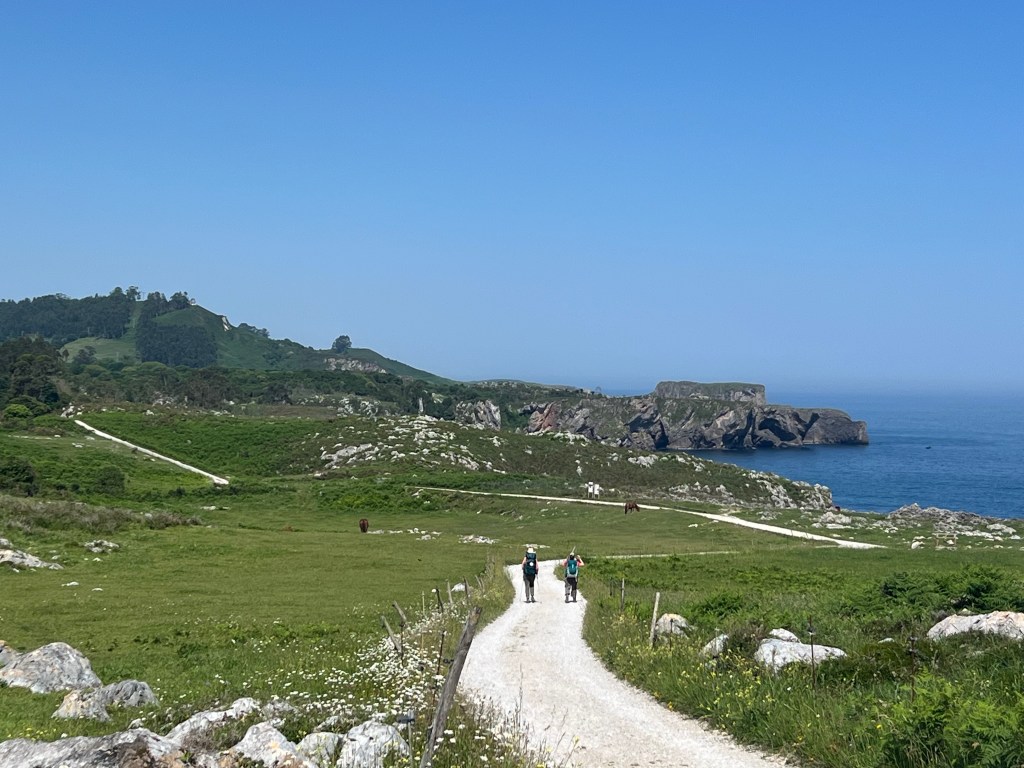
The paths tend to be more those that would have been there anyway, even if the Camino were not there.
There is more elevation gain and loss on the Camino Del Norte compared to the Camino Frances: +-17K meters vs +-13K meters over the length of the route, which at about 800km is similar for both.
(Refs: Camino de Santiago Forum, et. al.)
I could definitely feel the effect of the difference in terrain.
But how exactly does the difference in terrain affect the biomechanics of walking? There have been scientific studies of this.
When taking a step, there is a force exerted by the ground on the body. The amount of force varies during the step. Over level ground, it turns out that the maximum force does not change much over different types of ground surfaces. However what does change is the rate at which the force builds up to its peak. On harder surfaces like asphalt, this force builds up more rapidly. Moreover, for downhill slopes, measurements have shown that the peak force is greater than on flat surfaces. It has been shown that the body automatically increases tension in the legs in these situations, effectively as a sort of shock-absorbing mechanism. Muscles, tendons, and even fascia are involved. (References below)
This explains the increased stress on the body.
There are appeared to be a number of general-purpose vacationers and surfers in the Camino del Norte area, because of all the beautiful beaches and coastline.
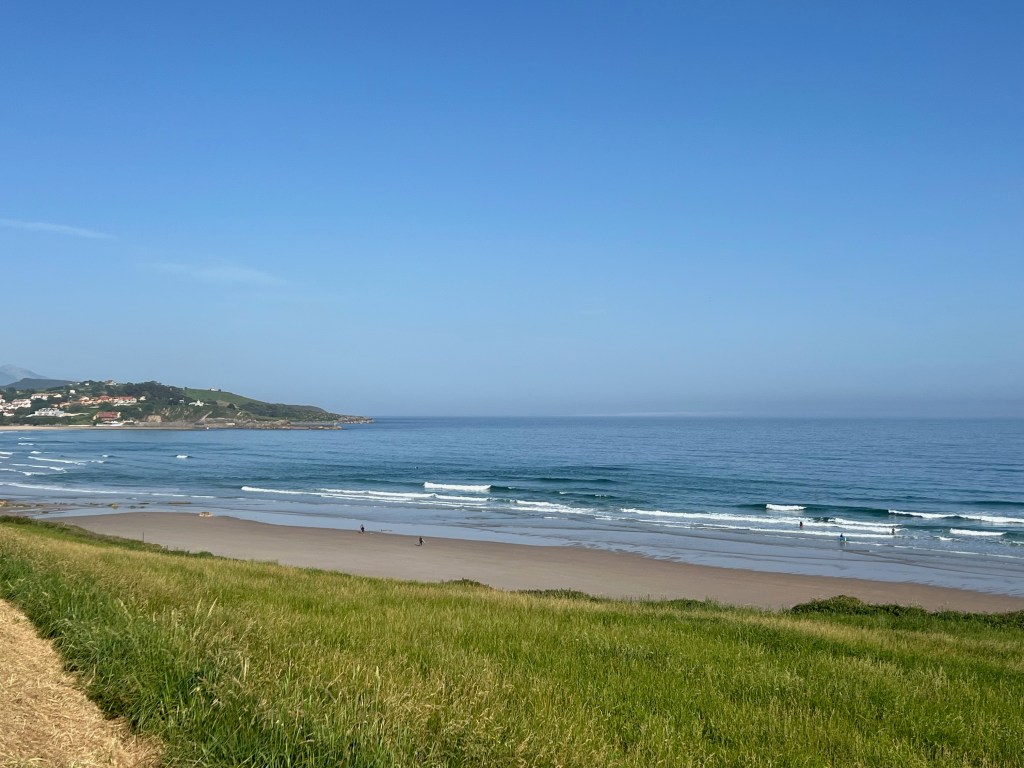
Not surprisingly, the number of people present depends quite strongly on the season. We were there in May which was still effectively the off-season.
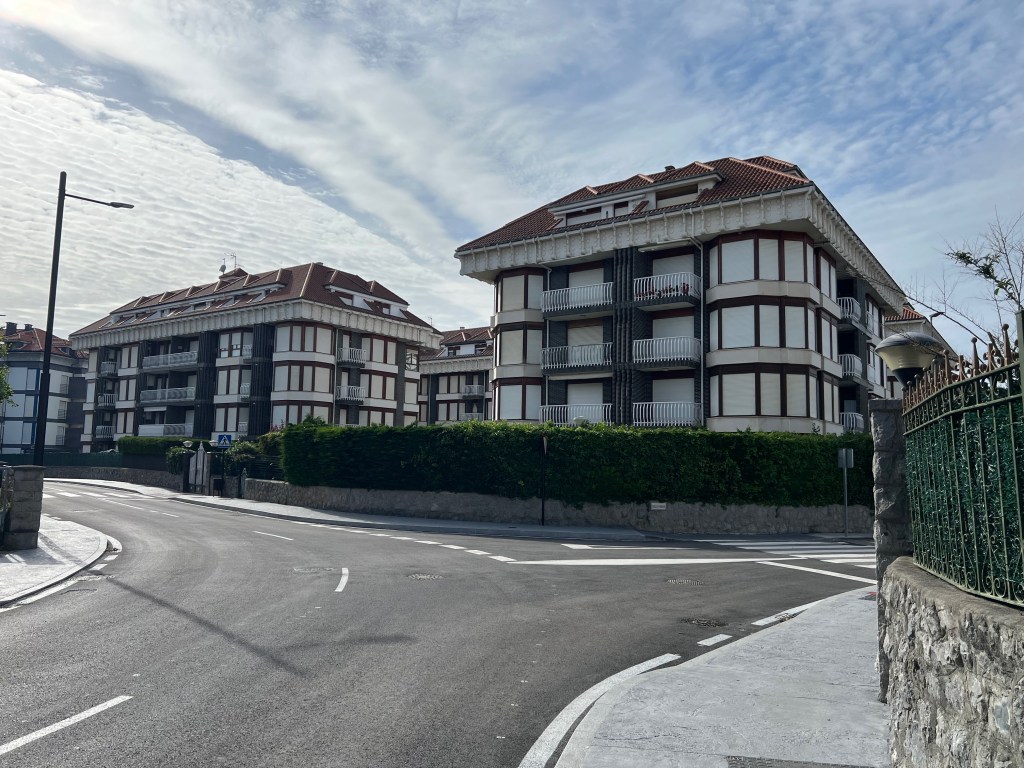
We visited the town of Noja for example. We remarked to the host of our accomodation regarding the many blocks of apparently empty apartment houses that we passed through, on our way to visit the beach there. According to my recollection, he informed us that the town has a population of over 100,000 in the summer season, and less than 5,000 in the off-season.
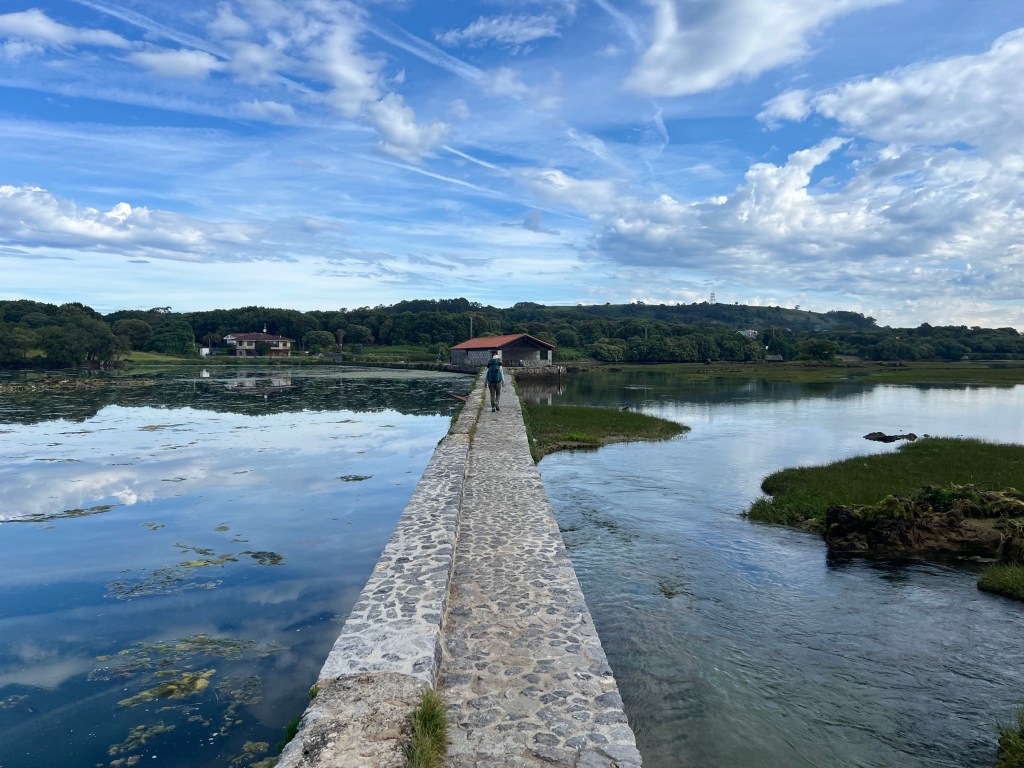
Shortly after Noja, and a bit off the standard Camino route, we visited a grain mill that had been used for centuries, and powered by the tidal currents of an estuary. (Marisma el Vao, Parque Natural de las Marismas de Santoña)
As it happened, we arrived at our destination city of Oviedo on a Saturday. In the evening we made our way over to the central plaza in front of the cathedral. Small children expertly passed a soccer ball around, while their parents had a lively conversation in a nearby outdoor bar. Teenagers darted about, while young parents with babies and centagenarians in wheelchairs all made the evening ‘paseo’. We came to the cathedral to visit, but could only peer through the massive wooden doors. We could not see much but could hear amazing music. That turned out to be coming from a large and talented chorus from San Sebastian, who were rehearsing for a benefit concert that night. We decided to get tickets for it, and went back out to the square.
We started to hear some thundering, swirling music coming from down a narrow street, with a crowd forming. Then a formation of bagpipers and drummers in beautiful traditional costume, playing in perfect unison and cadence, passed us by. They stopped by the cathedral and played some more to help attract notice to the concert. The choir came out then as well and sang. The benefit was for a rare-disease foundation, and one little girl who is affected by this was herself present in the throng.
References:
Warmerdam, E., Burger, L.-M., Mergen, D.F., Orth, M., Pohlemann, T., & Ganse, B. (2024). “The walking surface influences vertical ground reaction force and centre of pressure data obtained with pressure-sensing insoles.” Frontiers in Digital Health, 6:1476335. https://doi.org/10.3389/fdgth.2024.1476335 (open access, CC BY 4.0)
Boyer, K.A. & Nigg, B.M. (2004). “Muscle activity in the leg is tuned in response to impact force characteristics.” Journal of Biomechanics. This tested five different shoe midsole hardness conditions while measuring ground reaction forces, soft-tissue vibration via accelerometers, and EMG from the quadriceps, hamstrings, and tibialis anterior.
ScienceDirect
https://www.sciencedirect.com/science/article/abs/pii/S0021929004000314
 Along the Way