Oviedo
We started in the city of Oviedo , which is in the Spanish region of Asturias. Somewhat accidentally, Asturias had an important role in the development of Spain as a unified nation. Actually, around the year 700, Spain was already politically unified , as part of the Umayyad Caliphate.
Prior to that, after the fall of the Roman empire, Iberia was a complex, ever-changing mosiac of kingdoms composed of Visigoths, Vandals, Alans, Suevi, and others.
Located in the far northeast of Spain, Asturias was the first region to revolt against Caliphate rule. The specific issue that triggered the rebellion was taxes. Very gradually, more of Spain left Caliphate rule, as the kingdoms of Leon, Castille and Navarra became independent, and eventually coalesced together. 770 years later, this process, called the Reconquista, was complete.

Oviedo is commonly the starting point of a route to Santiago called the Camino Primitivo . The ‘Primitivo’ part of the name is due to the fact that this was the first route to the city of Santiago after the remains of St. James were announced as being buried there, around the year 811. In fact this was the only route safely possible at that time, when almost all of what we now call Spain was controlled by the Umayyad Caliphate. The Camino Primitivo route is thus tied into the history of the development of Spain as a nation.
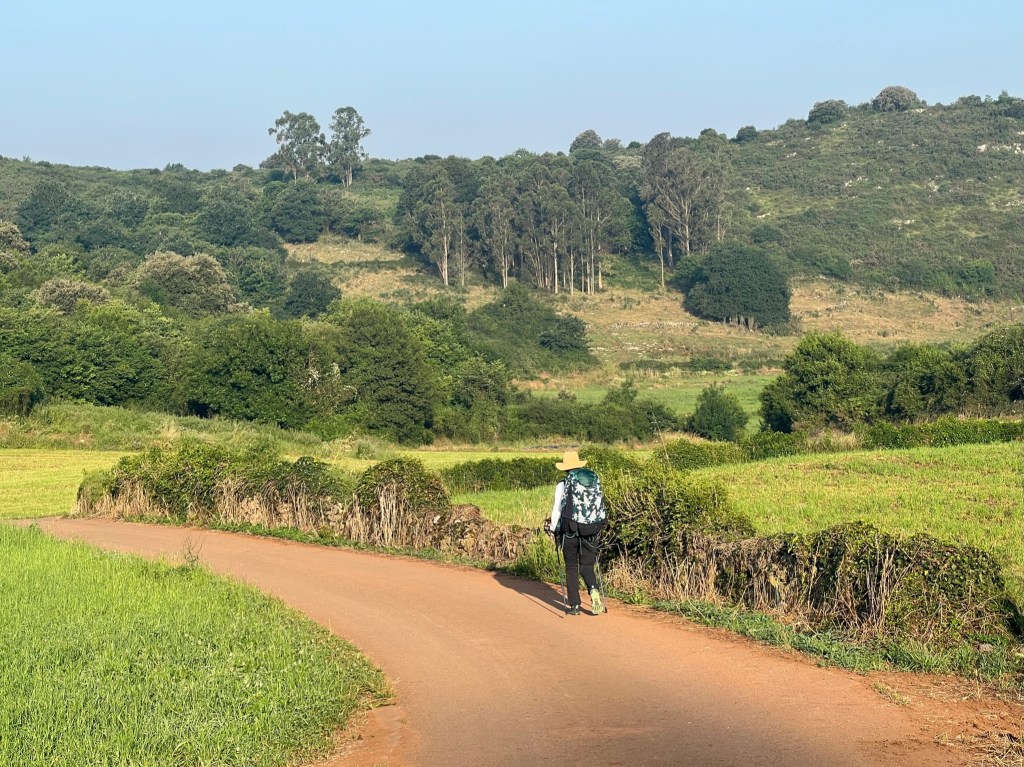
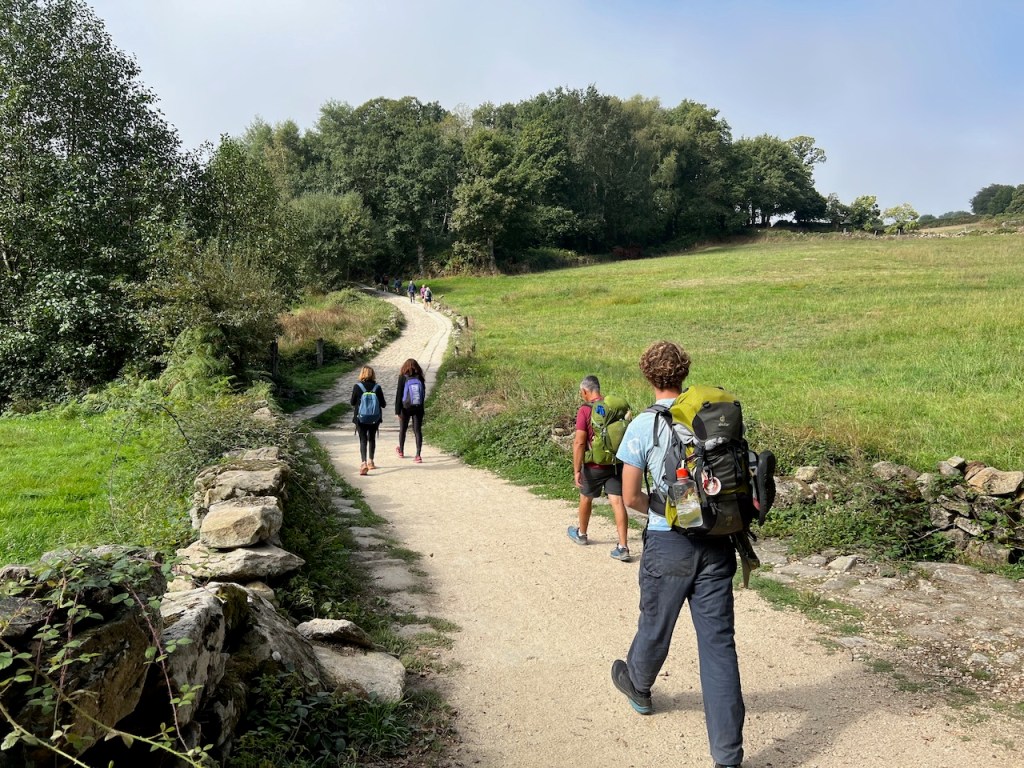
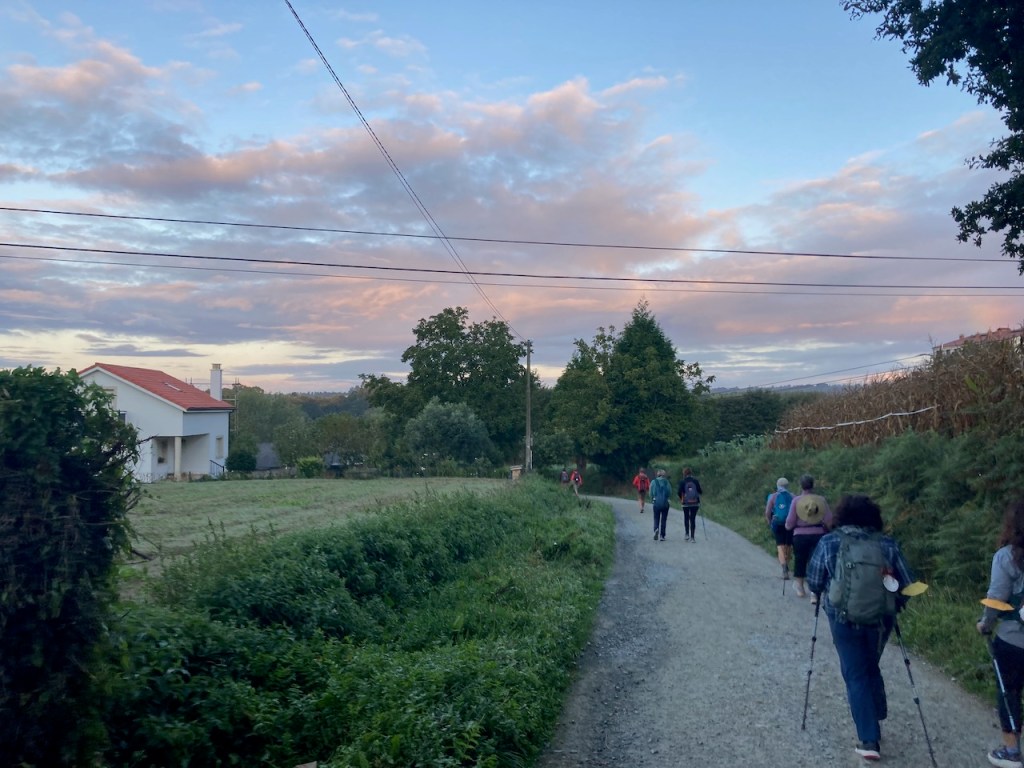
Once out of Oviedo, we encountered gentle walking through a wooded countryside.
Hospitales
The stage from the tiny village of Borres, to the town of Berducedo, took us up to what is called the “Hospitales” route.
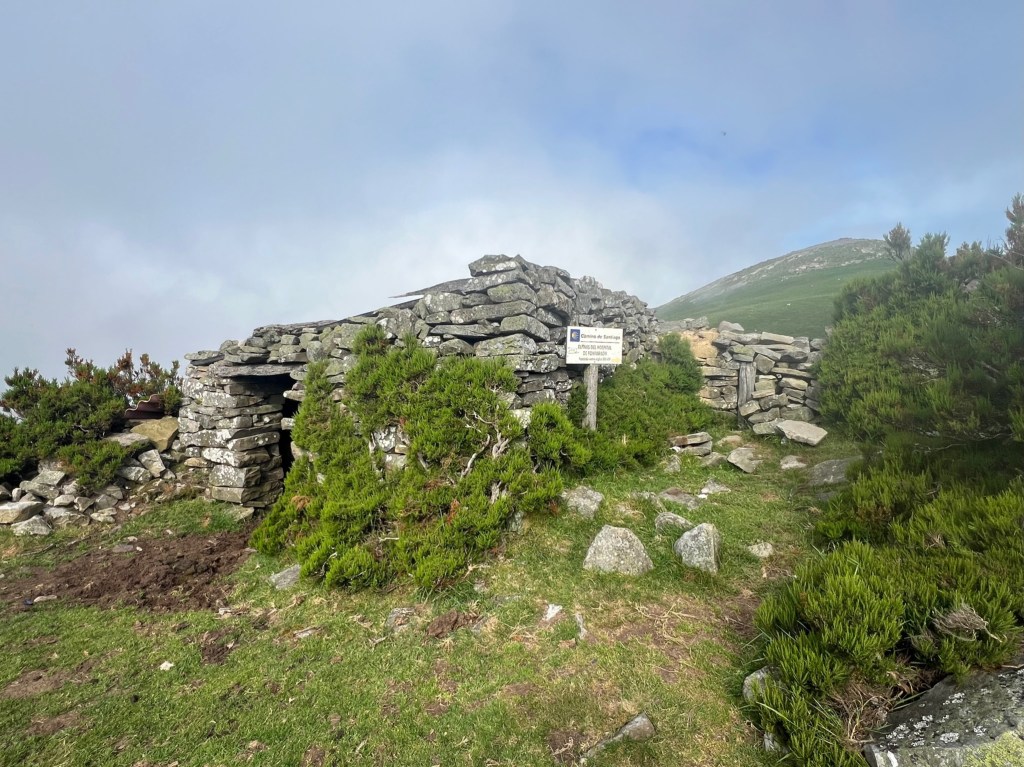
The old term ‘hospital’ here more refers to our English sense of ‘hospitality’ , that is, a place for refuge and accomodation, rather than the purely medical modern English term of ‘hospital’. There are the ruins of three hospitales on the route we took that day. The last one ceased operating at the beginning of the 20th century. They are quite small and broken down, and populated by cows. Only one appeared to still have any kind of roof.
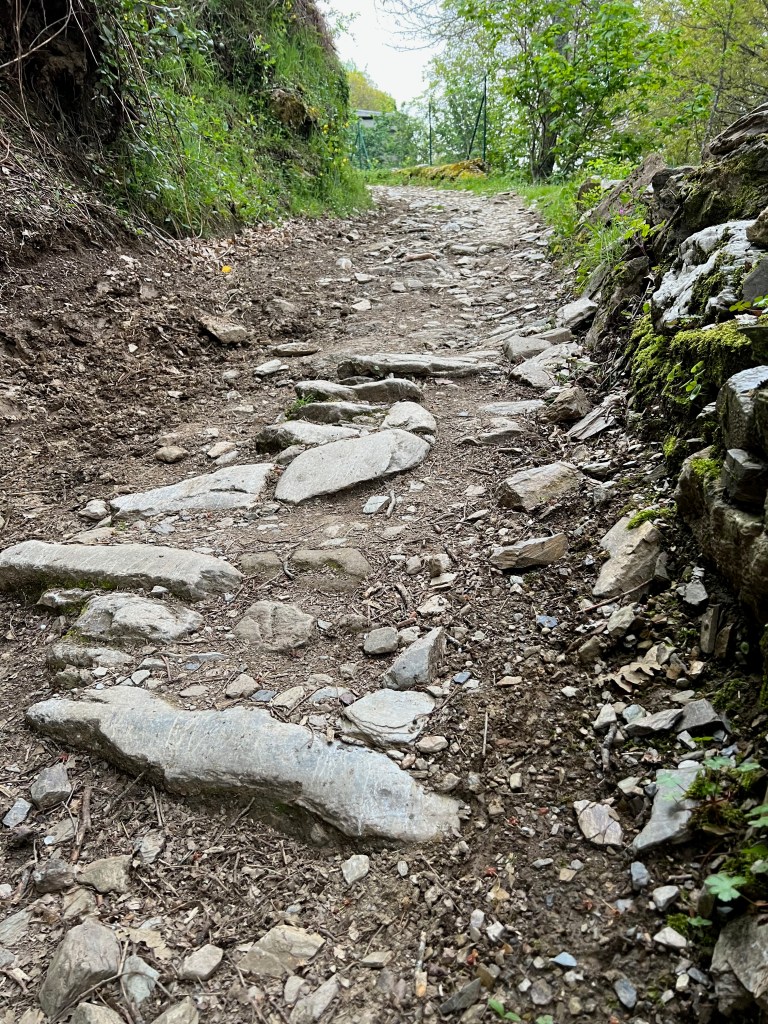
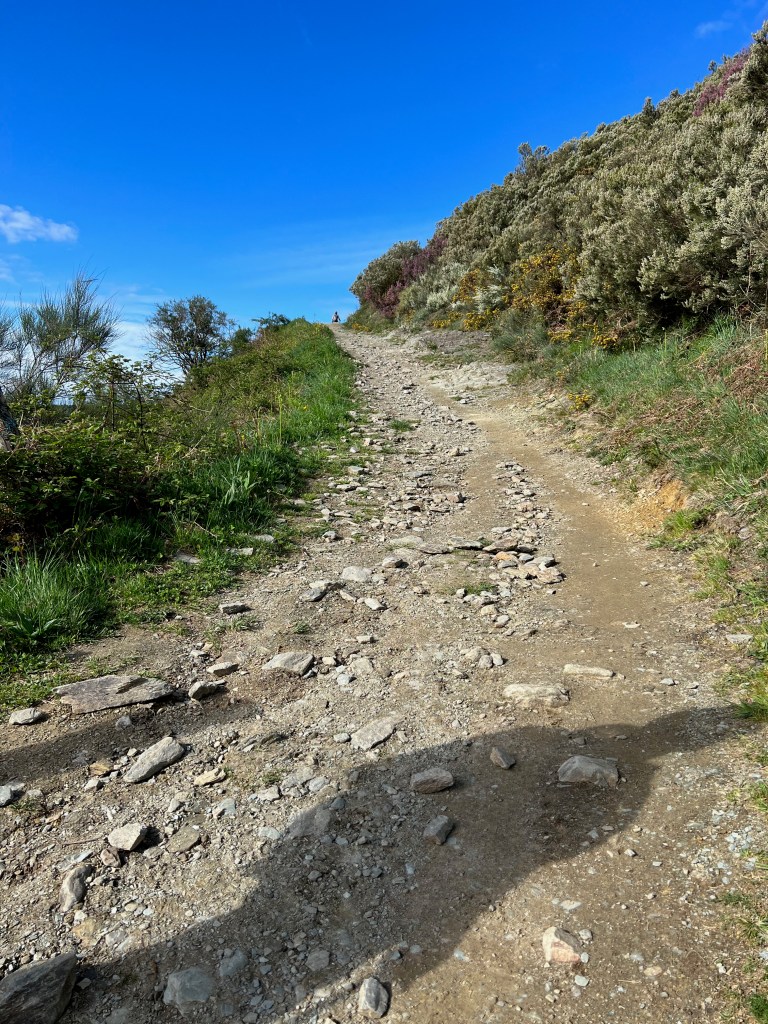
I did not find the uphill climb, while long, to be all that challenging in terms of steepness or footing.
(There is however an unbelievably steep and rocky straight-down descent after a place called Puerto del Palo.) The challenge is more a lack of services of any kind for 27 km, that is, not even water or a restroom. So it is best to be really ready when setting out in the early morning hours. ( There is an alternative route which passes through a town called Pola de Allande. )
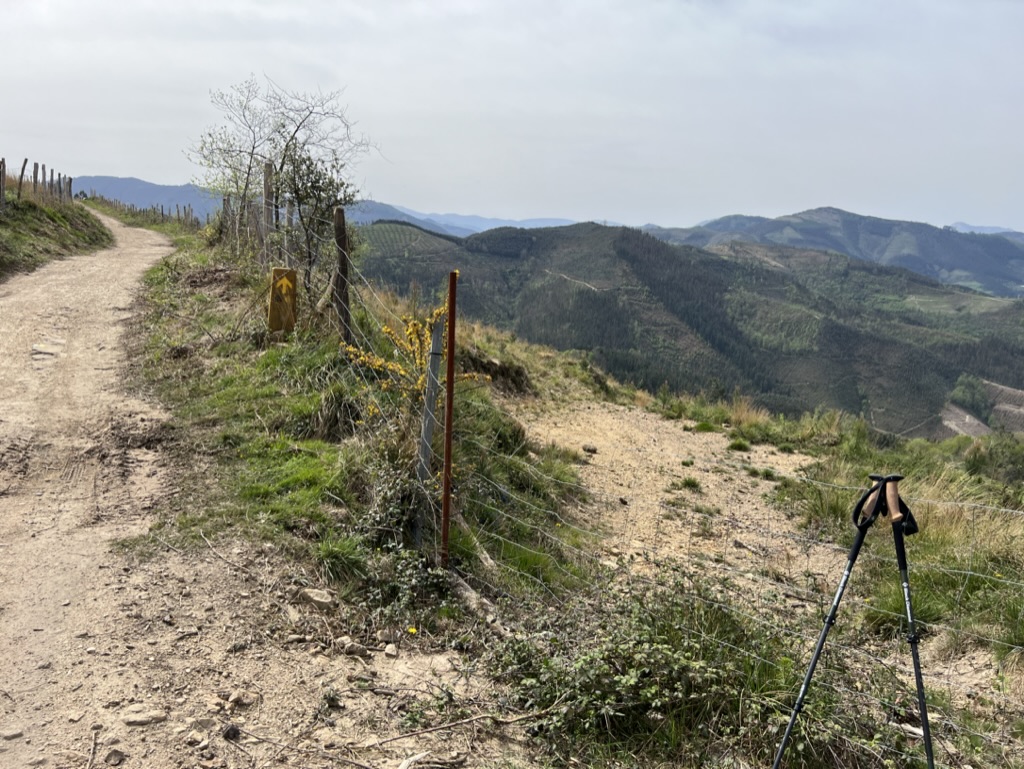
In contrast to other stages, there is not much vegetation of any size on the higher parts of the route.
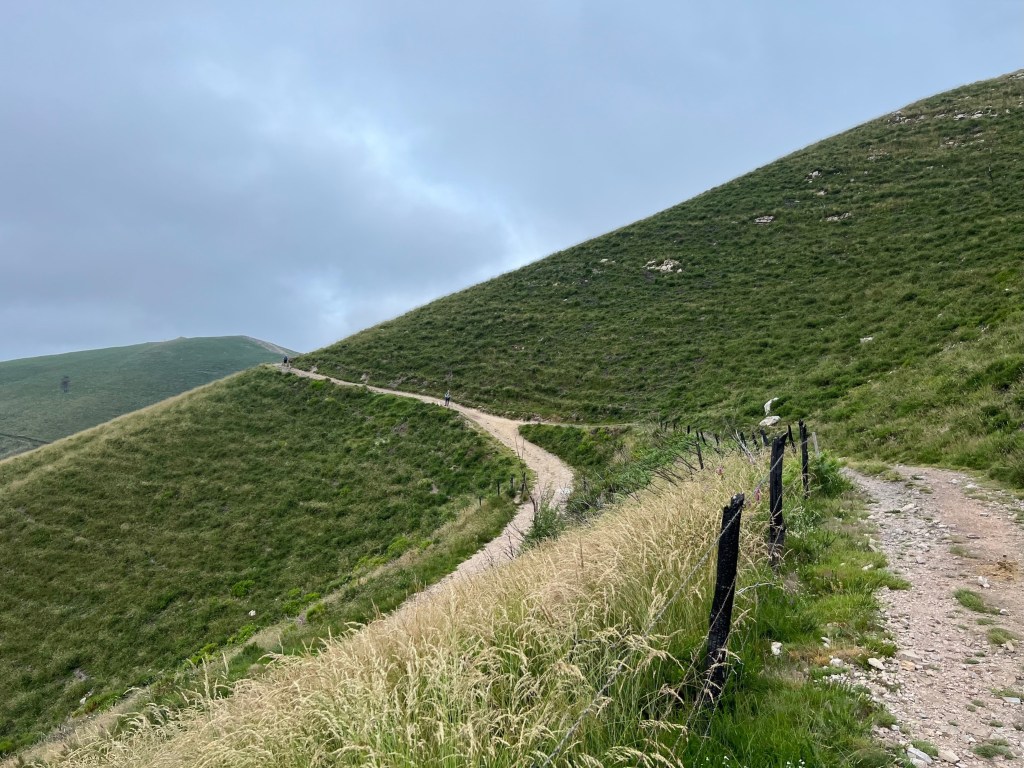
There is a pleasant, flat grassy area with expansive views , to be found about midway .
Hospital de Montouto
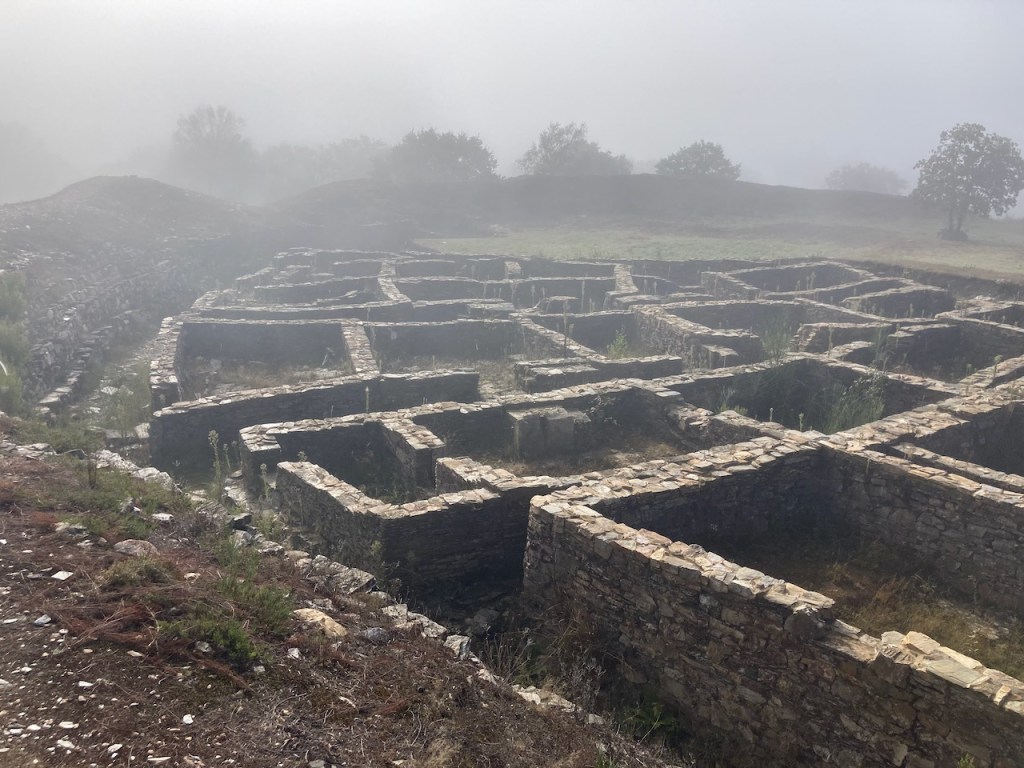
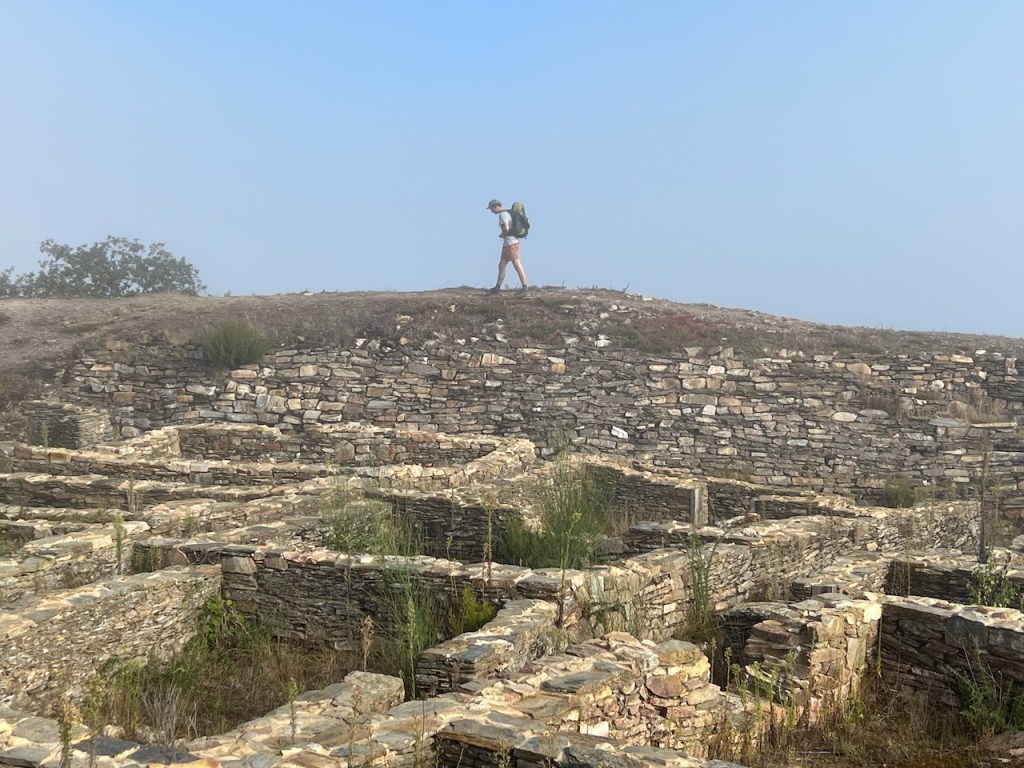
After the town of Fonsagrada there is a hill, upon which are stone walls which are the remains of a old pilgrim accommodation called the Hospital de Montouto. This was founded in 1357 and was still in use as late as the mid-20th century. There is also a megalithic monument nearby, and an hermitage which is the destination of an annual procession from a nearby town.
We did not end up seeing any of that however. Just as we approached the top of the hill, a driving rain started coming down. As it happened, the path continued up to a particularly exposed area, as the rain turned into hail. Looking around for any kind of shelter, we spotted a small structure to the right. This turned out to be a chapel, which already had several pilgrims standing under the narrow eaves. The chapel was locked, and as the storm intensified, we got colder and colder standing there. As the wind picked up, and more people arrived, it became more difficult for everyone to take shelter. A Spanish pilgrim noticed that the wooden bars of one chapel window had been broken into some time ago. She clambered through the window, and we all eventually followed, taking care not to impale ourselves on the jagged pieces of the wooden bars. A German pilgrim arrived, took a wry look inside and commented “I have never seen a church so full!” Some pilgrims had no rain gear at all, and were at definite risk of hypothermia, but some spare clothing was lent to them by other pilgrims.
After the storm passed, we continued down the hill and before too long, found a warm and cozy cafe where everyone stopped to warm up and get something to eat.
Lugo
Upon reaching the center of the city of Lugo, what is immediately striking is the immense wall completely encircling it. At 50 ft in height , it looks more impressive than that figure indicates. Built by the Romans in the 3rd Century, and impressively broad, one can easily imagine it accommodating a chariot or two, as one takes a tour around the city atop it.
Having a look at the history of Lugo, one can appreciate that this wall was put there for a reason.
Lugo was founded around 14 A.D. by the Romans ,on the site of former Bronze Age hill fort, as a camp for a half-legion of Roman soldiers. This was part of a plan by Caesar Augustus to exploit this region as a colony for mineral wealth (as was the plan elsewhere in what is now Spain.) The promise of mineral riches did not pan out, but the surrounding Galician countryside provided good farmland.
Over subsequent centuries, the area was fought over and conquered with battles involving the native peoples of area, the Romans, the Suevi (a now-forgotten tribe from central Germany), Visigoths, Berbers, Arabs, and Asturians, with endless turmoil and strife within each ruling group.
There is even a period of a century 400-500 A.D. in which no written record at all exists of what was happening in the city. In terms of the Reconquista, by 740 the kingdom of Galicia was formed , with Lugo as its capital. It was then more or less safe to pass through Lugo on the way to Santiago, when the Camino Primitivo route got started in the early 800s.
Melide
At the town of Melide, the Camino Primitivo joins the Camino Frances route. The Camino Frances route is much more popular and has been ever since the route was no longer under Arab control.
By the year 910, all the Camino Frances route was under the control of Spanish kingdoms (Galicia, Leon, Navarre).
Walking the Camino Primitivo, until we reached Melide we tended to reencounter the same 25 or so people each day. By contrast, on the Camino Frances we became immersed in a larger stream of hundreds of pilgrims.













 Along the Way