• Maps
    • subscribe to the blog

Along the Way

  • April 24-26, 2023 – Riego de Ambros to Herrerias – Time is Life

    December 22nd, 2023

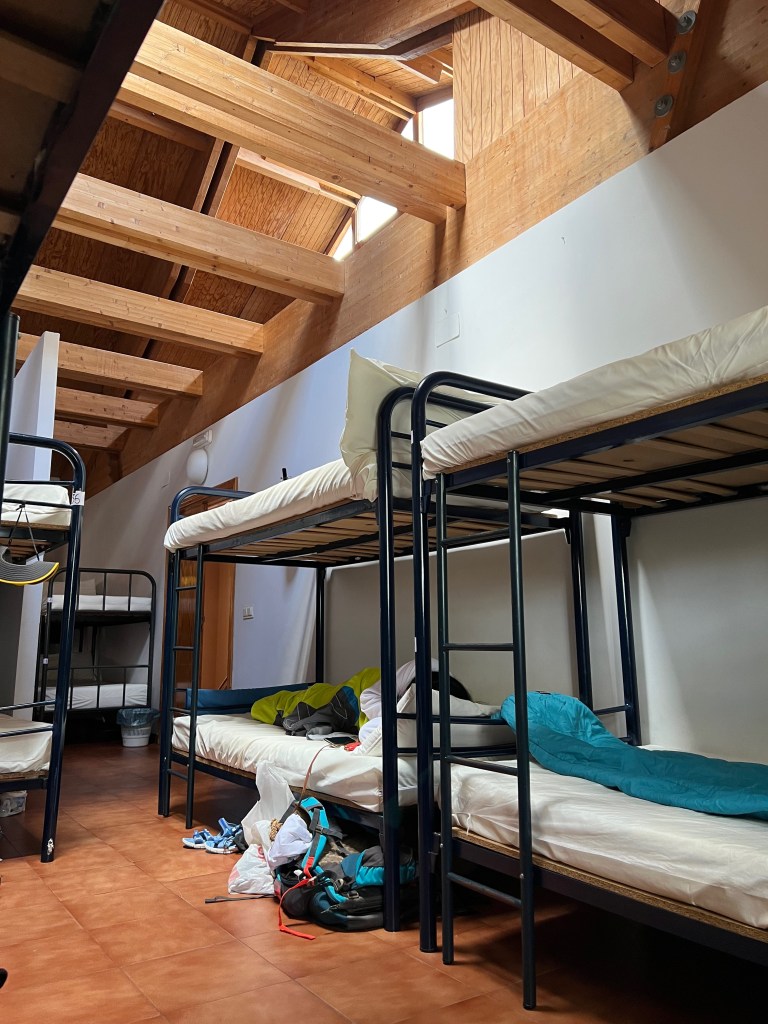
    The place I stayed in Riego de Ambros was a centuries old house
    which had been retrofitted to function as albergue. That meant that the ground floor was subdivided into a warren of cubicles with bunk beds, with meager light coming from the few windows. The floor was of wood and thin, and over a basement, such that even when we pilgrims walked as quietly as possible, we produced magnificently impressive booming sounds.

    Having exhausted the rhythmically expressive possibilities of our albergue floor, it was time to continue in the mountains of Léon.
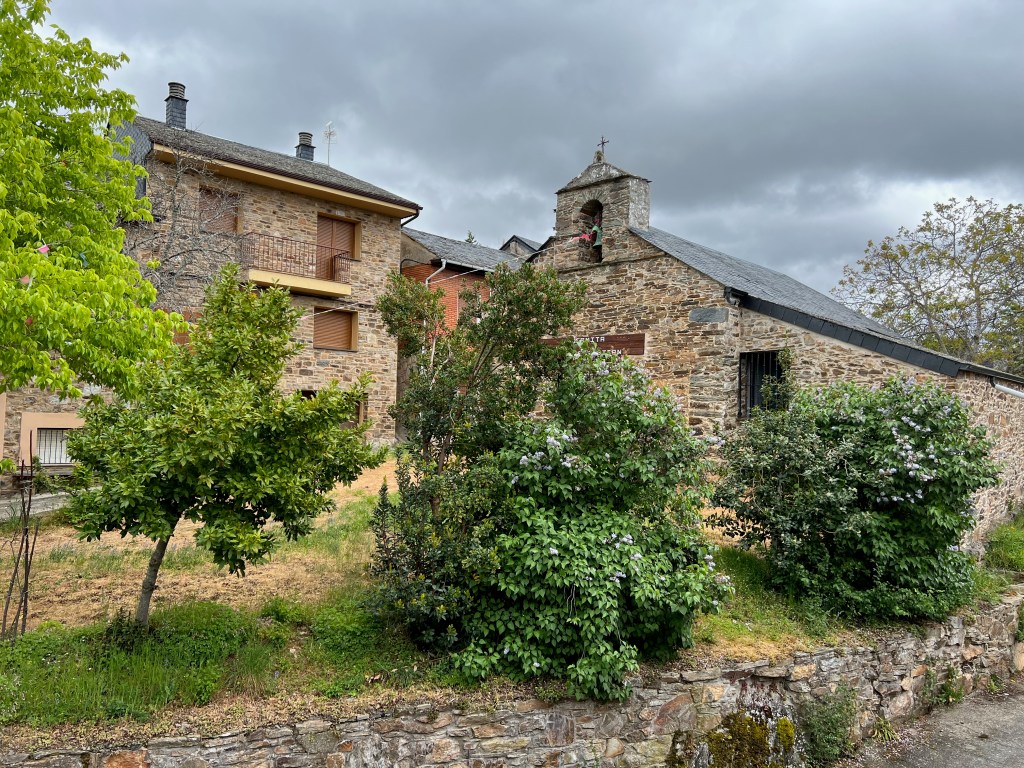
    Leaving Riego de Ambros, the way led steeply downward under an overcast sky, with rocks and wildflowers, downward to the pretty town of Molinaseca.

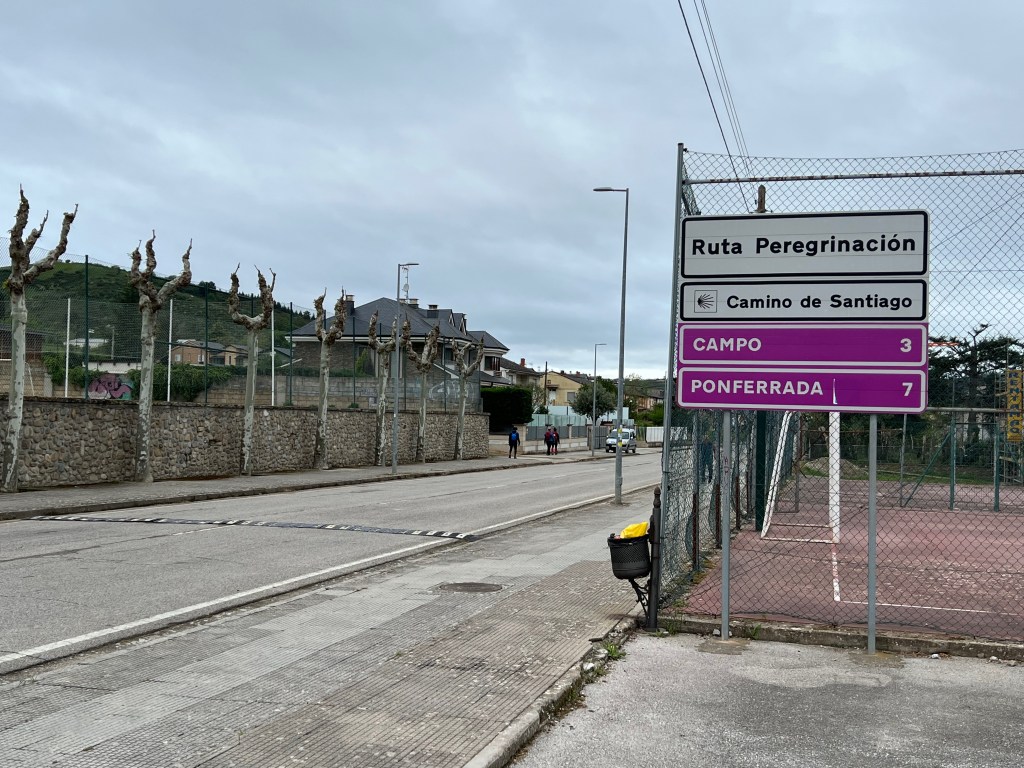
    Leaving Molinaseca was not as picturesque, as you can see. I took this photo because, as always, I was excited to see official-looking Camino signage like this, placed by some level of the Spanish government.
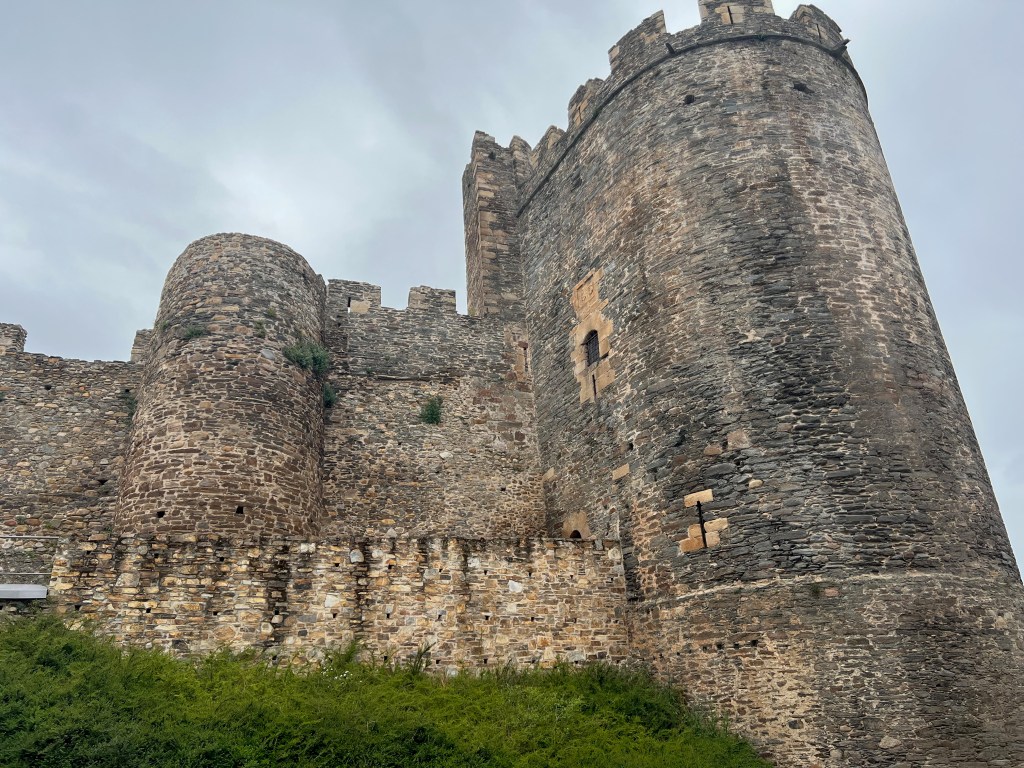
    The landscape leveled out into a valley which contains the town of Ponferrada. I walked on my own because I wanted to be able to stop and have a look at places on the way, such as the massive crusader-style castle in the town center of Ponferrada, built by the Knights Templar. The Knights controlled the town during the twelfth and thirteenth centuries, and from there, provided protection to pilgrims on the Camino. The castle features hidden access to water from the nearby river Sil, clearly useful during potential sieges.
    After passing through Ponferrada, the way opened out into a softly undulating valley of vineyards, under a clearing sky adorned with filigreed cirrus, and drifting cumulus clouds.
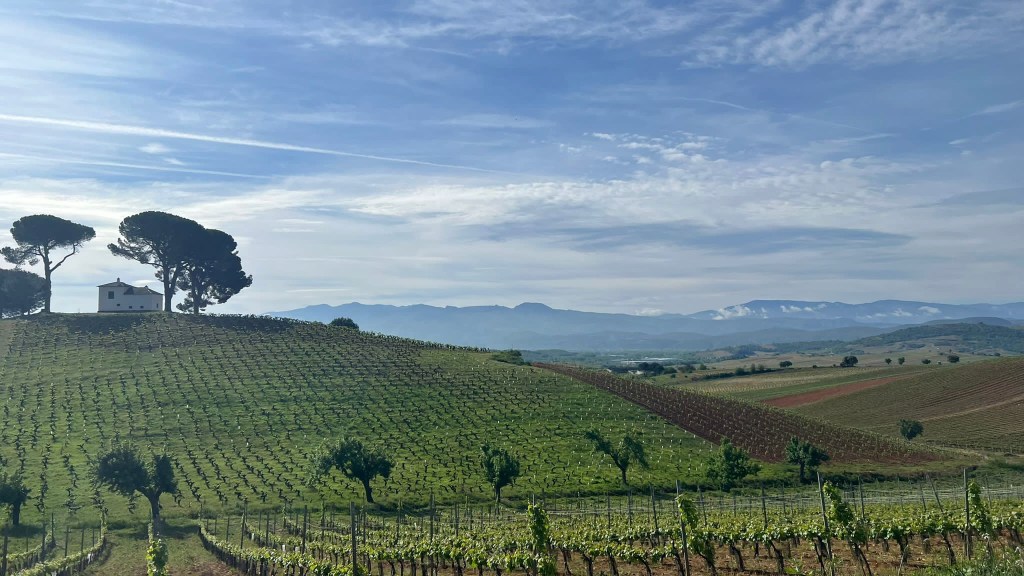
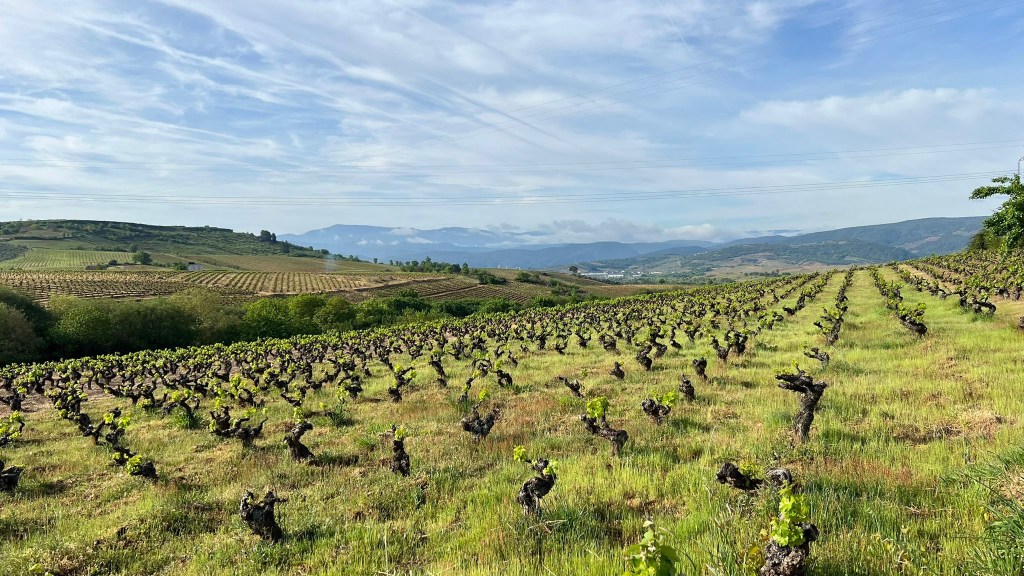
    This part of the province of Léon is known as El Bierzo. It is known for a red wine made from grapes of the varietal called Mencia. Our small pilgrim group sampled some of the Mencia at the town of Camponaraya.

    Link to location: (as well as a general map of the Camino Frances) :

    https://www.google.com/maps/d/edit?hl=en&mid=19tAJGWDD5lRHIHYAgY_MCe65NaN0Q6c&ll=42.57977807412057%2C-6.669100640781793&z=20


    At dinner at the albergue, we met someone from Korea (L.) who is on a long trek, planning also to walk to Fatima and Lourdes. He had more of a story as well which I only found out days later, down the road. He could speak Spanish as well as some English. We invited him to walk with our little group.

    We came to the town of Villafranca del Bierzo and stayed at a former convent, now converted into an albergue, which was very large and somewhat impersonal. We invited pretty much whoever ended up in our dormitory room, down to the town square to have dinner. One pilgrim could speak good Spanish, at least with the waiter, and when asked how, went on and on about how great Duolingo was for learning. It then transpired that his mother was a native speaker of Spanish.
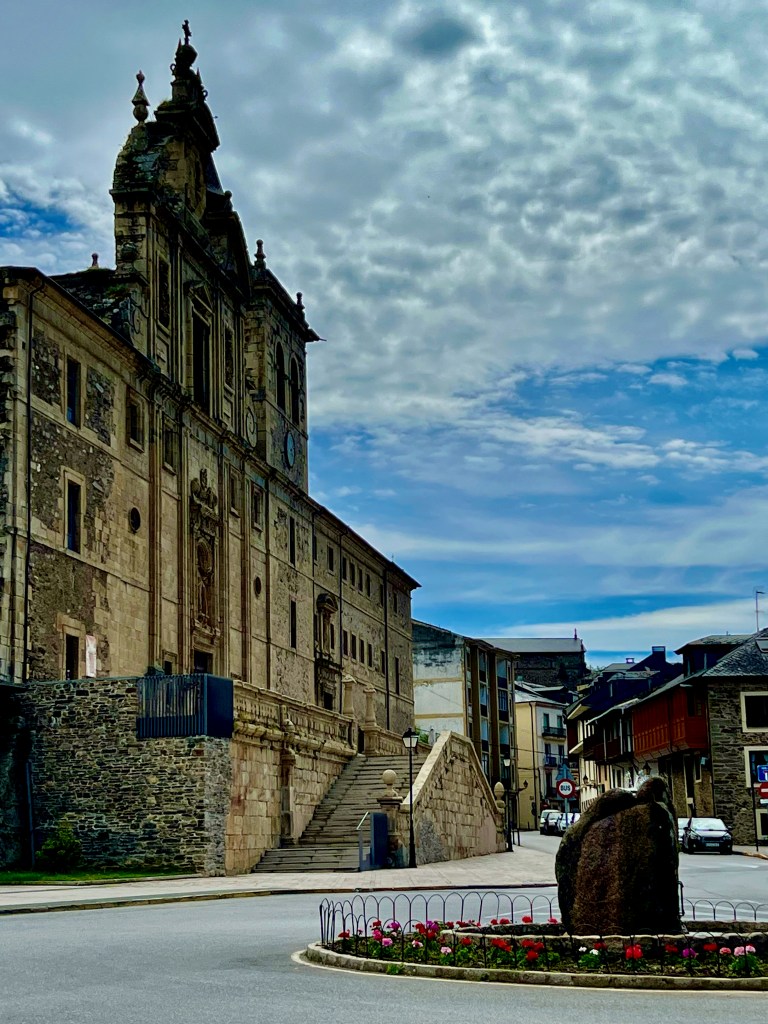
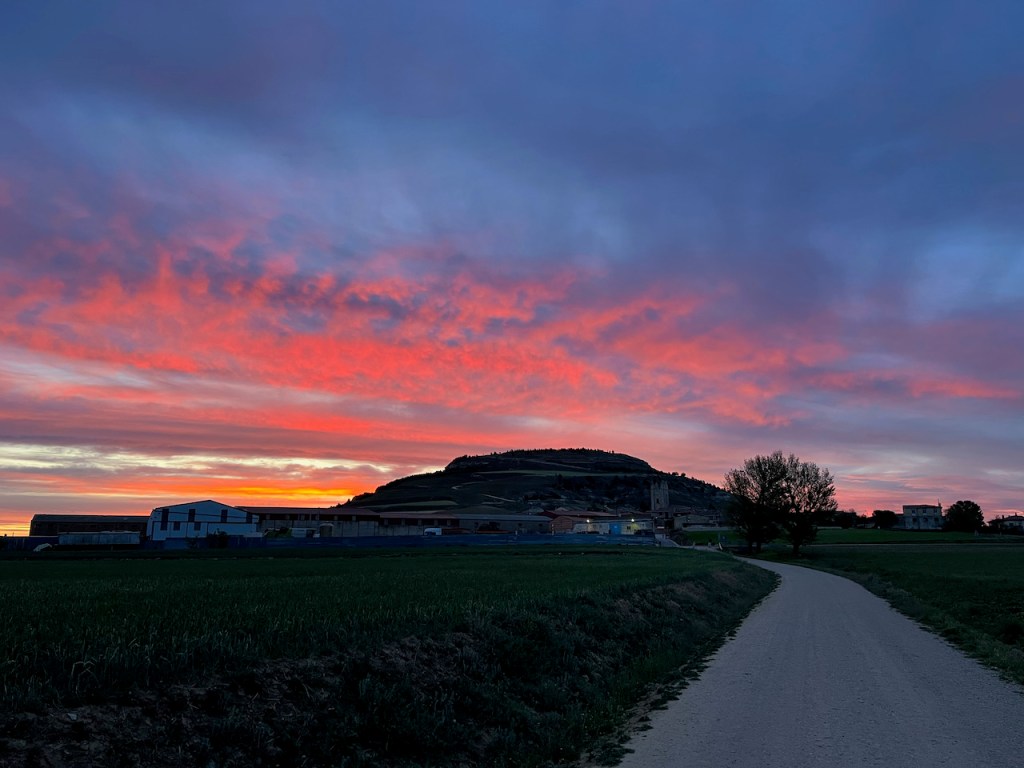
    Leaving VillaFranca before sunrise, we came to a crossroads. Pilgrims have a choice of either 1) a possibly fatally dangerous walk along an autoroute through a narrow valley or 2) a potentially cardiac-arrest-inducing climb up out of the valley. We could only hope to have the wisdom to choose correctly.
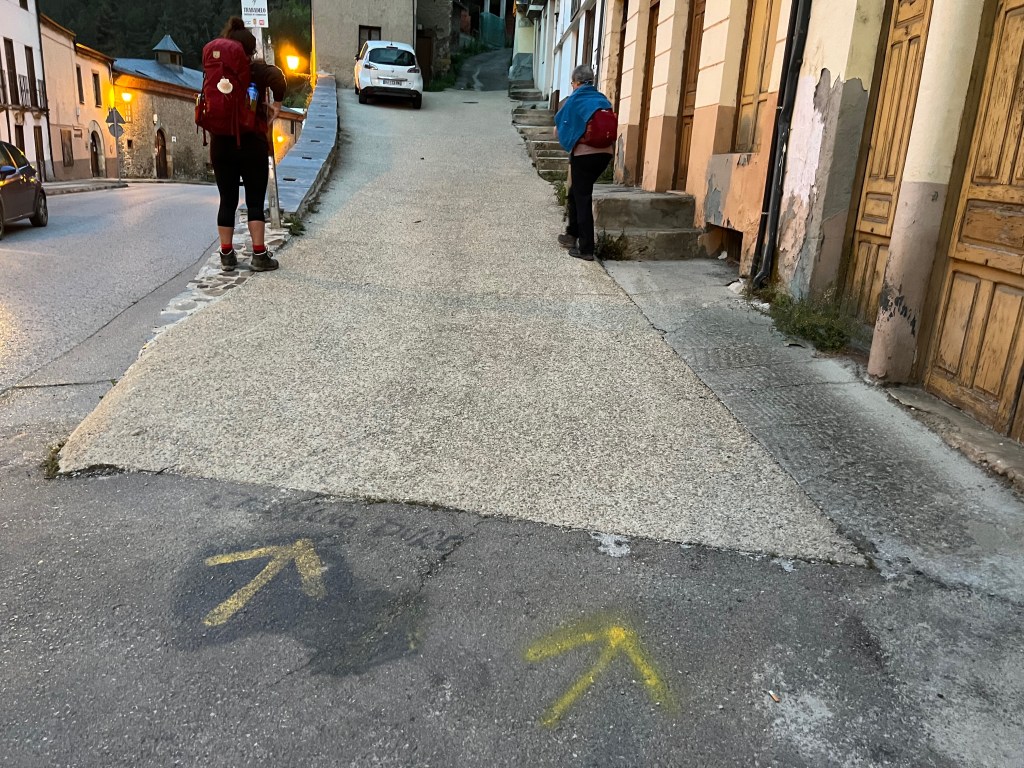
    We took the climbing option, called Camino Duro (Hard Way). The road was initially of concrete, through the outskirts of town. I had never encountered a road that steep, that was not actually stairs. However to someone familiar with the Sierra Nevada or the Alps, it is probably not that shocking. And the insanely steep section was not very long. Before long, one is high enough to see Villafranca in the distance behind, and broader vistas of the mountains of Léon which we had passed through days before.

    (Note by way: The route along the highway through the valley coming out of Villafranca is said to be improved in terms of pilgrim safety, since Hape Kerkeling’s walk and the hair-raising account in his book.)

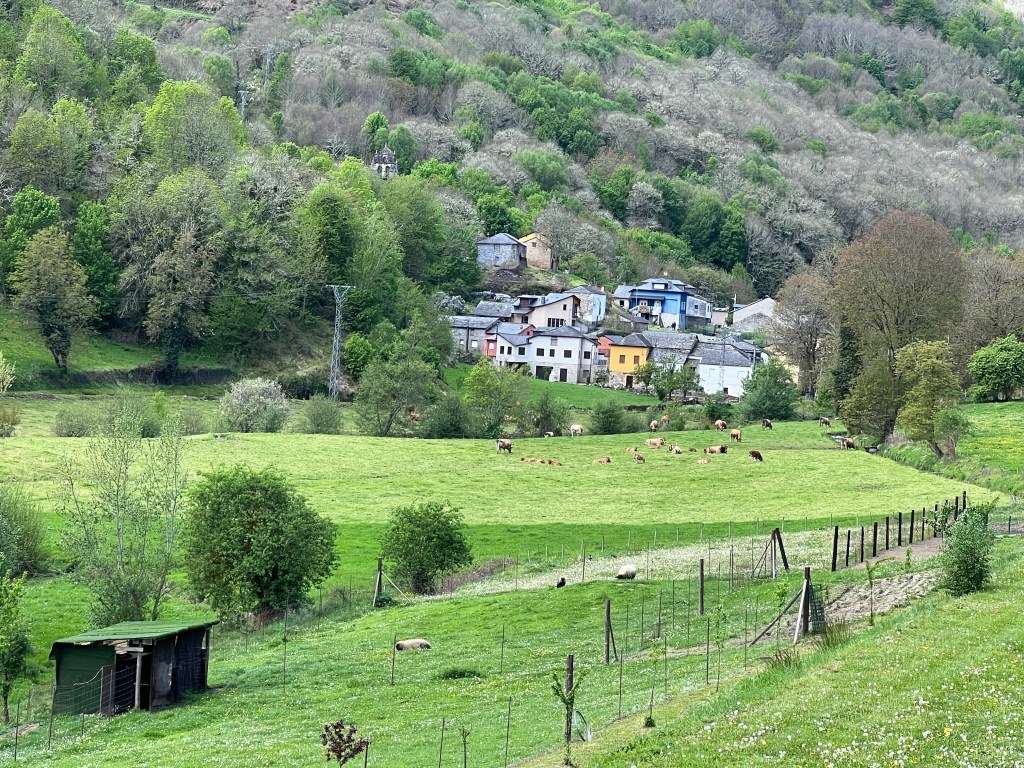
    Taking the Camino Duro did give us the opportunity to get somewhat lost, which we took advantage of right away. In a combination of poor signage, overconfidence that we knew where we were going, and just plain not paying attention, we found ourselves on a path taking us further and further away from the valley which effectively determines the camino route. Our path did have expansive views and fringed with forest, and eventually brought us to the town of Pradela. Being at this town, only just off the track, immediately had a different feel or vibe to me from the other towns that I had been passing through. For one thing, there was no sign of Camino “infrastructure” such as special accomodation or restaurants for pilgrims. For another, I could see a farmer ploughing a field using a donkey, as in previous centuries. A local working in his garden clued us in as to how to get back to the Camino.

    The stopping place for this day is called Herrerias, a small village at a point where the way starts to ascend again toward another high point. In the albergue I met someone from the Netherlands who is volunteering there. This person had walked the Camino and then decided quit their job, to come back and volunteer at various places and essentially stay and work on the Camino full-time. Discussing books by Thích Nhất Hạnh, a quotation in one of the books came up … instead of the phrase “time is money” , Nhất Hạnh has – “time is life” .
  • April 22-23, 2023 – Astorga to Riego de Ambros – Clouds and Stones

    November 23rd, 2023

    We were aware that the way would start increasing in elevation, but were not yet expecting any wind or rain.

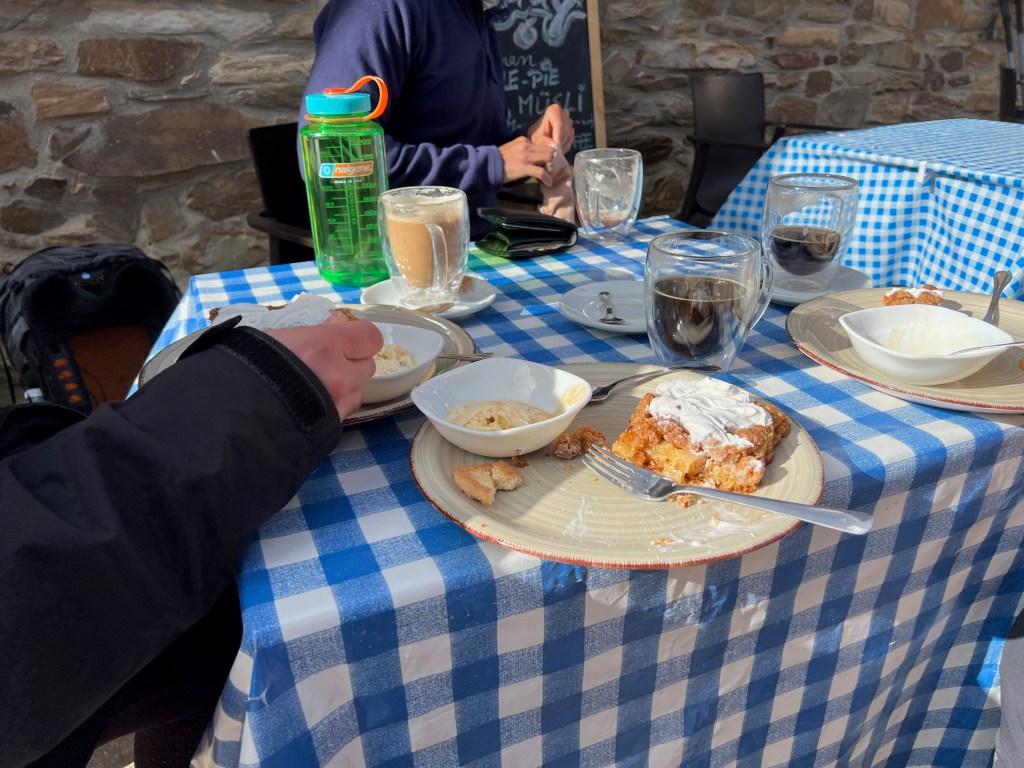
    We stopped in a small town called El Ganzo. There is an expatriate German family living there who are running a cafe that offers German style pie with ice cream. The couple was extremely outgoing, and my fellow peregrinos got into an extensive discussion into what life was like there. It transpires that houses can be purchased here for comparatively little money, probably because the town is so isolated. We also got into a short discussion with their son about bears in Spain (it turns out that bears exist there, but only high up in the Cantabrian mountains, and are extremely rare – numbering perhaps only about 300 in total.)

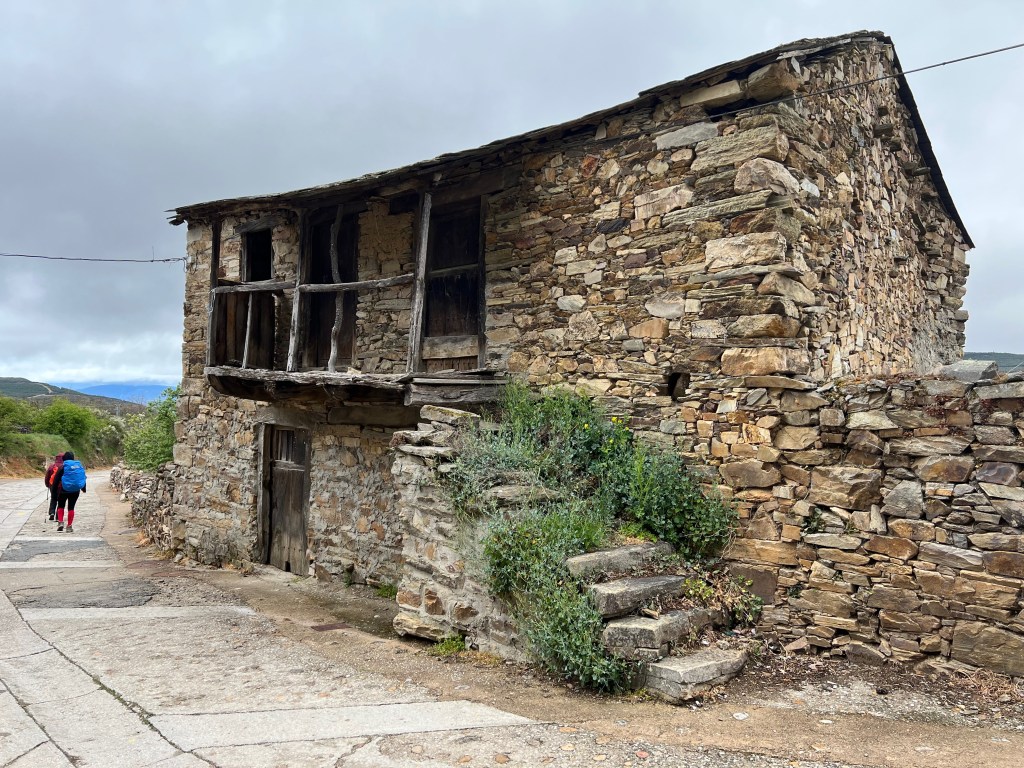
    This is one of the houses on sale there.

    This house was not on sale, would need some work beforehand

    Leaving El Ganso – if you look closely you can see a stork flying towards its nest in the church belfry.

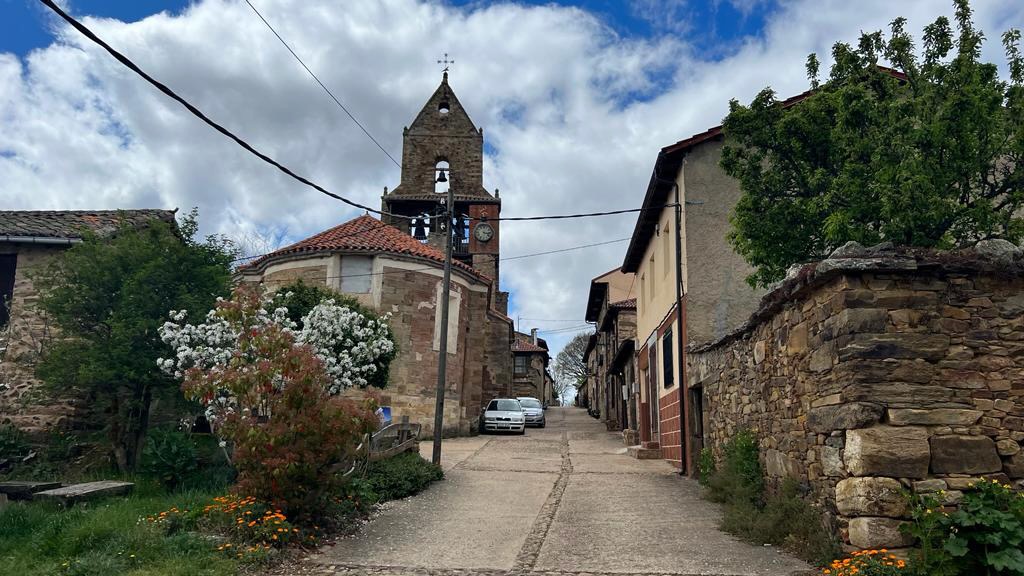
    Continuing on, we made our way up to the village of Rabanal. The buildings are mostly of stone, and the few streets are winding and steep. Our place for the night was a relaxed albergue that featured a bar at the front terrace. We met some new people there. One was R. from Sweden who we met (fatefully, as it turned out) at the bar. A. and C. met a young person right away who immediately shared his life story including a decade of drug addiction and a near-death experience. The Camino is a way for him to get beyond that.

    This is an albergue in Rabanal, run by a group of Camino enthusiasts in England.

    I visited the church in the middle of the village – made of stone, small, simple, ancient, dark, almost cave-like. However is was not unpleasant inside, perhaps because there friendly people around, including a few smiling and chatty monks. I found out that there is Gregorian chant sung there later in the evening, and I made a mental note to return then. I went on a search to replace one of the several Iphone accessories that I lost on the trip, and found one in a tiny shop. The shop was so small that it seemed to contain only a few apples, some shampoo , and thankfully a charger cable.

    There was a communal kitchen in the albergue, and C. made spaghetti with vegetables such as carrots, mixed in. We ate with some of the new people that we met (however R. ate dinner out in the cafe with some bottles of wine.)

    Not much for breakfast the next morning – for us, Just a couple of energy bars while packing , in the pre-dawn. Although for R. , what I later heard from him, is that he partakes of what he proudly calls a “Viking breakfast”, which apparently consists of a copious amount of beer.

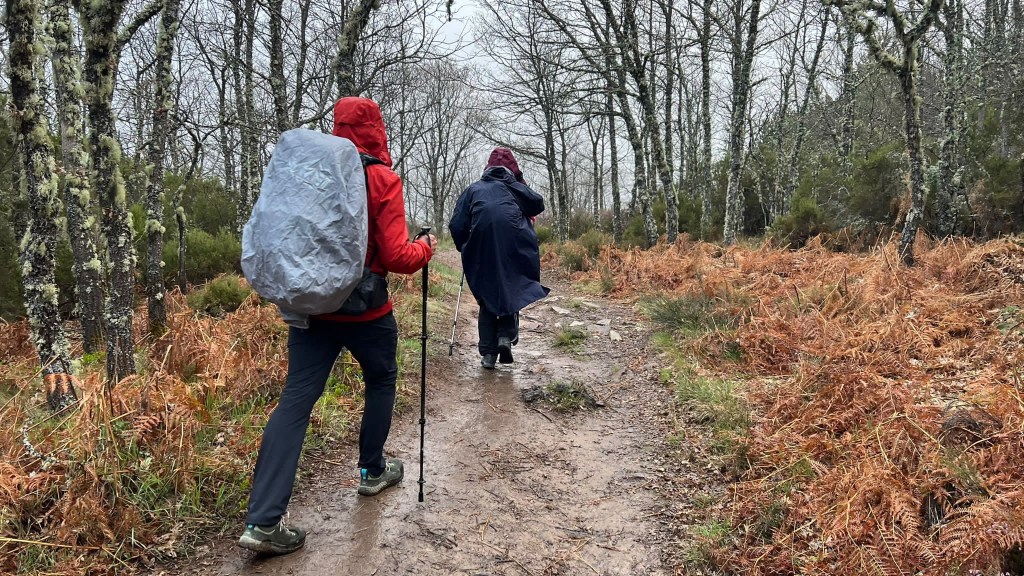
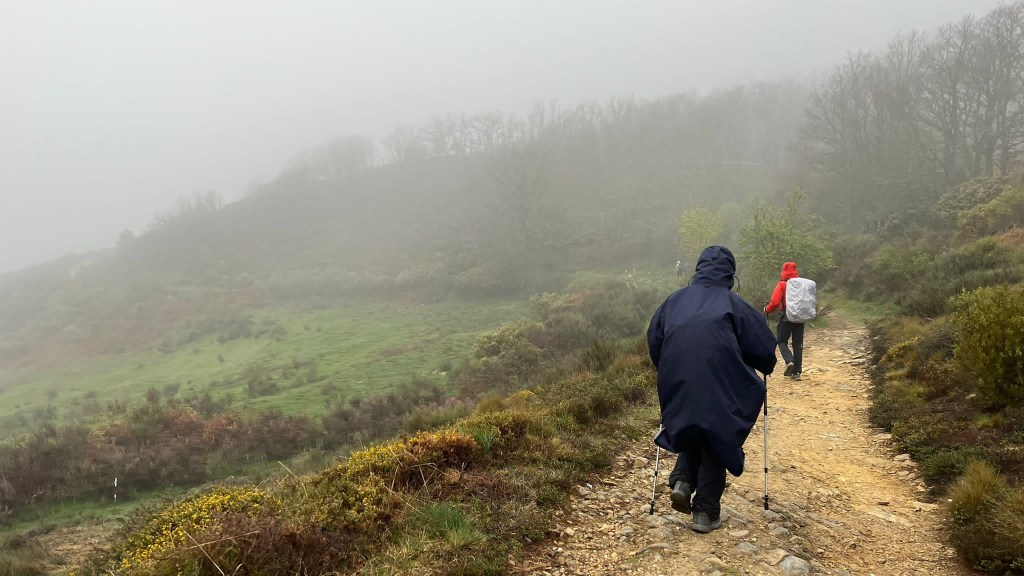
    With impeccable timing, rain started coming down as we left the gates of the albergue. This gave me a chance to break out my rain gear for the first time.

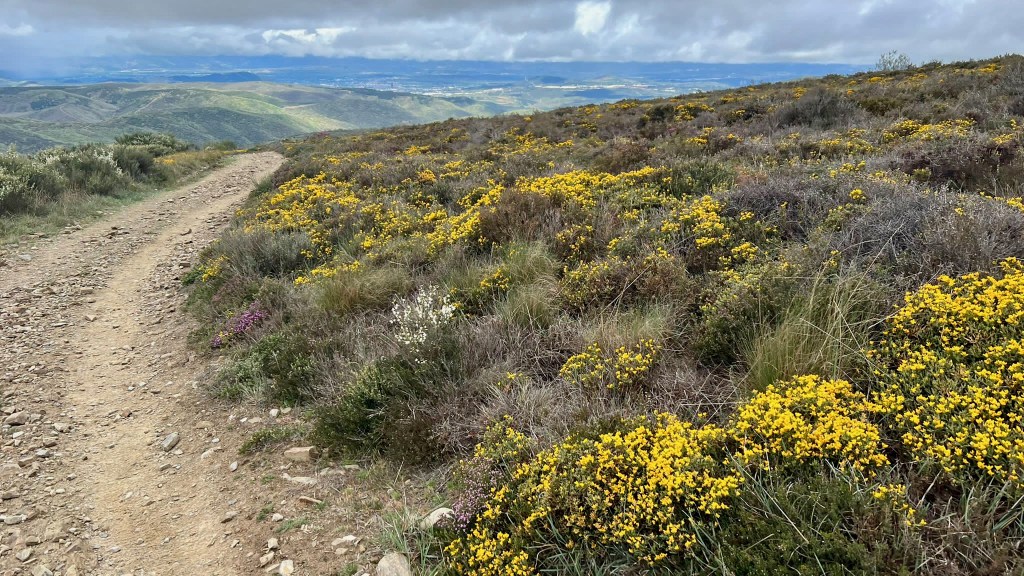
    Starting out up the path, the landscape was relatively is open, and exposed. There were few trees , rather mostly smaller plants which look similar to heather, or bloom, as found in Scotland. They were all blooming now in late spring, with white, yellow, blue, and purple. The uniform white light coming down from the cloudy sky made them seem to glow somehow.

    There were strong gusts of wind and showers of rain. I felt that the walking was OK under these conditions, but what if the wind and rain got stronger?

    We arrived at the hamlet of Foncebadon, which is notable for being highly feared by Hape Kerkeling as described in his book “Ich bin dann mal weg”. The rumor then was that it was uninhabited, except for aggressive, wild dogs. We found no wild dogs, but did find a restaurant open and ducked inside, because we still had not had a proper breakfast that day, and a cold rain was starting to pelt down more strongly. The proprietor did not mind us stumbling in with our dripping clothes and backpacks, and graciously made us coffee and huevos fritos. Did we express our gratitude profusely for that? Not really, but among ourselves we did feel free to criticize the restaurant furniture and wall paintings.

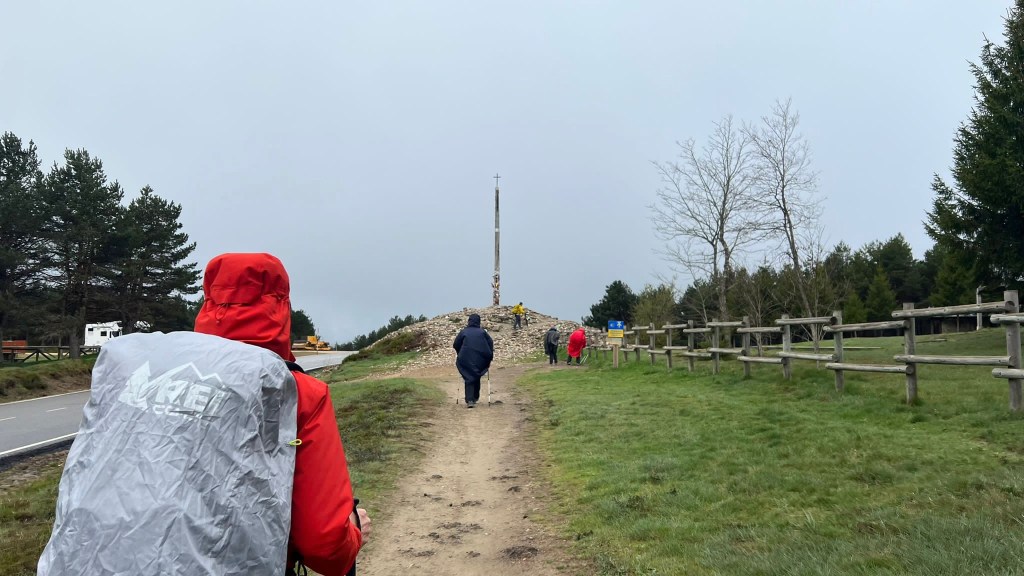
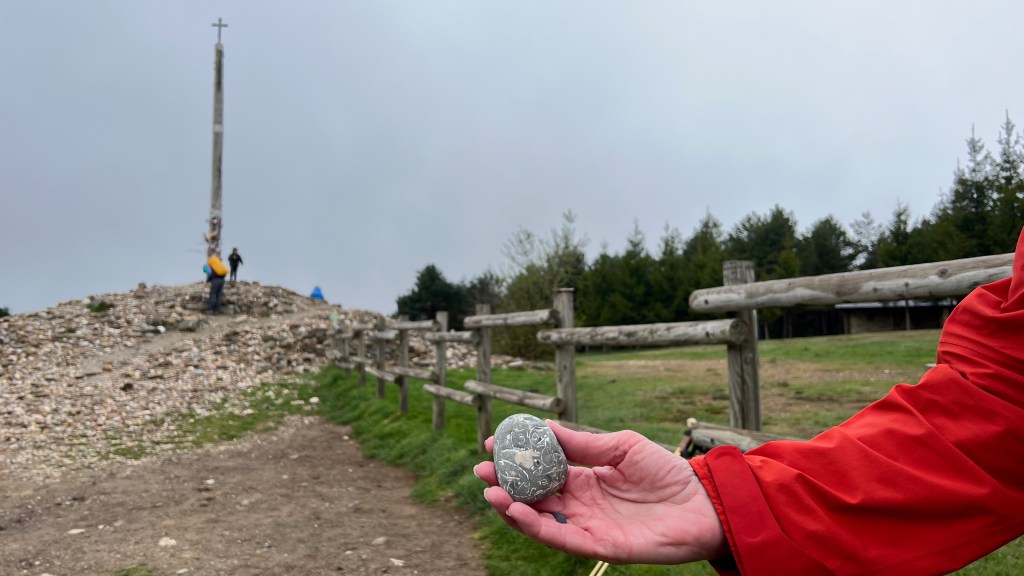
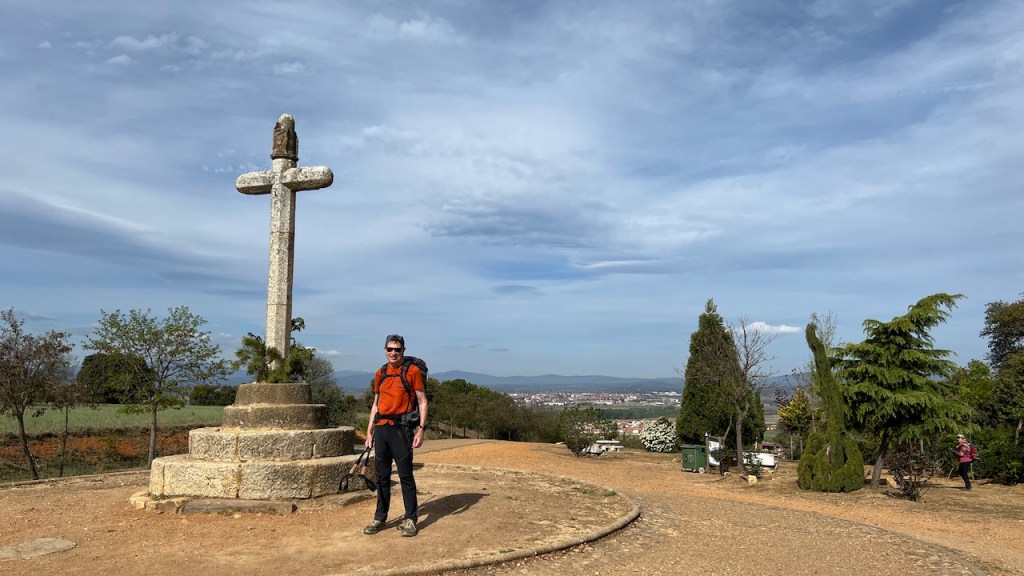
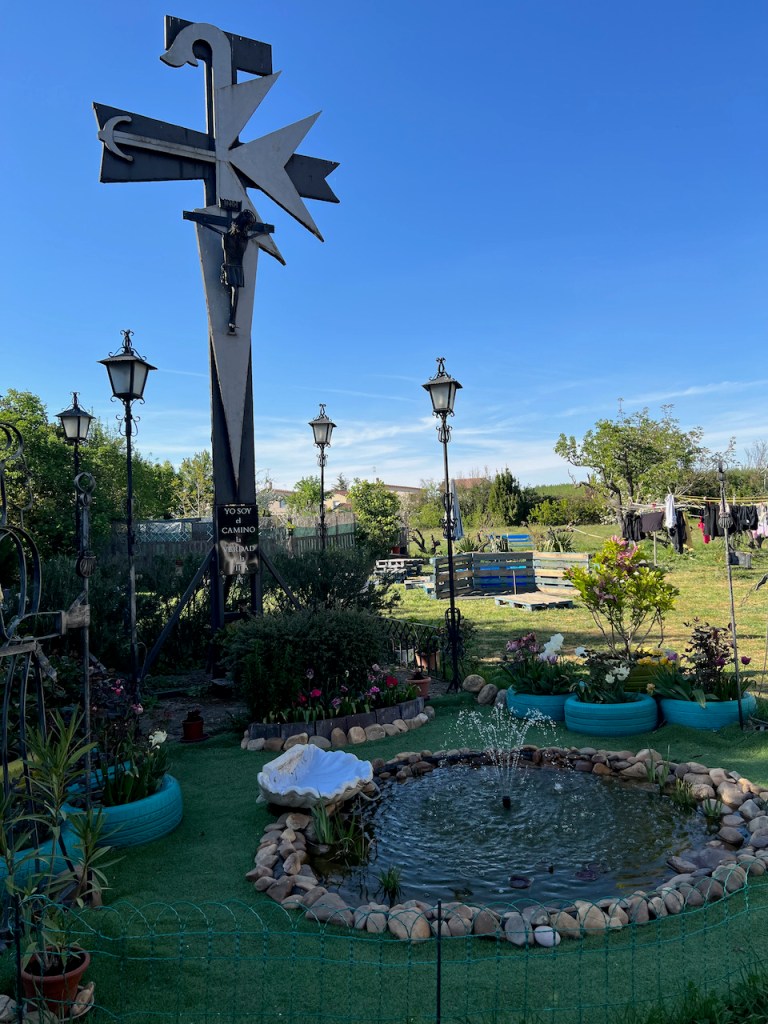
    The appearance of the Cruz de Ferro (Cross of Iron) is unprepossessing. It consists of a wooden pole with a cross on it, upon a mound of stones. The significance of it relates to other factors. It is thought to have originated in Roman (or even pre-Roman, i.e. Celtic) times. Mounds of stones are believed to have marked boundaries between ancient regions of the country. A tradition has developed around this place whereby pilgrims carry a small stone with them in their backpacks until they reach here. Then they deposit the stone on the mound, often writing personal thoughts or remembrances on the stone or paper attached to it. I brought a stone which had been found by my brother B. on a beach in California. It contains fossils from the ocean floor which are estimated to be about six million years old.

    At 1,504 meters, the Cruz de Ferro is a high point in elevation. Now comes the downhill, still beautiful, but long, steep, rocky, and with the rain, slippery. I would think that stretches like this would not be fun without trekking poles. There is a road for cars which more or less parallels the track. I have to admit that we resorted to taking the road sometimes , when the terrain got a bit too crazy for us. Note to self: for traffic visibility, have more colorful rain gear.

    View from a window of the place where I stayed at the end of the day, in a small village called Riego de Ambros.

  • April 21, 2023 – Hospital de Orbigo to Astorga – Who can it be now

    November 5th, 2023

    On the way from Hospital de Orbigo, walking through a farm and meeting a curious calf …

    On a stretch of the way which would otherwise be without facilities , we came to a ‘donativo’ – a rest stop with lots of good food, by donation. The friendly man providing all this, lent the place a relaxed atmosphere.

    Astorga in the distance

    At length, we approached Astorga. For anyone on a long-distance trek coming to the end of a day’s stage, there are some things in common. In this case, we are hot. We are somewhat exhausted from walking so far with the backpack on. We are dehydrated. We are hungry. Therefore we are encouraged to see the city up ahead, on a height. We can even see the albergue where we will be staying, It now appears so close. One can already imagine cooling off in the shower, then getting something nice in a cafe, then resting on the bed.

    But no …

    There is a large , strange green structure on the path between us and our goal . Instead of going forward, we now need to walk to the side for a long way on a shallow ramp, gaining height of about 2 feet, then, turn around the opposite way on a shallow ramp, again and again. Then we must reverse the process, with long ramps back and forth .

    Eventually we emerged on the other side of some train tracks. I found out later that this structure is referred to as the “Pilgrim Torture Tower.”

    Astorga has been a crossroads for millenia, and was an important Roman town. There are interesting Roman buildings in the town to explore.

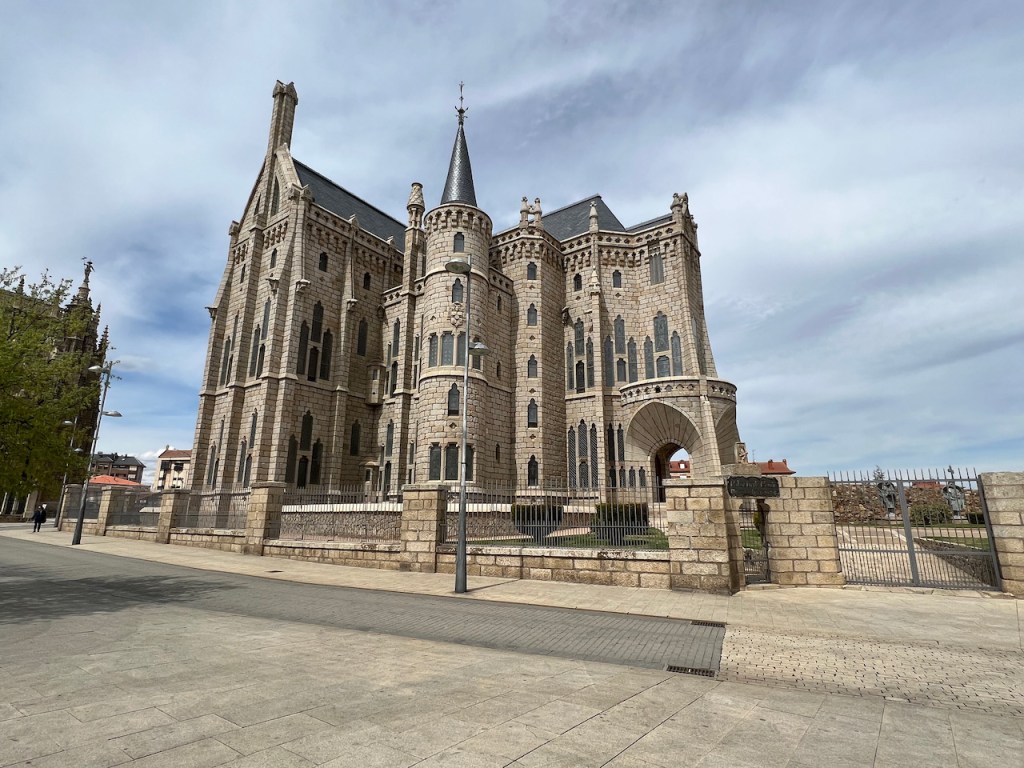
    This building is a work by Gaudi. It was intended as a residence for a bishop. However, the bishop that it was intended for decided that it was too ostentatious, and never lived there. To build something too showy for a bishop is really an achievement, when you recall that bishops regularly wear golden, conical hats.

    Eventually we got to the albergue. Later as I was in the common area, a guy dressed in a robe , with flowers in his hair, wafted in , went out on the terrace, and floated back in and away again. About a week later , someone I met asked me if I had also met this person. He said that he had met him out in field. Without wearing a robe, only with the flowers in the hair.

    The kitchen at the albergue was small. At dinner, it was packed with hungry pilgrims attempting to cook different dishes with high carb content, in clouds of steam. It was a bit too crowded and chaotic for me to deal with , but fortunately A. and C. were able to make spaghetti.

    One of the people in the tumult in the kitchen was a guy with black hair and beard, who seemed vaguely put out and annoyed. We got to chatting with him at dinner. He had been on another Camino way called the Via de la Plata, which starts in Seville and joins the Camino Frances here in Astorga. In his opinion there are far too many people on the Camino Frances, and “the magic is gone”. It seems to be true in any case that the various Camino routes have drastically different numbers of people who walk them. For the lesser known routes, especially in the non-peak times, from what I read, people report meeting only a few, or even no other pilgrims, in a day of walking. Whereas there are something like 50,000 people who start each year from Saint Jean Pied de Port.

    I can somewhat understand what he meant. Later on the Camino in the mountains of León, I was accidently off the main Camino Frances path for a few kilometers. It did have a different feeling. No special signage or infrastructure, just the resident people going about their business in the villages or fields.

  • April 19-20, 2023 – León to Hospital de Orbigo – Yes, this is really happening

    October 17th, 2023

    From San Francisco to Munich, then to Madrid, followed by a train from Madrid, brought me to León. Now to continue on the Camino Frances route, on the sections which I was not able to walk, back in September 2022.

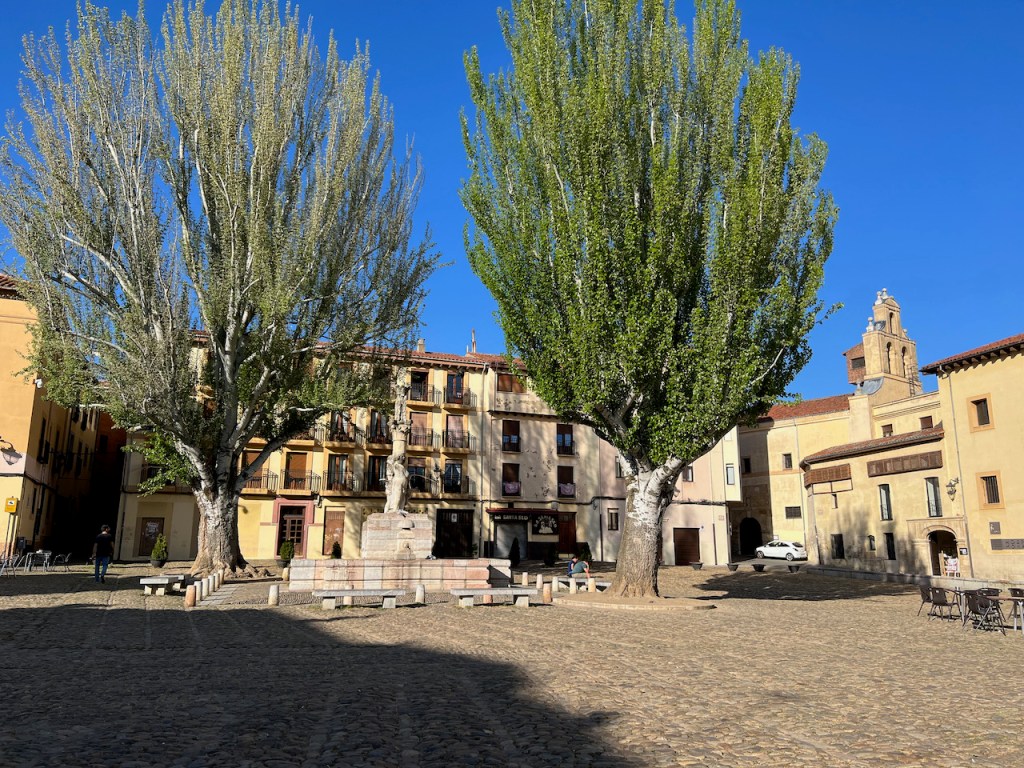
    I decided to stay in a ‘monasteria’ albergue run by nuns. I did not encounter much of a religious atmosphere, probably because I did not attend the pilgrim’s mass or any other such function. I was too busy looking at sights in León. I saw only one of the sisters, at the end of the night when the gates closed at 10:30 PM. However, the hospitelar/os/as were friendly and welcoming. And the location is great, on the quiet, historic square, quite central, in the old section of León, called the Plaza del Grano.

    This albergue was the only one I stayed in that separated male and female. I had started to hope that my room would be relatively empty, but late at night some guys came crashing in and took all remaining beds. Without showering. Extreme, all-male snoring ensued, causing me to deploy all my sound defenses at various times in the night (Mack’s earplugs, AirPods). However with jet lag, that still gave me plenty of time to lie awake in the night and contemplate whether it was a good idea to begin the Camino again, and whether it would not have been a lot easier to just stay home, in my quiet and comfortable house with everything I need…

    A. and C. came into the albergue also last night. Plan is to walk together as far as Sarria. Because of an injury that one person had previously sustained, it was decided to take public transport out through the suburbs of Leon. So we experienced our first Camino sunrise of the trip … from a taxi! passing freeway interchanges, warehouses, and even a Decathlon outlet.

    We emerged at a place called La Virgen del Camino. I had my first of many Camino breakfasts of ‘huevos fritos’ which consists simply of two fried eggs and a slice of bread. This was a good option as it is vegetarian, with some protein.

    I felt excited as we then started on the way. It began while still along the national highway, and slowly evolved from asphalt, into the commonly-encountered, broad, smooth, dirt path of the Camino in Spain.

    Further on , still paralleling the highway, we came to a small store which had very a good example of the traditional Santiago cake. We met a pilgrim there, from Alabama.

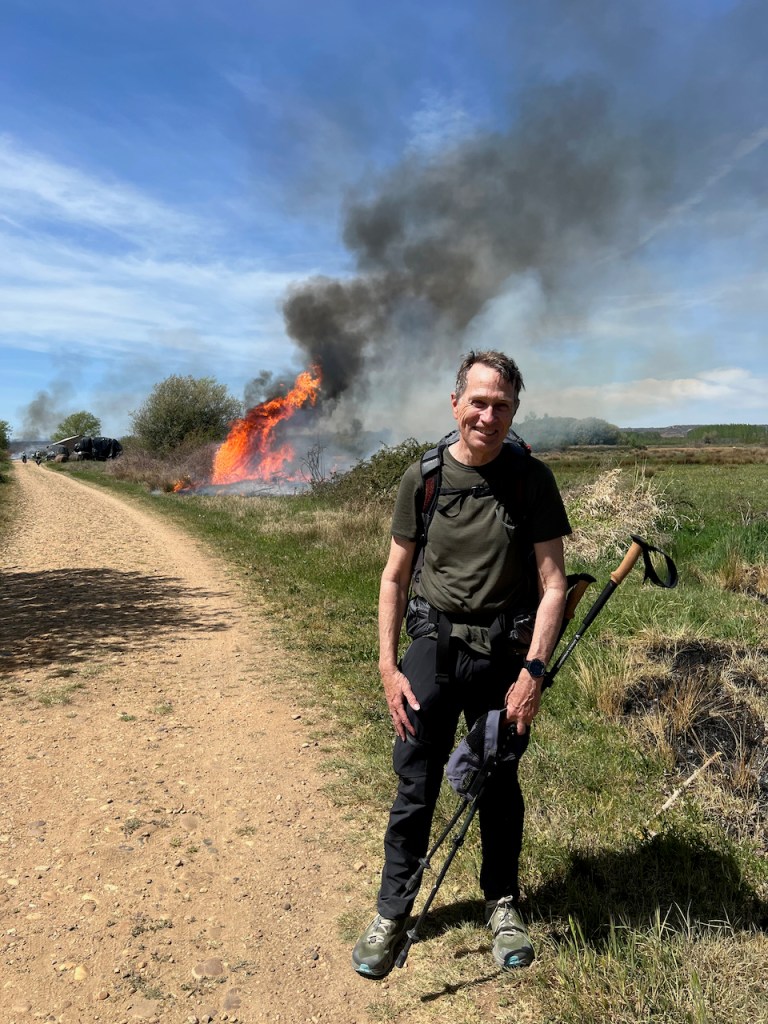
    The way continued, closely following a national highway. Straight and flat as the day warmed. The track finally turned away from the highway, as we neared our destination for the day in the town of Hospital de Orbigo. The scene was enlived by this section of the Camino being, and there is no other way to put it, on fire. In several patches of ground next to the path, there were fires of grass and bushes , burning vigorously.

    My immediate reaction was, why is there no one around trying to put the fires out? Made note to self: what is equivalent of the 911 number to call in Spain? (I looked this up later and found that it is 112.)

    The pilgrim from Alabama was there and was noticably annoyed. I could understand why when I walked through and felt the extreme heat and sparks burning me, and was choked by wafting clouds of smoke. I confess though that rather than being concerned about the camino path being put out of commission, my main worry was that I did not want my specially-selected merino wool clothing or lightweight backpack to be damaged.

    Hospital de Orbigo is at the end of a long 13th century bridge, and is named for a pilgrim hospital that was once there. Now , there are some nice albergues, such as the one we stayed at, which is run by a German Camino confraternity.

    The albergue had a pleasant back garden where people could meet and chat. However, the quiet peace there was occasionally broken by the appearance of a lean, heavily tanned and tatooed man with long hair, and no shirt.
    He would begin furiously smoking and arguing loudly on a cell phone.
    It was so loud that he did not need actually need a phone – whoever he was talking to could probably hear him anyway.

    We had dinner in a restaurant nearby, with the best tinto de verano drink that I had on the journey.

  • May 8, 2023 Reliegos to León

    September 29th, 2023

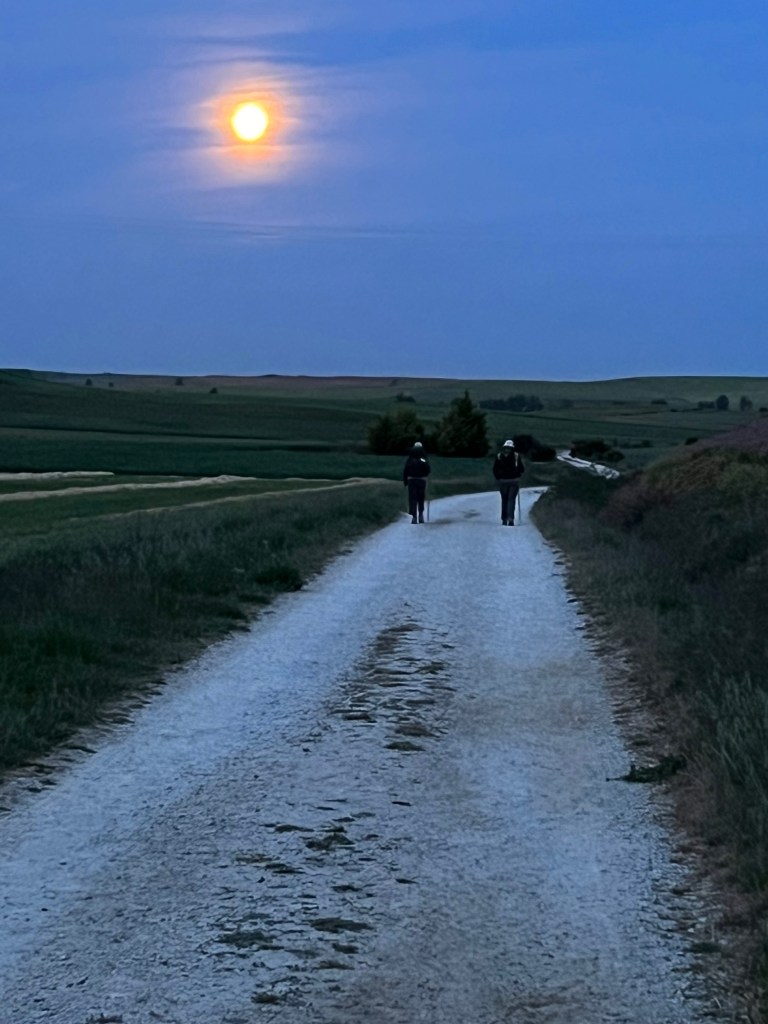
    Started before sunrise – excited for the walk today which finishes the Meseta section of the Camino Frances, and ends at the old town in the center of the city of León. This city has a population of about 124,000 and was founded as the encampment of a Roman legion in 39 BC. Many sections of the original Roman walls are very much in evidence.

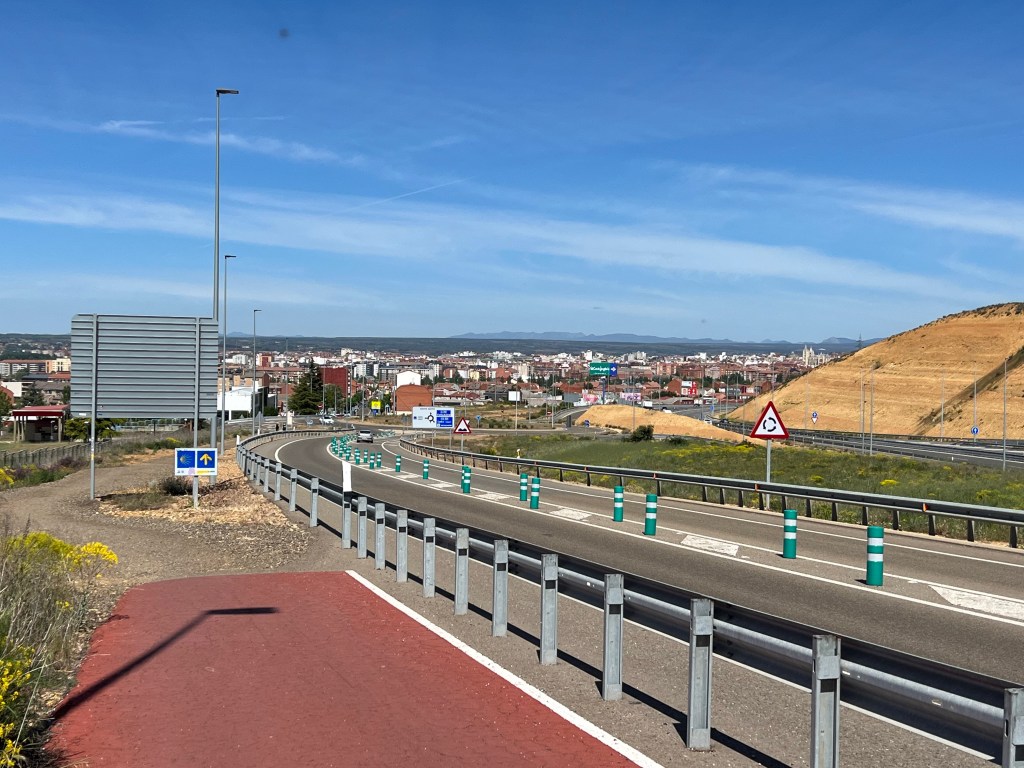
    But before that, there is a long section of walking through the suburbs of León. One must get past a seemingly endless succession of car repair shops, freeway interchanges, outlet stores, roundabouts, auto dealerships, upholstery shops, canine associations, and even taxidermists.

    Once finally past all that, one comes into the beautiful old part of the city. As I arrived, the narrow streets were lively with people. With my backpacking gear and from the direction that I was coming from, it must have been pretty clear to the locals that I had just come from walking across the Meseta. I got some quiet acknowledgement from locals passing by who recognized this, and I felt happy and proud about that.

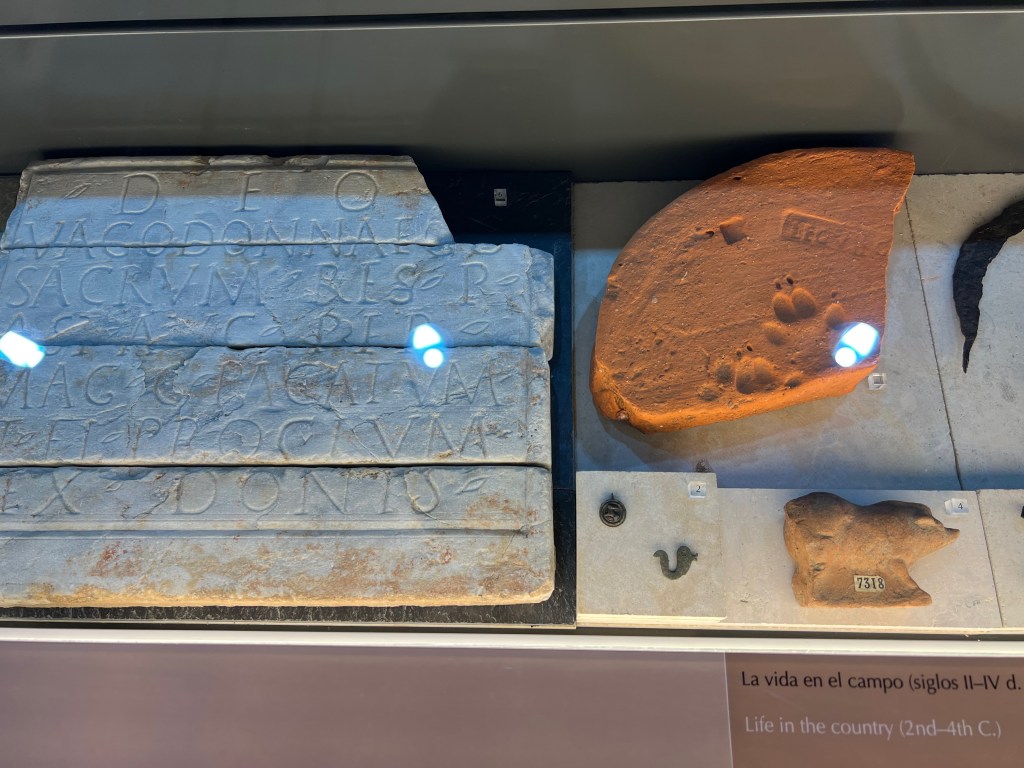
    I visited the modern and well-designed Museo de León, which presents the vastly long history of of the city.

    At dinnertime, caught up with L., E. and T. at the Plaza de San Martín. This is a classic place for far-flung pilgrims to serendipitously run into each other again, as described for example in Hape Kerkeling’s ‘Ich bin dann mal weg’.

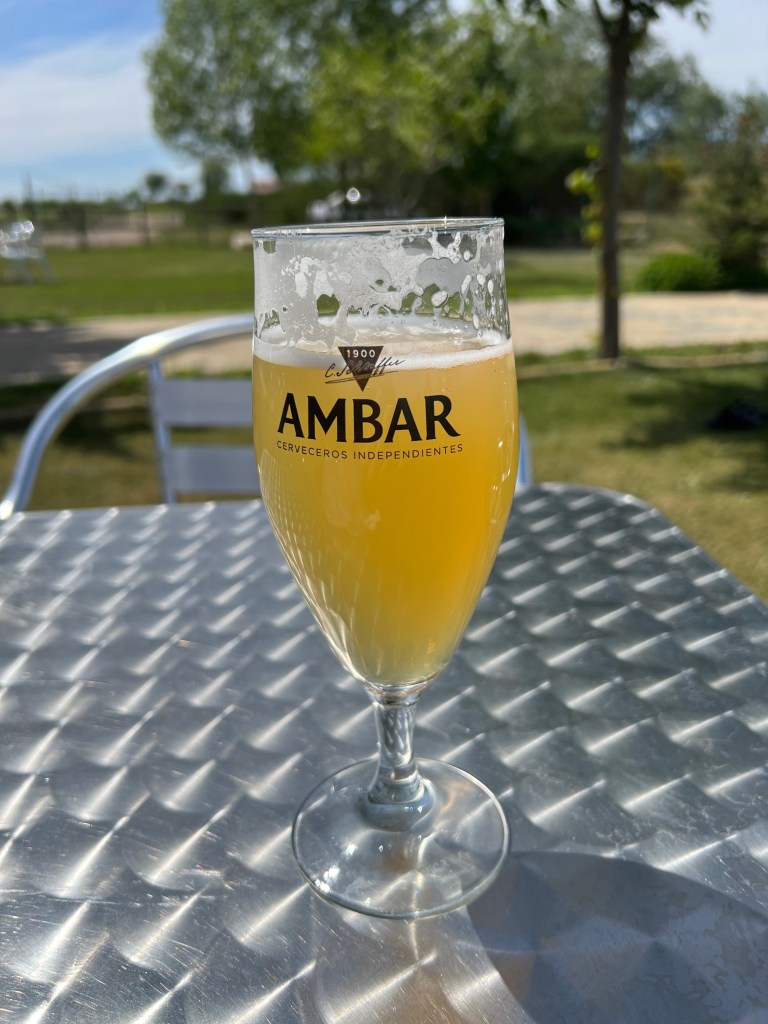
    After dinner we decided to go for drinks at the lovely and quiet Plaza del Grano. The Tinto de verano shown here, is a favorite drink of (at least modern day) pilgrims.

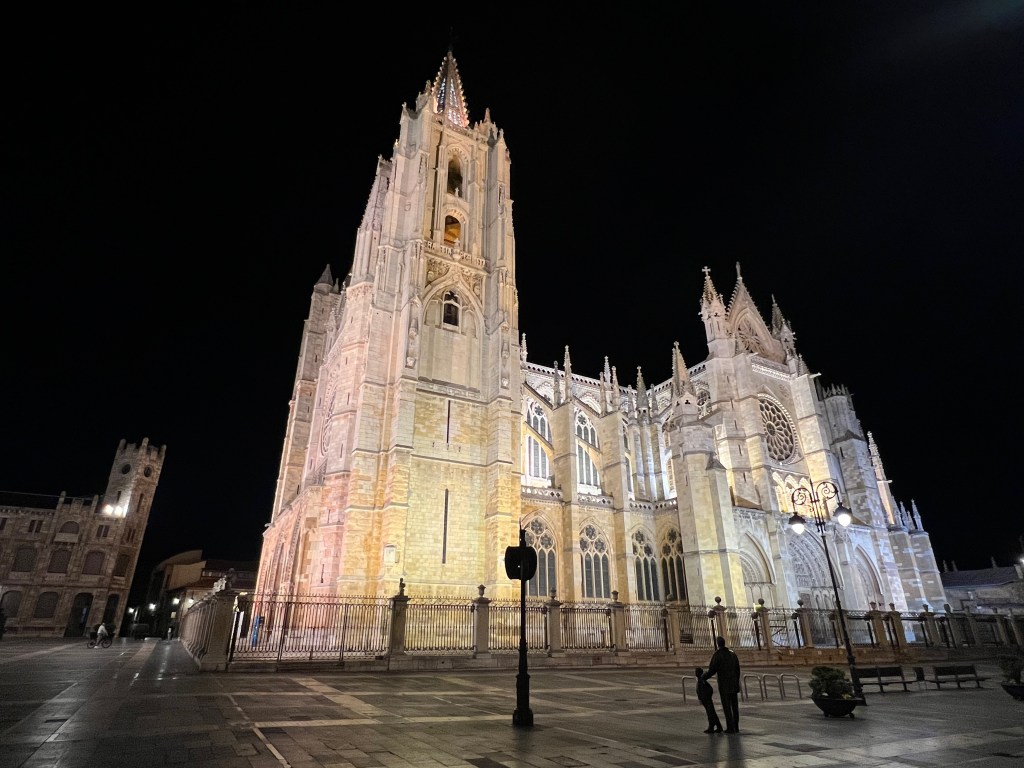
    Later in the night, on the way back to where I was staying, nearby the cathedral, I saw it lit up in spectacular fashion.

  • May 7, 2023 Bercianos del Real Camino to Reliegos

    September 16th, 2023

    The route for this stage is again in a straight line west, paralleling roads.

    I had curated another music playlist some time before coming over to Spain. With different music styles, often referring to the road: https://open.spotify.com/playlist/4ue5PB2N2y3DBGWeeykiaU?si=186a7e3386ae4a89

    Listening to it made me feel more energized and inspired at times.

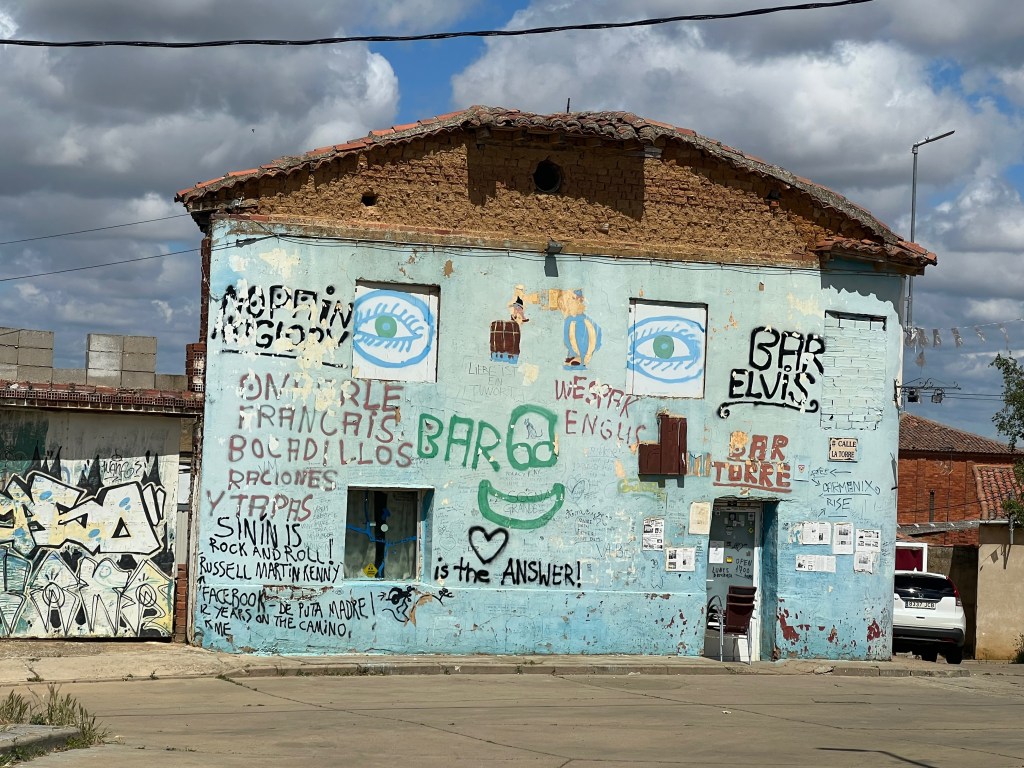
    Reaching the town of Reliegos, I encountered the locally-well-known “Bar Elvis”.

    It appears to me that this building is in need of a design intervention of some sort. I message an architect friend for ideas.

    I meet E. and L. , who as it happens are staying in the same albergue as me.
    I also see F. who I had met in Carrion des los Condes, and T., staying in a place one street over.
    It’s hot in the afternoon, and people congregate at a bar in the village center.
    L. showed me where he had taken a photo of a cat, taken on an earlier trip to this village, which he had sold as part of his free-lance photographer business.

    In the albergue it’s then siesta time. As it happens I have a small laptop with me for this section (Macbook Air). It feels out of place in this context and I don’t take it out much, but it can be useful sometimes. I use it now on my bed in the dorm room, with some music composing software, reshaping some melodic lines.

    I had noticed a microscopic market with a hand-lettered sign saying that it will open at 5 PM for a brief time window and I return at that time.
    I am holding on to eating vegetarian. Yes, it is a challenge in Spain. Since the albergue has a kitchen I decide to make my own dinner. I make a kind of “decarbonized” spaghetti carbonara – spaghetti, with eggs broken into it, and parmesan.

    Visiting the friendly Bar Elvis, I notice the same sort of decor indoors as well as out ….

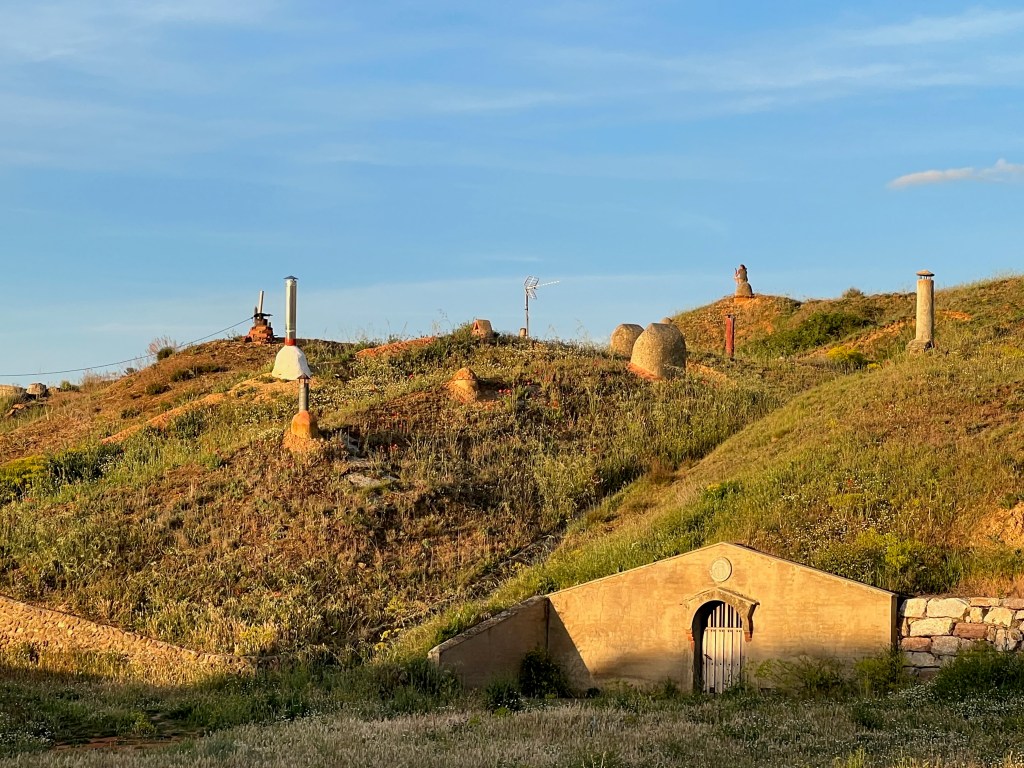
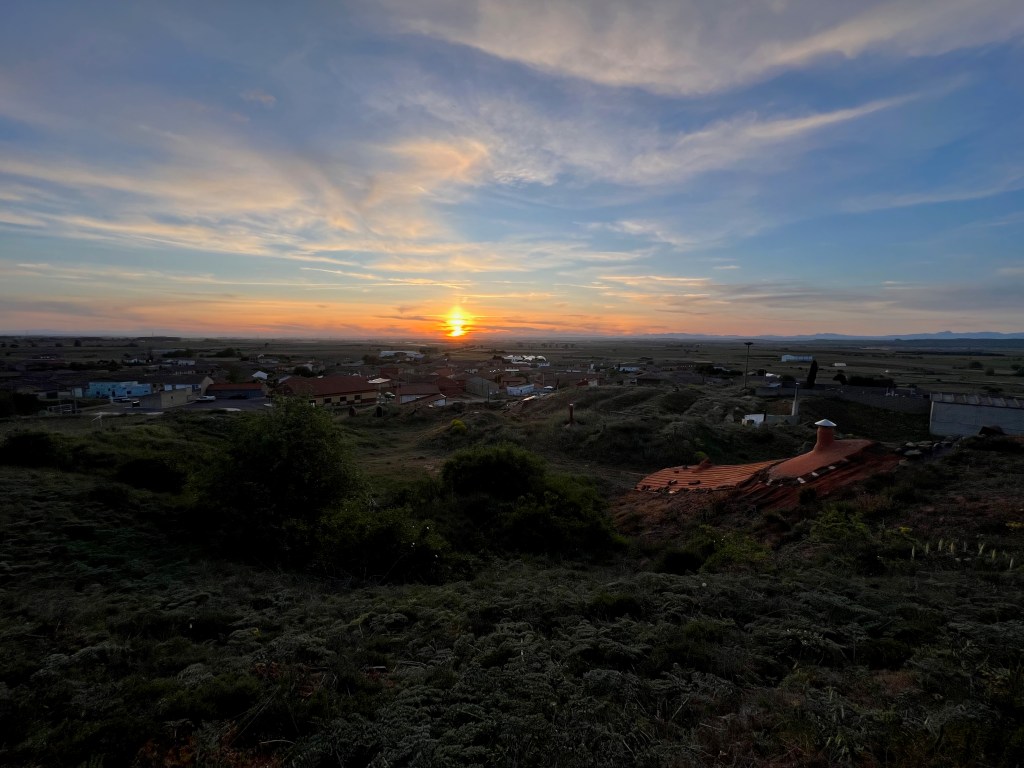
    At sunset I climbed up a small hill which contained bodega structures dug into it. There I could to connect back to California with Facetime.

  • May 6, 2023 – Terradillos de los Templarios to Bercianos del Real Camino

    September 3rd, 2023

    The path today is again straight, flat or gently rolling, though wheat fields and occasional small towns.
    In one such town I run directly into L. and E. – because the camino runs directly past a cafe that they are sitting outside of, having breakfast and cigarettes. I join them but immediately go inside to order something, because this cafe looks like it offers what has become my go-to breakfast here: Huevos fritos, which is literally, just two fried eggs on a piece of bread. As simple as that, but can be made quickly, and has protein.
    After I come back outside L. asks me how I am feeling . I remark that it can be a bit disorienting to continually meet people on the way, have nice conversations with them over a couple of days, and then have them disappear as if the earth had swallowed them. L. thought for a moment and said, “that’s the Camino”.

    I began to see curious caves dug into the sides of hills.

    Passing through Sahagun, and a farmer’s market.

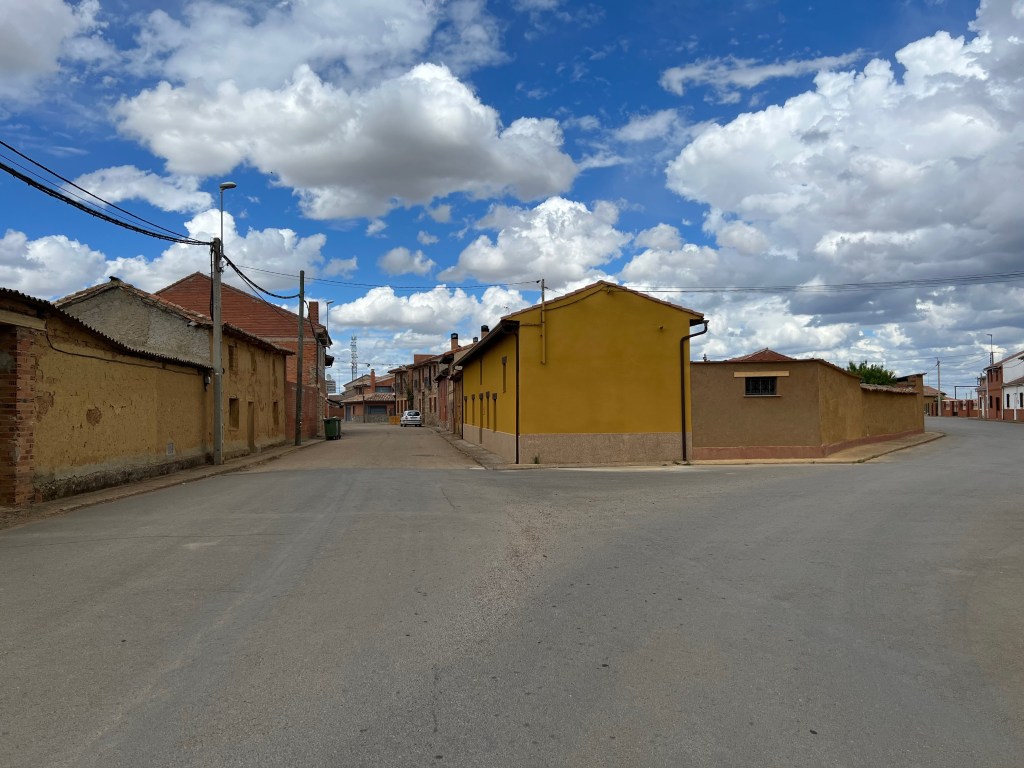
    I arrive at the town with the albergue that I plan to stay at. The town is called Bercianos del Real Camino and looks impressively deserted even by Meseta standards.

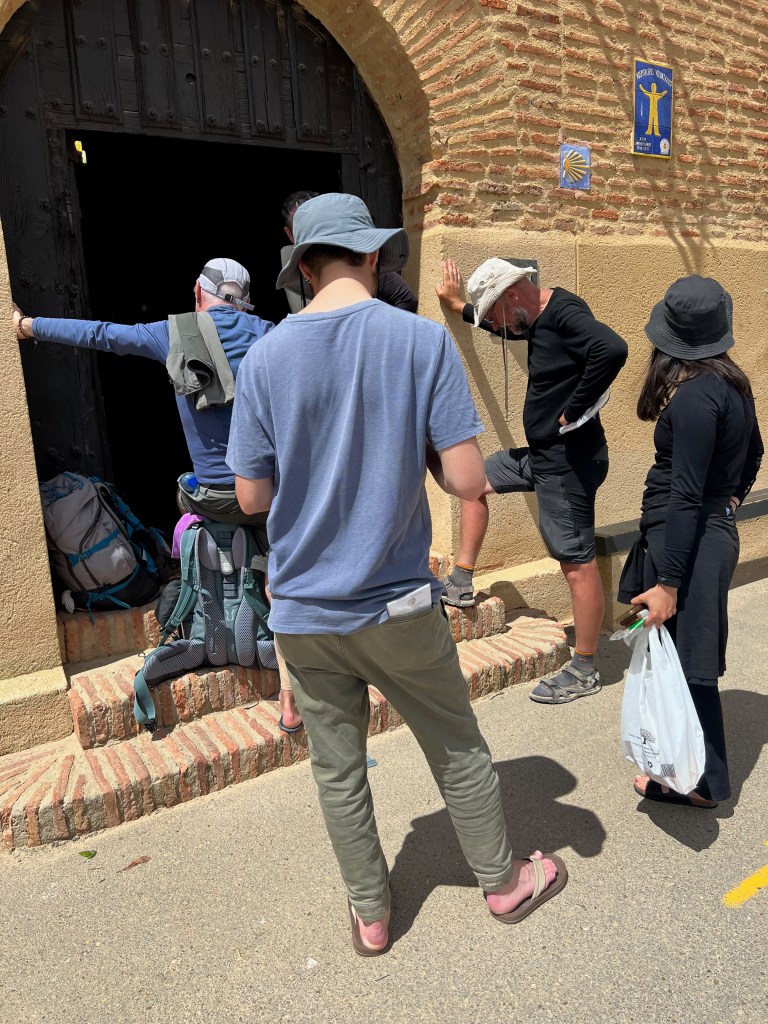
    I have, as usual, no reservation at the albergue. There is a line outside to check in, but with only a few people, speaking French. I see a man walking up to the door with two dogs, and find enough French to express my surprise at this, because dogs are not allowed in albergues. One of the French people in line asks me where I am from and when I reply, he switches to English and asks “do you know the American (K.) ?”
    On the face of it, it seems unlikely that I would have, because pilgrims are stretched out at random places over (at this point) at least 400km of road, without any organisation or common plan, coordination or communication. But this being the Camino, as it happens I actually had met K. (I had walked with her for a few kms while she regaled me with descriptions of her marathons, ultra-runs, and other feats of endurance.) He then remarks “I slept with her last night!” . I was momentarily taken aback by this, until I realized that, English not being his first language, he simply meant that he had stayed in the same albergue.
    Entering the albergue, still in line, I already feel a strong Camino vibe. The place is run by a couple of friendly, older guys who are volunteers. It’s a ‘donativo’ albergue – there is a box on the wall into which we later put whatever cash we feel is appropriate. There is also a photo on the wall indicating that the film crew for the beautiful documentary “Six Ways to Santiago” had stayed there. There is a room in the back with religious statues, for meditation and an optional sharing circle later.

    As each pilgrim registers, they are asked where they started from. Most say something like “St. Jean” or “Pamplona”, but one man says “Geneva”. I find out later that he is doing the trek in (large) sections – Geneva to Le Puy-en-Velay, then to St. Jean, and now the Camino Frances in Spain. He is part of a small group of people from Switzerland and France. One (L.) turns out to speak 5 languages (French, Italian, Spanish, German and English).

    I have learned that it is important to have some food with you in your pack at all times here on the Meseta – a source of calories such as bread or energy bars. Grocery stores and cafes are relatively scarce and are often closed. Hence I am keen to find a shop to buy some food for tomorrow’s walk. One is said to open at 5 PM, so I head to that location through empty streets. The sky has meanwhile turned dark and threatening rain, as I realize that I left behind my rain gear. There are already a few people waiting outside for the shop to open. As it opens, sprinkles of rain come down, and thunder rumbles. The shop is tiny and so narrow that two people can barely squeeze by each other. Most of the food is behind a counter with two ladies in attendance. Each person must therefore communicate what they want to have, the items retrieved and the bill added up with pencil and paper. This feels like a long process, and by the time I get out the door, there is a flash of lightning, a crack of thunder, and rain starts coming down in sheets.

    I had not done any running on the Camino, but now seems like an appropriate time. The town is small, but the streets are random and mazelike, and I am not sure where I am going, as I try to find the albergue. After getting lost a bit, I see the albergue at the end of a street. The rain is still pouring down. I remember that I washed my clothes today, and many items of my clothing are hanging outside to dry. So before going in I retrieve them – how they will get dry now is not clear.

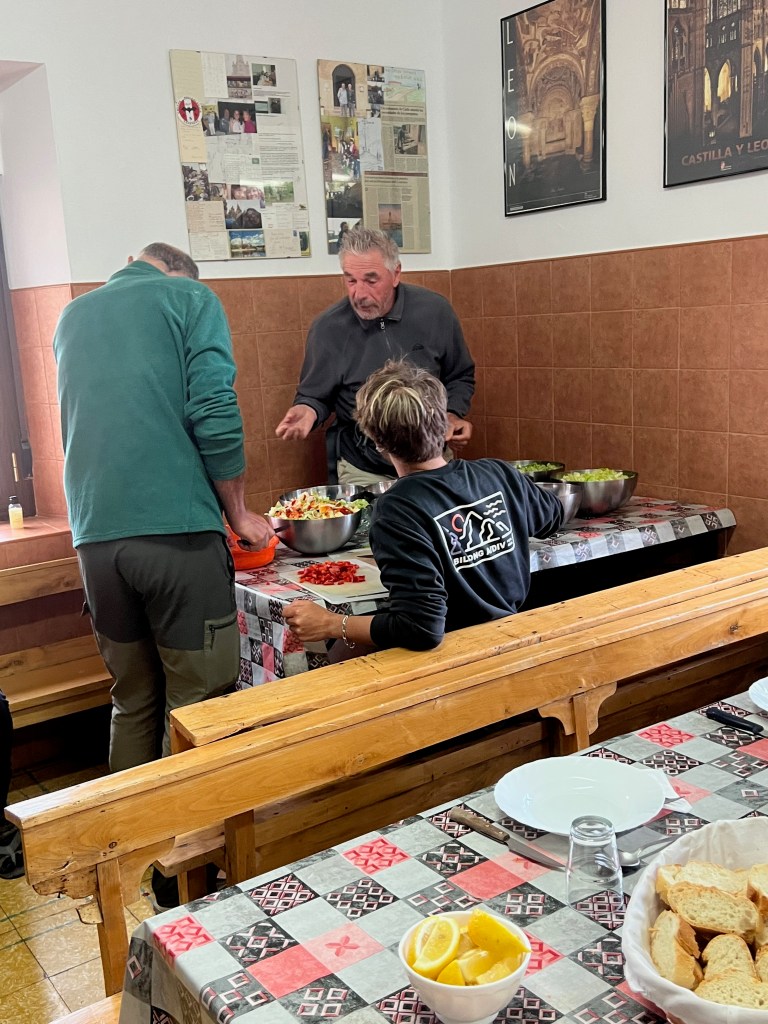
    There is communal meal for dinner – with communal meal preparation also. It turns out that the guy who appeared with a backpack and two dogs, is the chef for the evening. The main course is to be a lentil soup. I volunteer myself and go into the kitchen. There aren’t many words exchanged or understood – it’s a noisy and polyglot atmosphere – but I do manage to cut up a large number of bell peppers for a salad. When there does not appear to be anything more that I can do, I sit down at a long table. The Swiss / French contigent arrives, with all the others. There is some discussion about who should sit where. Perhaps because I had said a few simple sentences in French earlier, everyone is OK with my sitting at a table where they are speaking French.

    There get to be enough people speaking simultaneously in different languages in the same room, that it gets to be almost impossible for me to discern what anyone one at the table is saying. A couple of times the Swiss/French stand up with wine and enthusiastically propose a toast, but what the toast is for and to whom, I could not say. But the people at the table are sympathetic, L. helps with translation, and we can communicate a little in basic French and English. L. says that the Camino in France is different – ther are fewer people on the way, and the accomodations are smaller, less dormitory-like, with more locals.

    After dinner, everyone (including the two dogs) goes outside, up a small hill, to view the sunset. I chat with a New Zealander, who is doing some writing, about his strategies for learning Spanish.

  • May 5, 2023 – Carrión de los Condes to Terradillos de los Templarios

    August 29th, 2023

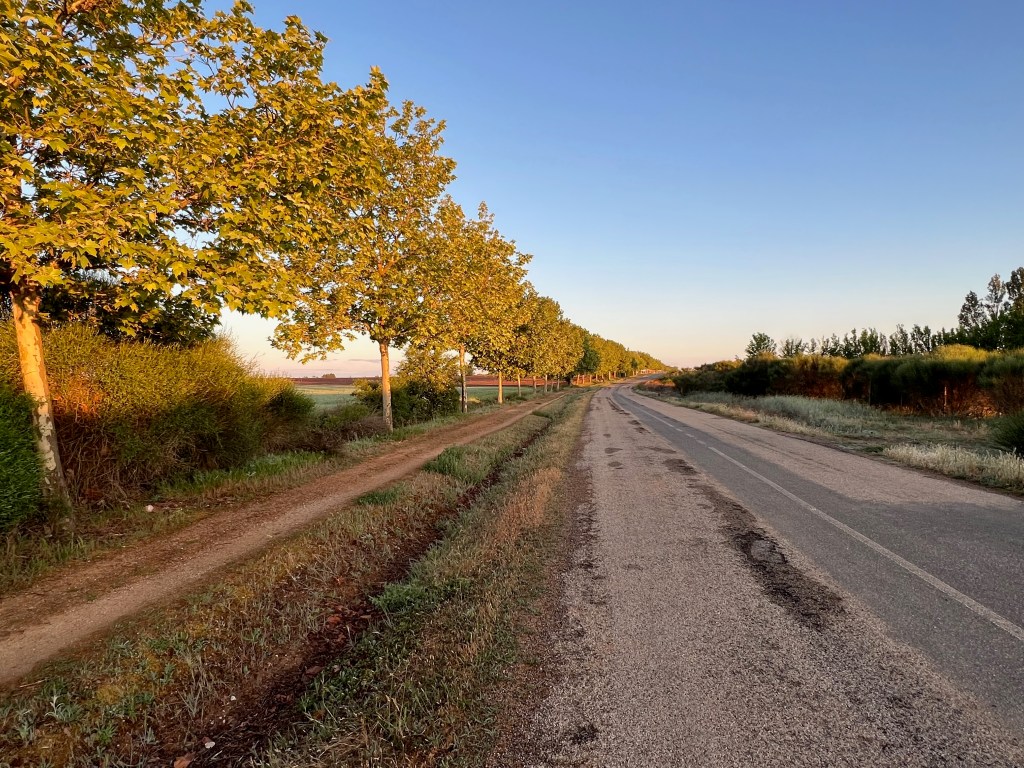
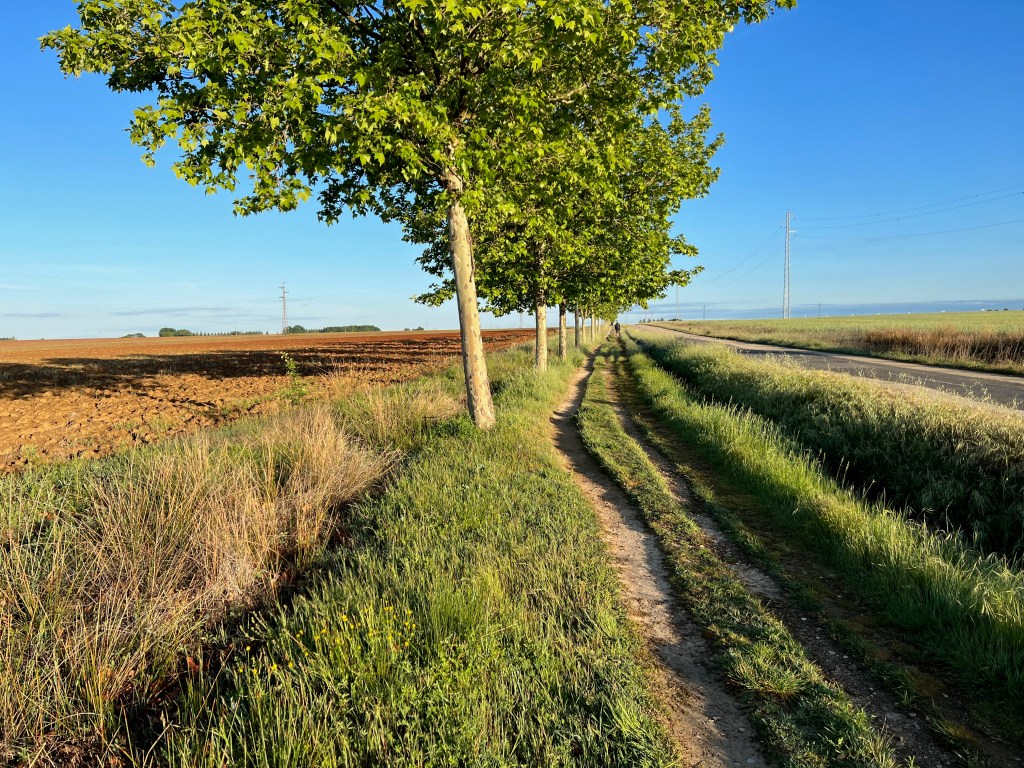
    This stage is moderately notorious among pilgrims for having the longest stretch of road (17km) without any services such as cafes or restaurants.

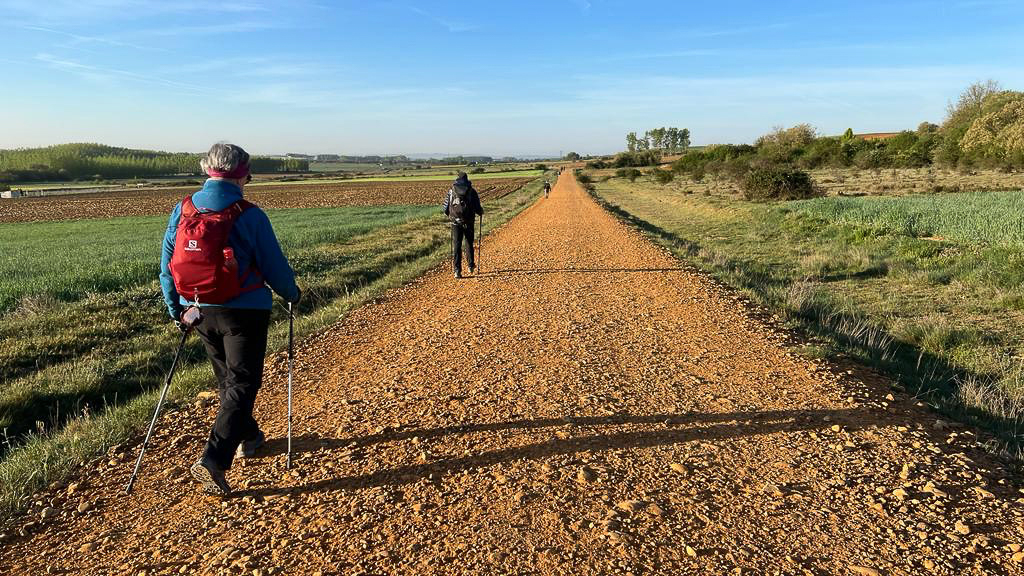
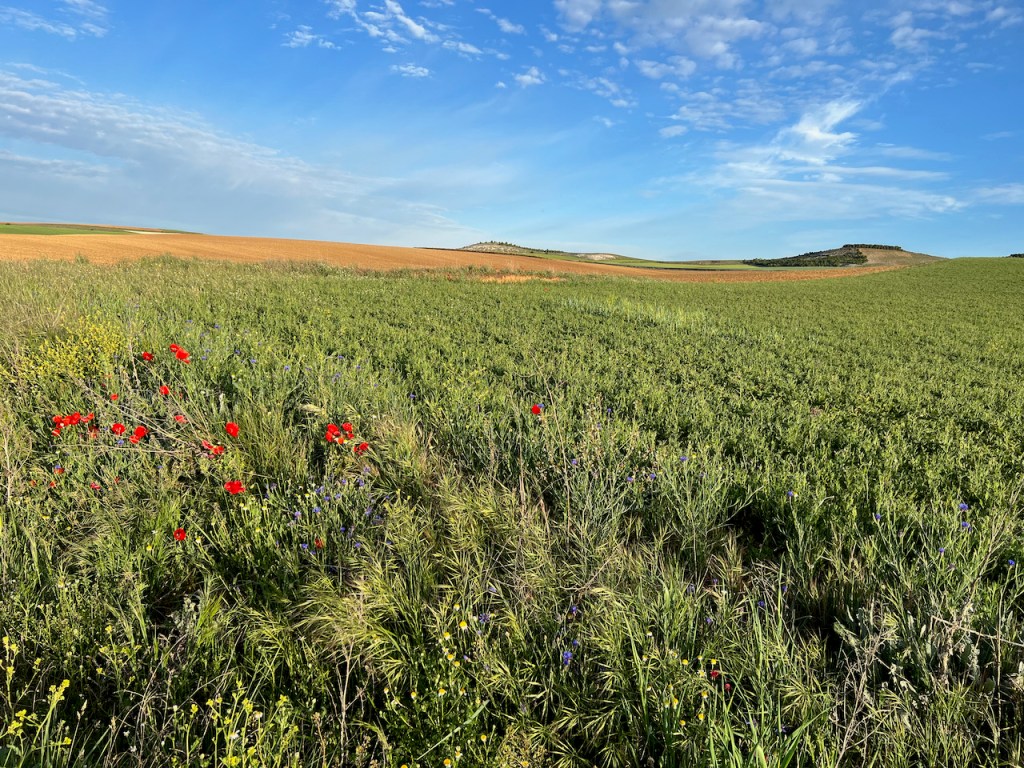
    It is also effectively a path straight through a flat, featureless landscape of wheat fields.

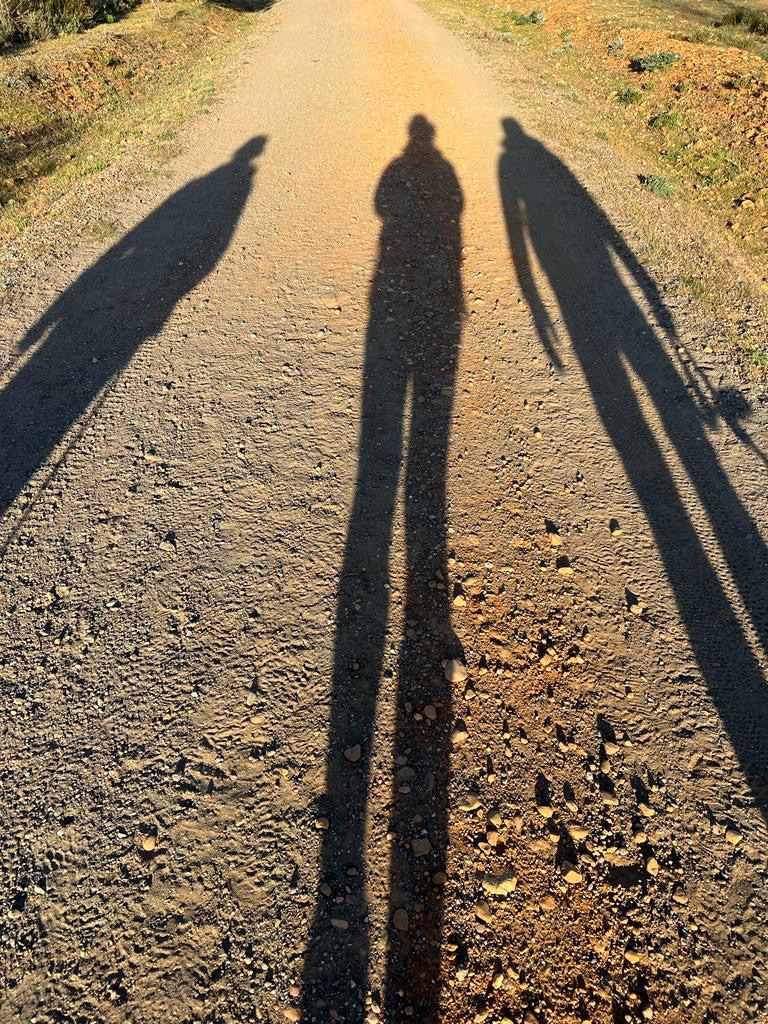
    Hence the walking experience on this stage is something like … this …

    And this may be too much information, but even finding a place to go the restroom becomes an issue. For some reason, the one or two coffees that I drink in the morning seem to multiply into vast reserves of liquid inside me. Over more particulars I draw a veil.

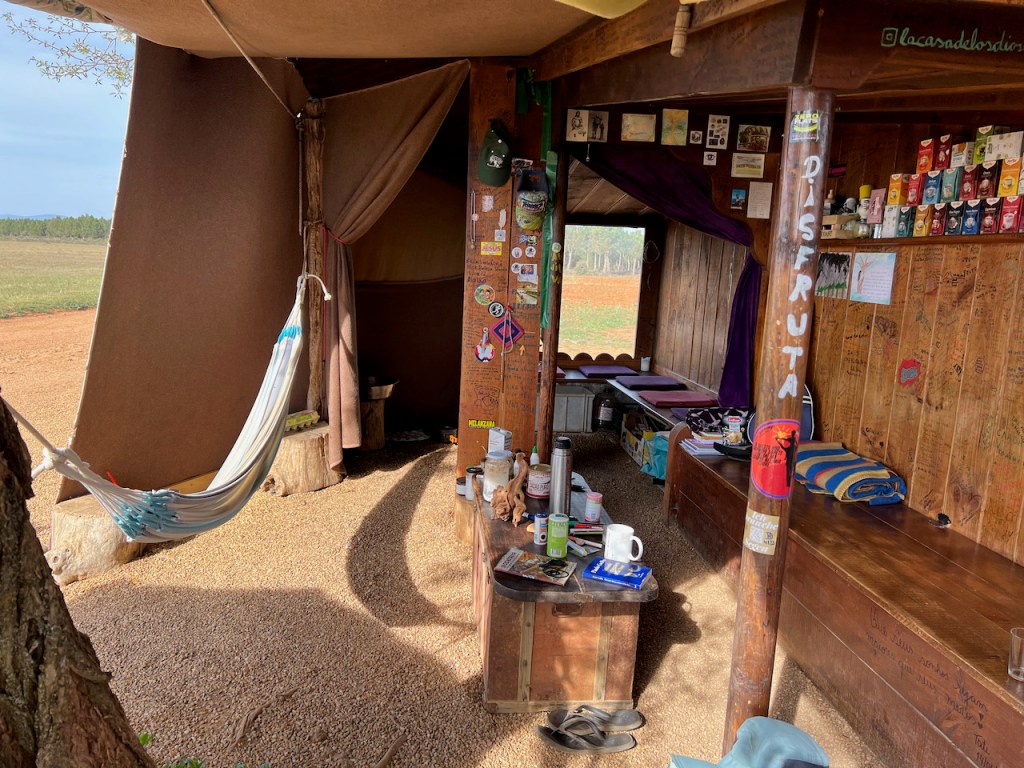
    As it turns out, there happens to be a sort of pop-up cafe, right at the midpoint of the 17km. Naturally, virtually everyone stops there. I greet a man from Singapore who I had chatted with earlier in the day. He had explained how, according to him, virtually everyone in Singapore can afford their own home. I also meet the group of Germans from earlier stages, including E. and T. It is a bit surprising how heartening it is to see someone you recognize on the way. As if you had known these people for years. Even though objectively speaking, you may have only talked to them for less than an hour total.

    When I did at last get to the town at the end of the 17km stretch, the first cafe which I came across was so tiny that I passed it by, thinking that there surely must be something better coming up soon, which turned out not to be correct. Anyway in the last hours the heat grew and the sun seemed to be glaring down with unusual ferocity. So I was happy to arrive at my destination albergue where I could find this …

    The albergue is situated outside the small town of Terradillos de los Templarios, effectively on some farmland. Thus it is unusually spacious in that it has a lot of land around it – I would estimate a couple of acres. Well organized, but overall I felt it was somewhat lacking in terms of Camino vibe.

    The adjacent town was a stronghold of the Knights Templar centuries ago, although nothing now remains of that apart from the name of the town. The Knights Templar were essentially an order of heavily armed monks, who got their start during the Crusades, and became a strong presence in Europe. This led to a violent power struggle with the French monarchy, which the Templars lost in the 1300s. The Templars seem to have some modern-day fans. I have seen the Templar cross at a few places along the way, once when some enthusiastic pilgrims pointed it out.

    L. is also stopping here, as well as E. from France and T. from Germany. I had first met T. back at Castojeriz.

    For dinner at this albergue, the setup is a bit more formal than usual. People are to be seated at small tables for two to four people. I was chatting with L. on the terrace and we invite Ti. to join us. During the meal, L. (from Milan) starts discussing a bad pizza that he had encountered, and mentioned with horror that it had ketchup instead of pizza sauce. Somehow he also mentions mustard, and at that point T. exclaims “that is very interesting to me!” . It turns out that on the way he is playing a game with cards – he has a card with the word “mustard” written on it, and if he meets someone who, for whatever reason, mentions that word, that person must take that card (and record where they are, with an app.) They need to keep that card until they meet someone else who mentions that word. Thus L. accepts the card.
    My dorm room is pretty small and full with older guys, mostly Italian it seems. But considerate and trying to be quiet. Later, as I head there in order to sleep , I hear L. talking to E., trying to get her to say the word “mustard”.

  • May 4, 2023 – Fromista to Carrión de los Condes

    August 27th, 2023

    I am up early, packed and ready to go by 6:15 AM. The afternoon before I had mistakenly agreed to pay for a breakfast, when the albergue owner had impatiently demanded an answer about that. I didn’t think it through well enough, because I now realize it will not available until 7AM, and I do not feel like waiting around.

    So off into the predawn darkness. I see dim figures of pilgrims ahead and behind, in ones and twos in the yellow light of streetlamps. I use my headlamp, but quickly lose my way anyway by missing a yellow arrow on a building, and have to retrace my steps. I make frequent recourse to an app with GPS (called Camino Ninja).

    Once finally out of town, with the sun coming up, I start walking long, straight, flat stretches of road.

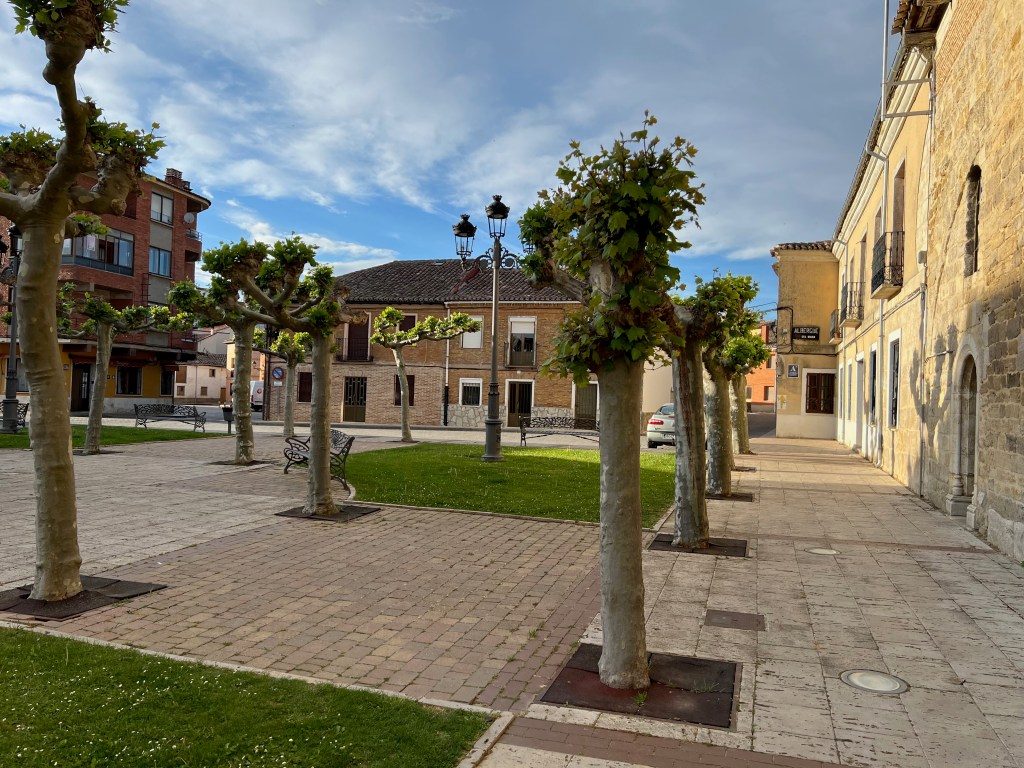
    I pass through some small villages, hoping / expecting that I will pass by a cafe in one of them . Walking through the third without success I realize that there may not be one open directly on the Camino path, and so go into the town and start asking around. I finally find an open cafe on the Plaza Major.

    The small towns on the Meseta can appear remarkably deserted. I saw one village, a bit off the Camino, which even appeared to be completely abandoned. Why this is so can be explained by recent Spanish history. Francisco Franco had an vision for Spanish society in which most people would be living in the countryside, on farms or in small towns. This bucolic ideal was not shared by the actual population, so as soon as Franco died in 1975 there was a migration of millions of people to suburbs outside the large cities like Madrid, in search of industrial jobs.

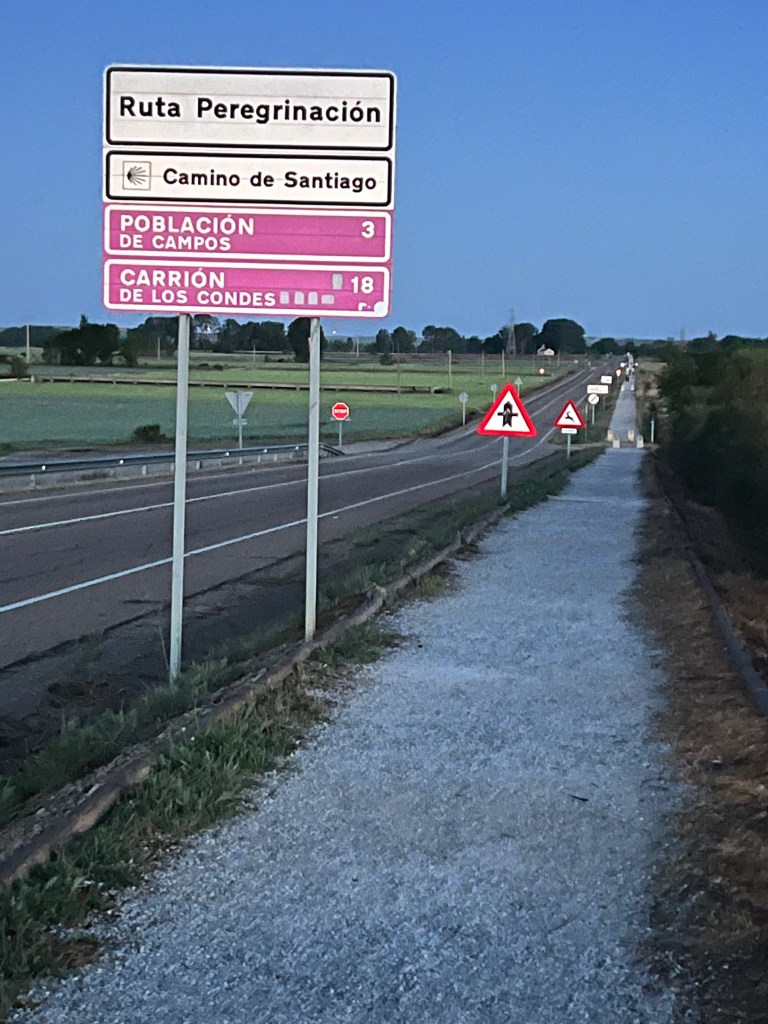
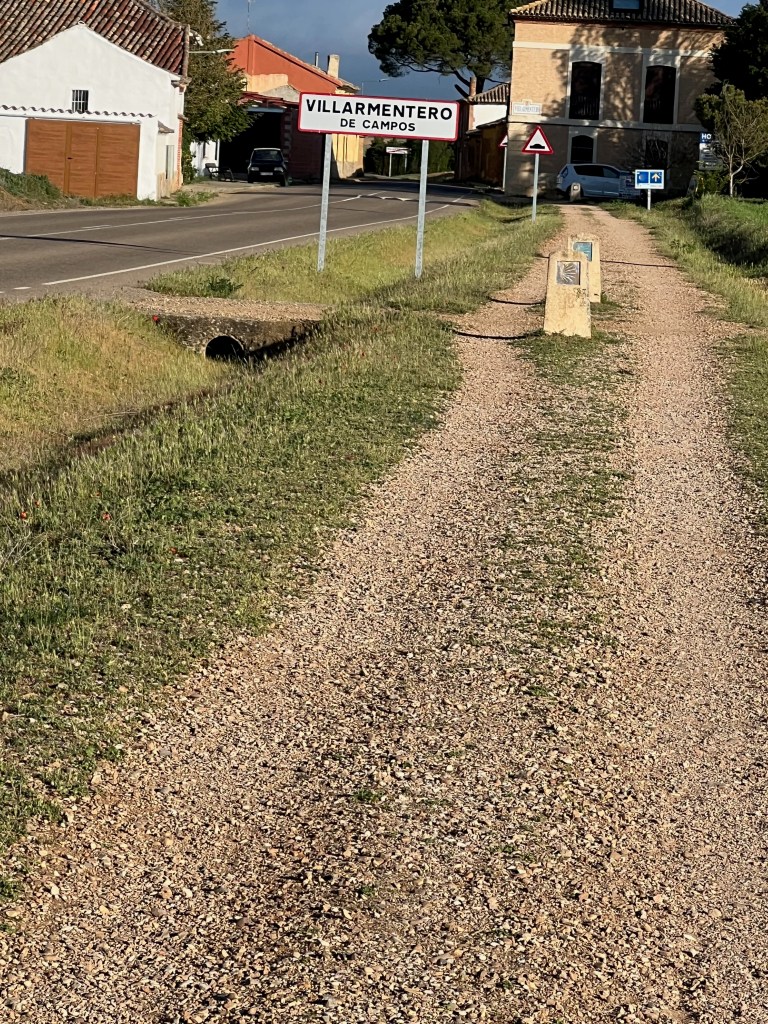
    This town is so small that I could capture the signs for “entering” and “leaving” town, in the same photo.

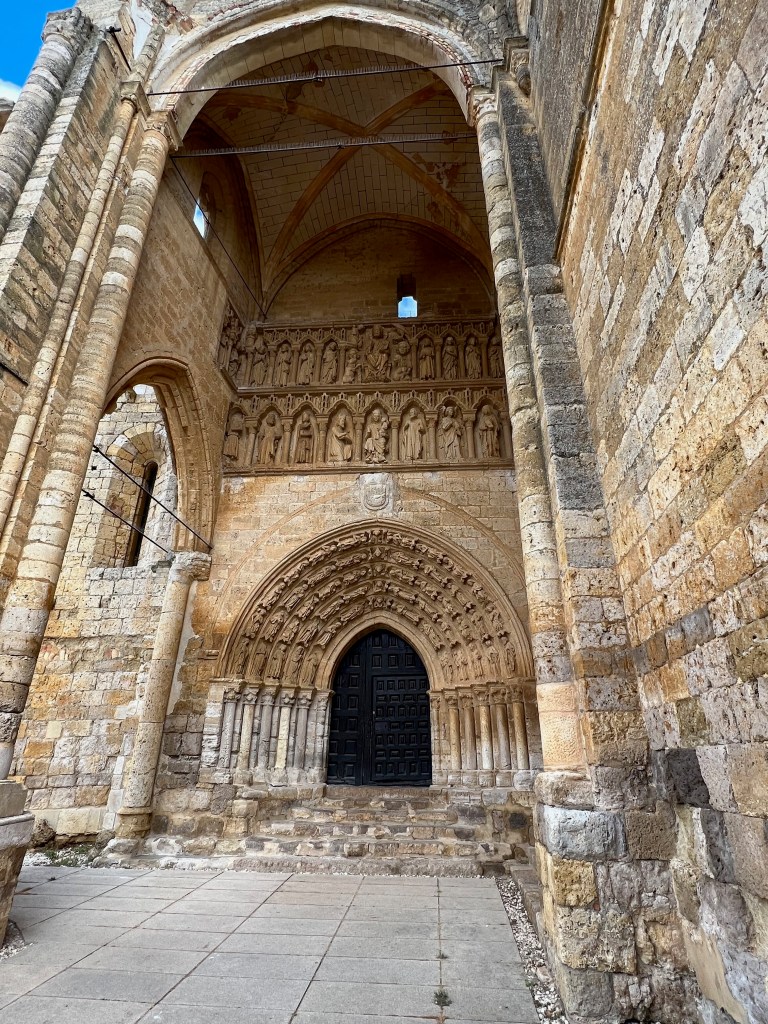
    It was worth walking into the town center to see this beautiful Romanesque church.

    Meanwhile on the way, the wind caused rippling waves across the wheat fields.

    The name of my destination town today, Carrión de los Condes, begs for some explanation. Condes refers to some long-forgotten counts, but Carrión? I was not able to find out if this has any relation to the English word carrion. The reason may be lost to history. The town was founded by Romans, then settled by Visigoths, after all. I did keep my eye out for any “Ask a Visigoth” visitor information.

    In fact Carrión turns out to be a medium-sized and lively town. There is a street market going on in the center of town when I arrive, which is interesting but results in such a confusion of market stalls and people, that I initially can’t locate the albergue which I am looking for. I do eventually find the place where I plan to stay. This is run by friendly group of four Augustine nuns. The place is relatively spacious and has a large kitchen – I go food shopping at a supermarket and make my own dinner of pasta, as several others are doing.

    The albergues almost always have an area where you can do hand washing of a few clothes. I usually hand-wash mine because so much is merino wool. It’s easy to meet people at the washing station, because (as here) there are multiple sinks, but only a few people, and there are ready-made conversation topics (is there any soap? is there hot water?) I meet F. from La Rochelle in France, now living in Paris.

    Outside in the garden there is a sharing circle event at 6 PM with the sisters and the people staying here. People introduce themselves and offer religious and folk songs and poems. T. from Germany brings his ukelele and sings a somewhat unexpected but heartfelt version of Frank Sinatra’s “My Way” .

    There is also a pilgrims service in the church next door. I feel a bit of imposter syndrome and am somewhat reluctant to go to this, but it turns out to be relaxed with no expectations of religious belief. There are two Brazilian ladies who I have seen on the way, who wear T shirts from their church group back home. They are very much affected by a certain special statue of Mary in the church, and start crying.

  • May 3, 2023 – Castrojeriz to Fromista

    August 24th, 2023

    The host of the albergue here in Castrojeriz had kindly arranged for there to be good, hot coffee available here in the early morning, so that we could all start in a good mood. There were no cafés yet open when most people were leaving.

    Cats outside the albergue, in the predawn darkness. Again the ‘Tau’ symbol appears.

    Looking back towards Castrojeriz before sunrise.

    Climbing the hill outside of Castrojeriz. People are walking this morning alone, with their own thoughts …

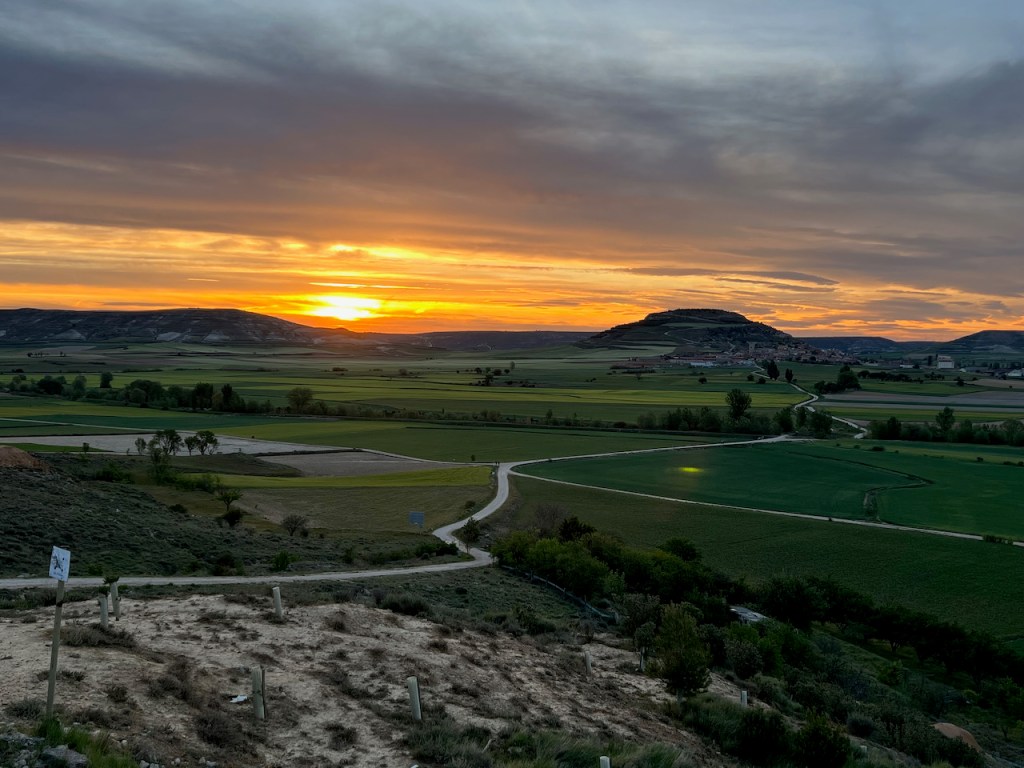
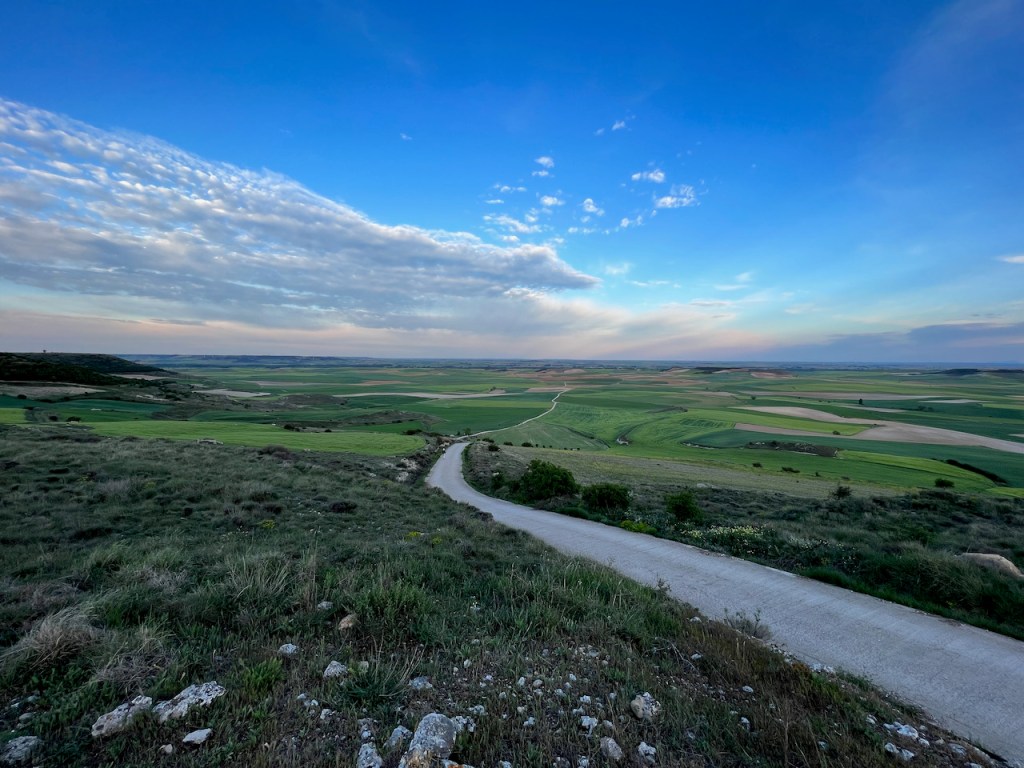
    At the top of the hill, on the other side, looking west. One of the most expansive views on the Meseta. I stood here for some time, taking in the panorama and listening to the wind.

    Is wheat something you enjoy? Then come to the Meseta in May.

    I pass by a small albergue which has been in operation for centuries (Ermita de San Nicolás)

    However I understand that a foot-washing ceremony is part of the stay there, and I don’t want to get involved in that. I need my space.

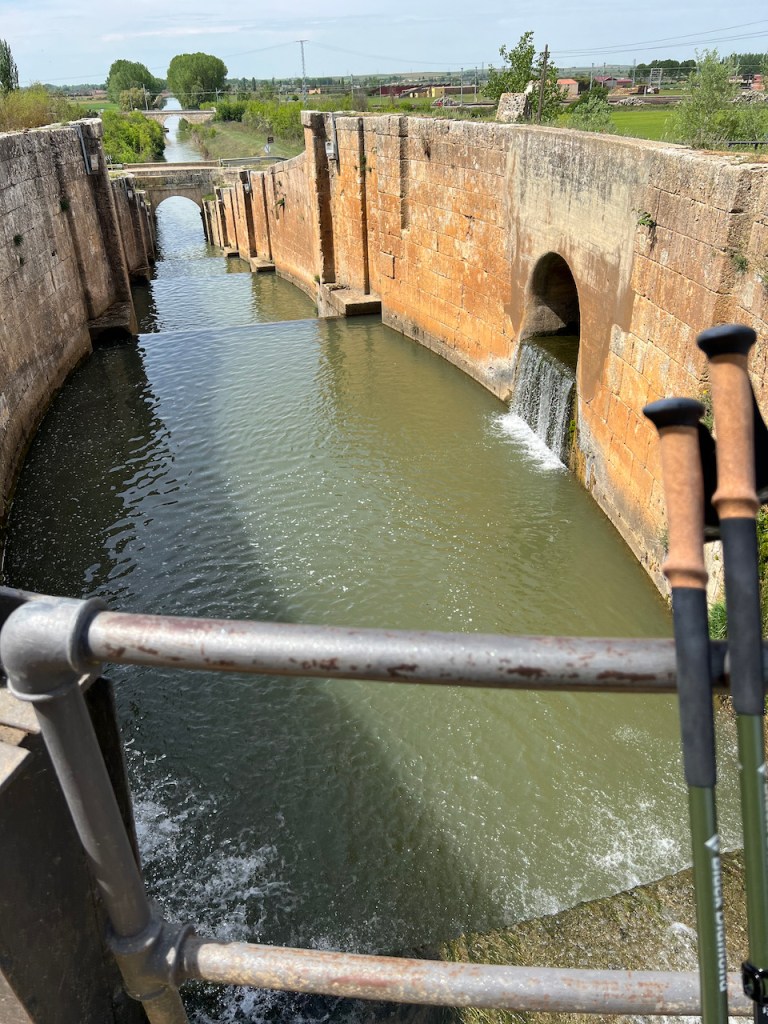
    There is an extensive system of irrigation throughout the area, involving the local river.

    L., who has done the Camino Frances ten times, and is something of a connaisseur of albergues, had warned me about the albergue in Fromista. He decided to stay in another one, in the town before. But that town seemed so utterly deserted and dead that I decided to keep on and see for myself. I got to the albergue and took place in a line outside. Every other accommodation in Fromista was booked. I was very early in line and thought that I was assured of a place to sleep there. However I got a surprise – the albergue bills itself as a ‘municipal’ albergue (which don’t take reservations) but it isn’t actually. It does take reservations, which means that it might be booked out as well. Which means that we all might be looking at sleeping on benches in the plaza … After a long wait in line I do finally secure a bed in a cramped and crowded room. While waiting in line I meet a French cyclist, M., who is cycling from France to Portugal on the Eurovelo route 1.

    I meet again a few Germans who seemed to have formed a fairly close-knit group. They had been walking together from the start in St Jean, and were much younger than myself. But I would see them again from time to time in the towns along the way in the Meseta. People are mostly hanging out in the small albergue courtyard, and looking exhausted. But I end up going out to a small market and then a restaurant. I feel that my metabolism is getting to be like a furnace in a old-fashioned steam engine. I need to keep feeding it like the railway engineers did with shovels of coal.

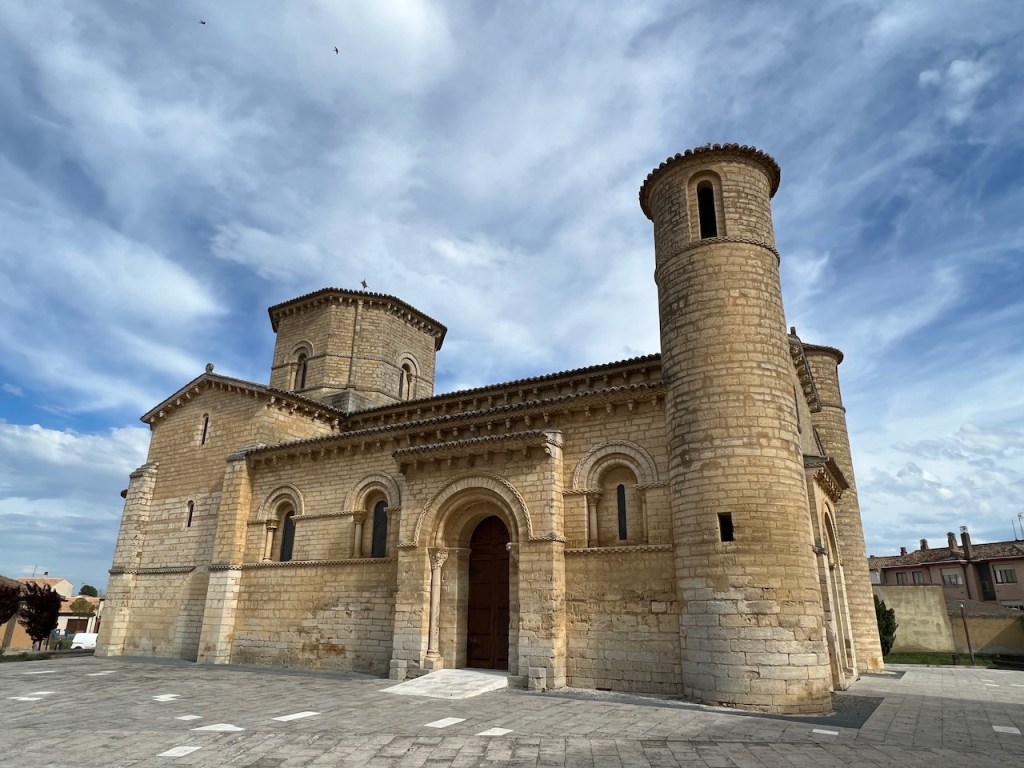
    The main church in Fromista , which is actually more like a museum. It has rather fantastical carvings of figures on the outside, some of which were removed to museums because they were considered indecorous.

←Previous Page
1 2 3 4
Next Page→

Blog at WordPress.com.


Loading Comments...
 

    • Subscribe Subscribed
      • Along the Way
      • Already have a WordPress.com account? Log in now.
      • Along the Way
      • Subscribe Subscribed
      • Sign up
      • Log in
      • Report this content
      • View site in Reader
      • Manage subscriptions
      • Collapse this bar