After a flight from San Francisco to Munich, and then Bilbao, I arrived by bus in Irun, a town on the French-Spanish border. A total of three pilgrims emerged from the bus into a gray and drizzly day. All were recently arrived from the US, and in a somewhat jet-lagged state. We helped each other get oriented towards the various places that we would stay in overnight, before beginning the Camino del Norte the following morning.
I had chosen the municipal albergue, which I thought would be a good idea in terms of meeting people, since I was starting this section alone. I was met by two friendly hospitalero/a s, who were excited and eager to help check me in. It was the very beginning of the Camino season for them, this being only April 2. It’s a dormitory-style accomodation that has 60 beds on two floors, around a circular, rotunda-like common area. The hospitalero remarked that he would wake us all up with heavy-metal music on a loudspeaker, at 6 AM. Later I put together enough Spanish to ask him how many people are staying there that night, and he replied that there were 25 people.
The hospitalero also kindly let me know where I could find a grocery store nearby so I could cook something for myself for dinner. I had decided to try to make an effort to continue to eat vegetarian even on the Camino. Cooking for myself, rather than going to restaurants or bars, made that easier.
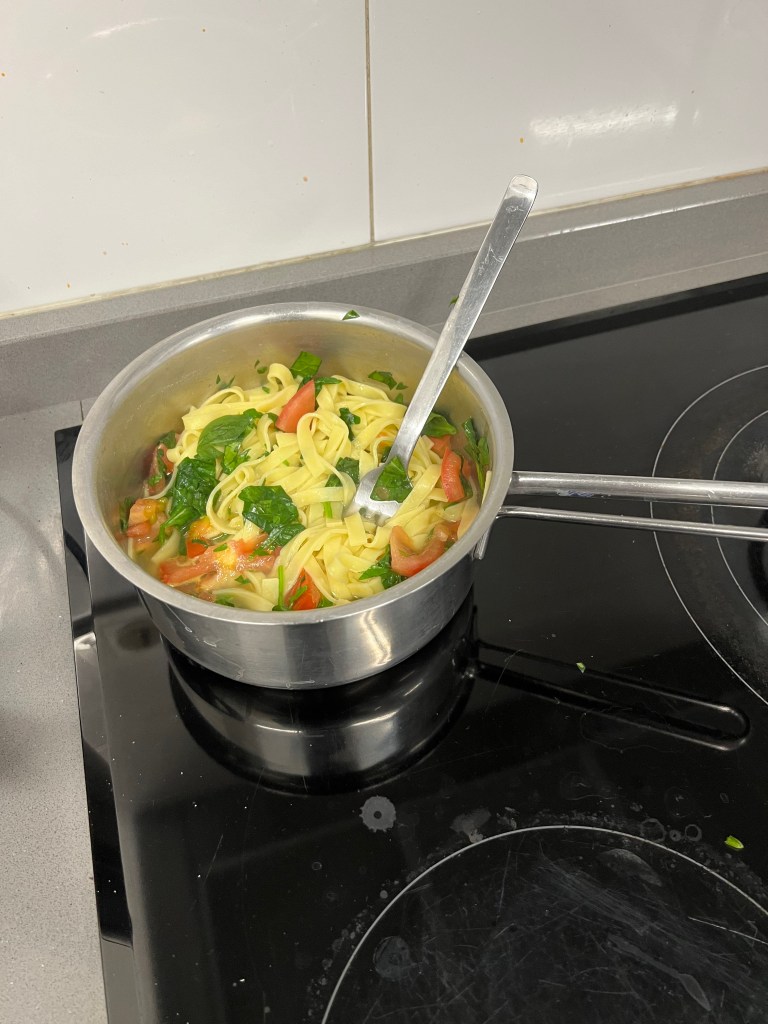
The other pilgrims there that night seemed to be mainly good natured, middle-aged or older Spanish and French guys. I considered that if this is it how it is going to be along the Camino route, I will improve my Spanish and French conversation. Their own enthusiastic exchanges did reverberate powerfully in the dome-like common area.
In the initial days of a journey, I tend to wake up in the morning not having any idea where I am. Awakening to metal music from Linkin Park in the 6 AM darkness intensified this feeling, until I remembered what the hospitelero had said the night before. The rotunda-shaped common area seemed to shape and focus the sound into a swirling, churning, echoing melange.
There was a breakfast provided by the hospitalero. Even though it was just bread and jam from the supermarket, and percolated coffee, I tried to appear enthusiastic and grateful. It was actually nice that a hospitalero was actually there in the morning at all. Often, in my experience, they are not among those present, in those early morning hours.
I started out from Irun on paved roads, curving and climbing uphill. I was excited to finally begin the actual walking.
I came across a French man who I had seen last night, gesticulating, exclaiming and conversing in a friendly way with myself, other pilgrims, and indeed, no one in particular.
The road flattened out and came to a church where most pilgrims stop,
called the Santuario de Guadalupe. There I saw again a nice young couple with colorful tatoos, who had paused for a smoking break.
Shortly after the church came a fork in the road. There are two ways towards San Sebastian along an extensive ridge, one being a relatively wide gravel road which is below the ridgeline slightly inland, and another, somewhat higher one which winds exactly along the ridgeline. I chose the higher one because the weather was clear, promising expansive views out over the Atlantic, back towards the hills of France, and west towards San Sebastian.
Having met a lady when getting water at a fountain, my French was enough for her to make clear to me that she was Basque (not French or Spanish, mind you), lived close by in France, and was planning to do the Camino in week-long sections.
The path was narrow, steep, rocky and uneven, often following the ridge line like a knife edge.
Looking down from the ridge line, the ocean showed as deep blue, dotted with cargo ships, under a clear sky, with a brisk wind. In the other direction, looking inland , a range of higher mountains was visible.
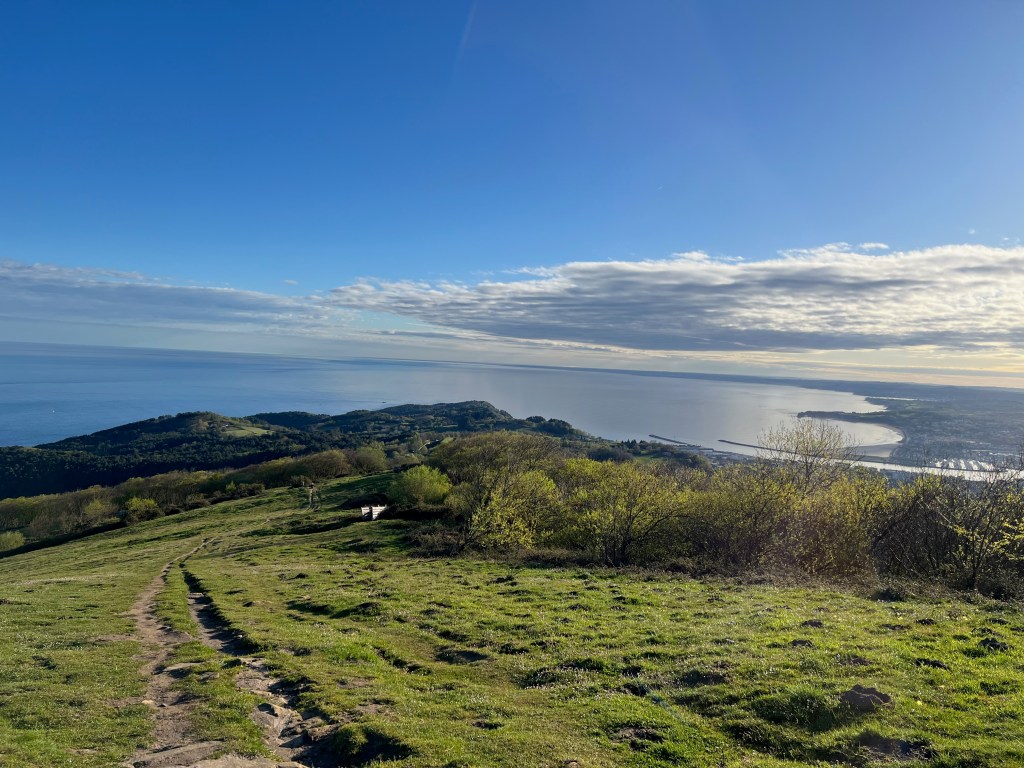
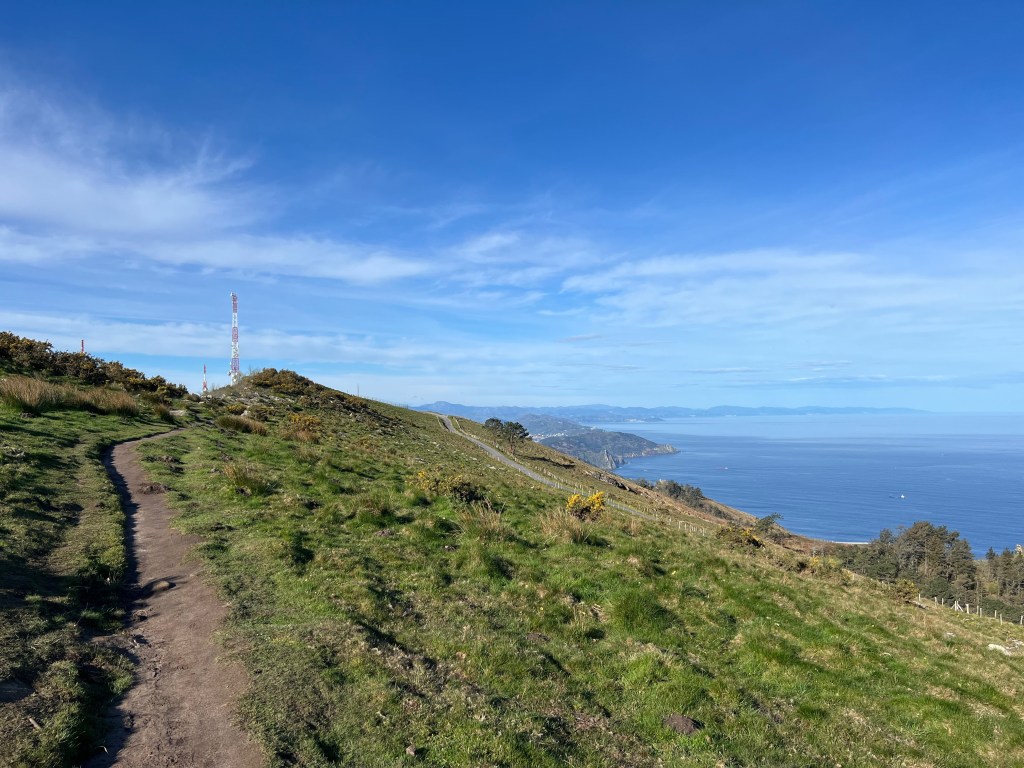
After continuing on the ridge for quite a while (about 15 km overall from start), I started descending, on rough switchbacks. I eventually came rather abruptly out of a forest, into an urban environment with a school, housing, busy intersections, parks and everything else – an area called Pasajes de San Juan.
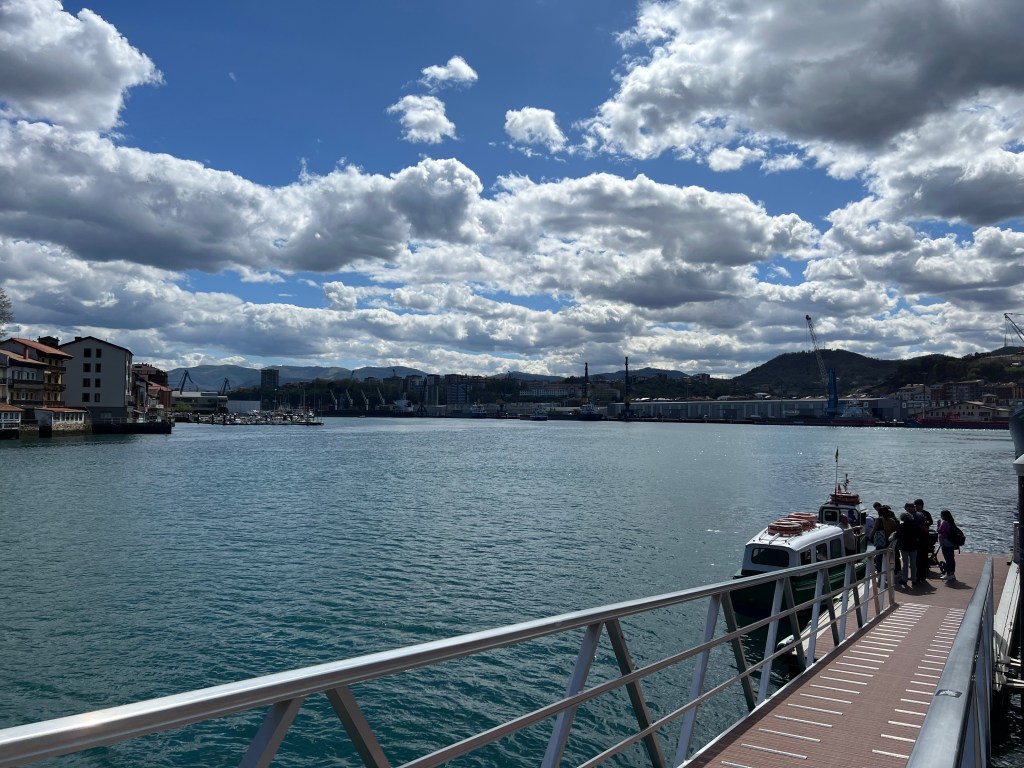
I sat down on a bench to rest, and chatted with a Belgian guy who was also there. We agreed that this was already enough for a first day’s hike. As I saw later, Pasajes had a nice old town by the harbor, and I could have stayed in that town. But San Sebastian beckoned, although my destination was still 10 kilometers away. There was no Camino signage that I could find, so I just used the smartphone to navigate through the city to the day’s destination, an albergue at the far end of San Sebastian.
Midway, there is a short ferry to find. The ride is curiously short, in a tiny launch, across a sort of narrow estuary. I was going to take a photo from the launch, but by the time I got ready, the boat trip was already over. I felt that constructing a bridge here would not be out of the question.
Continuing on through the city, I eventually found myself on one of the main boulevards of San Sebastian, heading towards the beach on the La Concha bay. Passing by the sleek clothing stores, restaurants and bars in my pilgrim attire of backpack, floppy hat, and trekking poles, I felt a just a bit self-conscious, and did not spend a lot of time there. The boulevard ended at a wide beach with beautiful golden sand, featuring a picturesque island in the middle of the bay.

I walked along a sidewalk above the beach before finally finding my accomodation for the night at a youth hostel. It has 100 beds, but had only 6 people staying there that night – it was only the second day of being open for the season, as the friendly staff explained. I ran into the Belgian guy again, who was intent on finding a restaurant, however I had decided to make dinner for myself once more. In the kitchen /dining area there were only two people , both Americans. I chatted briefly with one of them, who complained of the difficulty of the day’s route, and the weight of his pack.
In the night I had to use all my anti-snorer techniques. One guy in the room became so notorious later on the Camino, that people would switch accommodations (not to say cities) to avoid him.
 Along the Way