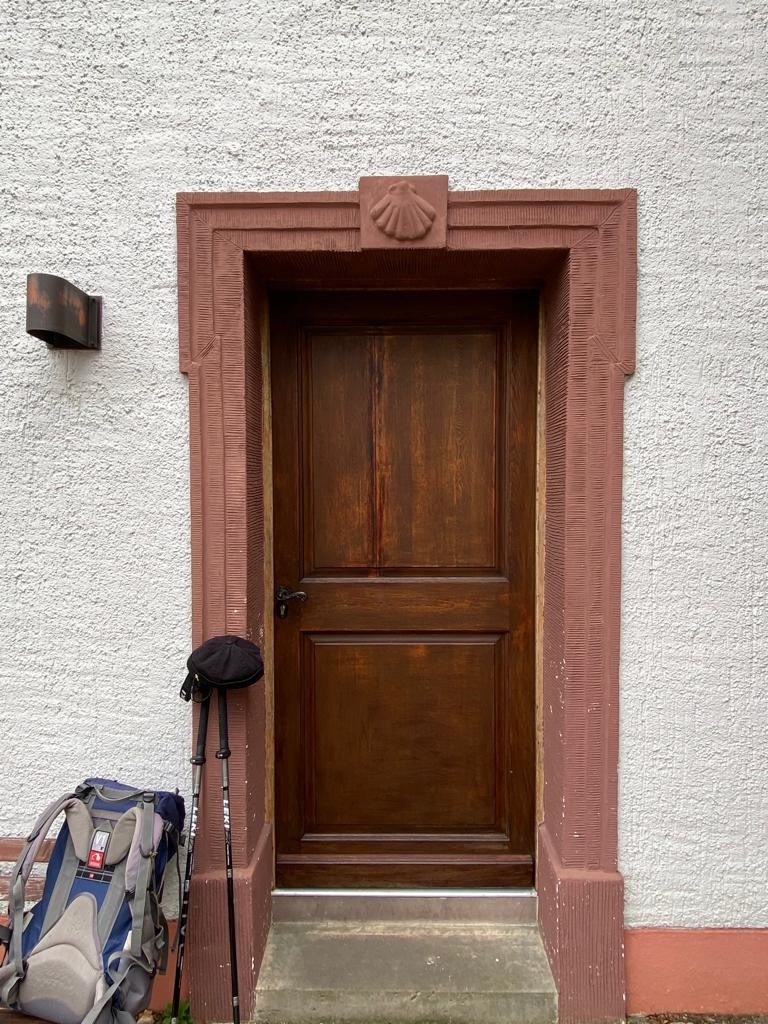
I recently volunteered at an albergue (pilgrim accomodation) on the Camino de Santiago. People who work at such a place in Spain are known as hospitaleros/as.
The days went like this:
At 6 AM my Iphone alarm goes off . It is time to unlock the albergue doors so that pilgrims can get on the road. As I come downstairs, there are already a few people getting ready, re-packing their backpacks. I make coffee for anyone who wants some, from the ‘Moka’ coffee makers on hand in the kitchen . Then wish buen camino to the people that I had met the day before.
One reason why some people get going so early, is that so they can arrive at their day’s destination before the afternoon, at which time many restaurants and shops tend to close until 8 or 9 PM. Something like 6 or 7 hours of time would typically be involved in travelling what is usually somewhere between 15 and 30 kilometers per day.
One morning a few people requested going even earlier than 6 AM, because the sky was clear, and they wanted to see and follow the stars east to west in the classic fashion.
By 8:30 all the pilgrims are on their way.
At 9:30 there is some general cleanup work for the albergue, such as disinfecting beds and sweeping/mopping floors , divided up among the hospitaleros/as.
By 11:30 pilgrims have started arriving in town in order to stay the night, and are either at cafes in town, or waiting in a line outside the albergue. In old-school fashion, there are no reservations taken. At this time of year the albergue only ends up being about half full. People tend to keep arriving until about 5 PM.
At 12 PM we open the doors of the albergue. Since they are pilgrims finishing the day’s walking, they tend to be pretty tired, hot, hungry and generally uncomfortable and are just looking to get assigned a bed as soon as possible. Unfortunately we have to first ask them quite a few questions, as required by police officials. Walking the Camino is considered very safe, and the Spanish authorities have an interest in keeping it that way.
People are for the most part, pretty patient with the following process…
- We ask if they would like tea or coffee
- explain about how to self-register, using their smartphone. This turns out to be easy or impossibly complicated, depending on the person.
- after the registration form is filled in, we ask for the passport and check it against number given in the form.
- stamp pilgrim credential.
- ask if they want a sleep sheet.
- take payment.
- assign bed. This is done on paper and we have to be careful to get this right.
- give basic info about the albergue – where the beds, kitchen and laundry are.
- explain about activities and events later on in the evening, such as a sharing circle.
People appear with passports from the Netherlands, Germany, USA, Australia, Hungary, Canada, Latvia,
Korea, Taiwan, France, Spain , Portugal, Italy, England, Ireland, and others. The hospiteros/as are all multilingual and connect with pilgrims in their native language when possible.
One older portuguese man explains that he is walking in the reverse direction, that is, away from Santiago, which is quite rare. He plans to arrive eventually in Barcelona and then go by sea towards Rome. He then spoke somewhat disparagingly of pilgrims who in his mind, behave just like normal tourists.
Another somewhat unkempt, bearded man arrives with a large, dusty backpack, and mentions that he is on his “26th Camino”. The hospitalera whispers to me that this is a “lifestyle” pilgrim (essentially, a homeless person). Apparently not unknown on the Camino, but I only encountered one person like him.
One young person needs to wash all their clothes, and after starting laundry, goes around in the albergue draped in a sleeping bag.
A different, very fit young person arrives, and if I understood correctly , mentions proudly that they have walked more than 40 km that day, and are keeping up that pace every day.
At the sharing circle, a common question for people is why they are out here on the Camino.
People give responses ranging from I don’t know, or just wanting to hike, to life transitions, to personal loss.
At this point on the Camino, many people have formed groups. They go food shopping at a supermarket, then cook dinner together. I notice people especially from Italy, the Netherlands , France, and Korea. Proceedings are sometimes a bit chaotic in the relatively small kitchen, and at other times quite orderly.
Someone finds a guitar and starts singing and playing, which makes for a nice ambience as people eat dinner.
At 10 PM I lock the doors of the albergue.
 Along the Way