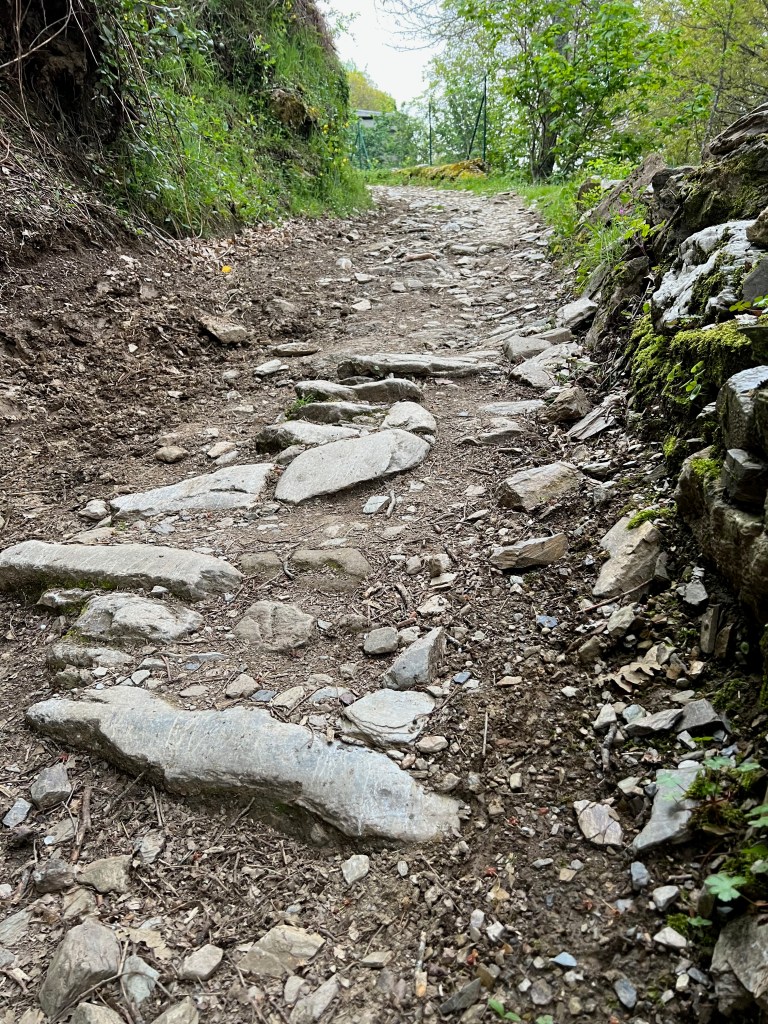
The way up from Herrerias towards a high point at O Cebreiro was steep and stony. As we passed alongside a village, one of the pilgrims in our group remarked that this was a place “wo füchse und hase begraben sind“. I asked about that expression – literally, ‘where foxes and rabbits are buried’ . It turned out that that expression is used to describe a place without human activity. Indeed, the village, while not abandoned, appeared grey and lifeless in the early morning overcast.
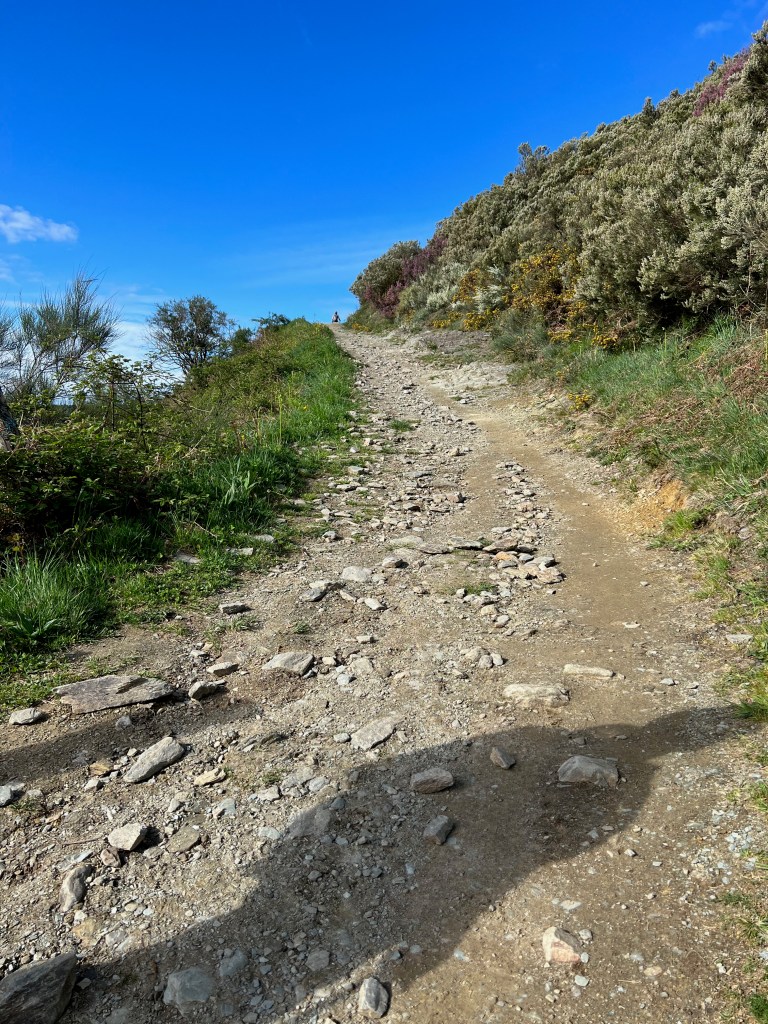
We were rewarded with sweeping views of the Cantabrian mountains in León. These mountains stretch for about 200 miles across northern Spain, and in places can reach heights of nearly 9,000 feet. Here in Galicia in April, they wore an intense green.

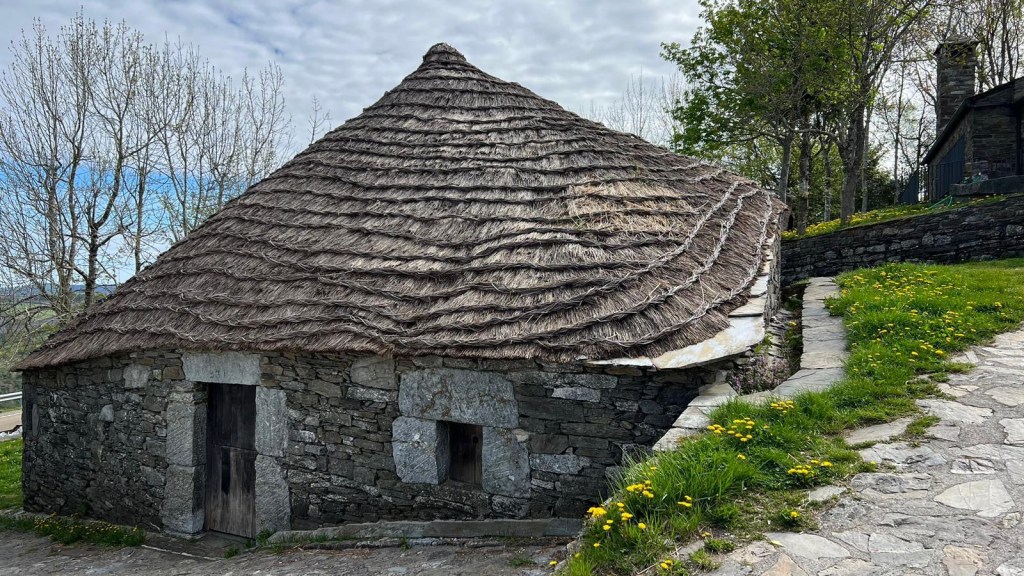
Coming to one of the high points in elevation on the Camino Frances (4242 ft), we found O Cebreiro (‘O’ means “the” in Galego). Galego is a language spoken in this region of Spain (Galicia) , with similarities to Portuguese. O Cebreiro is situated on a mountaintop, with grand views, and consists of several shops and bars , a church , and some curious oval dwellings with conical , thatched roofs . The name given to this type of house is palloza. The design is thought to be extremely old ( pre-Roman, perhaps even Iron Age). Originally, both people and their animals lived in them.

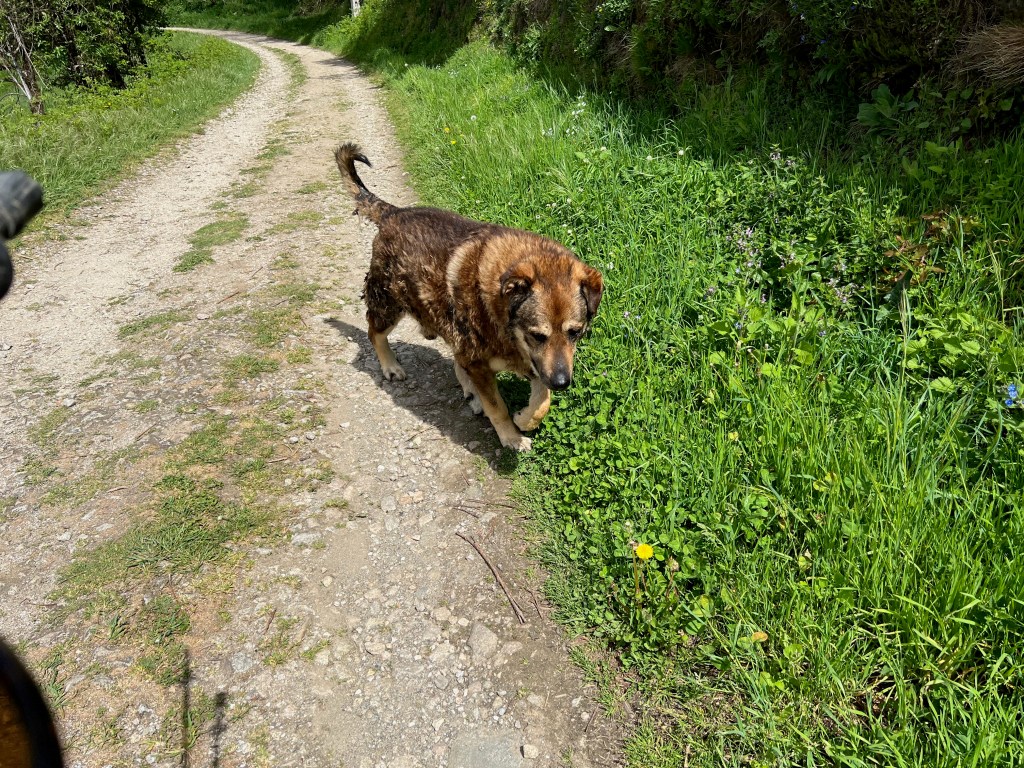
Continuing on downwards, we met this friendly dog. On the Camino I did not see any mistreatment of dogs as described several times in Hape Kerkeling’s book. I did notice dogs tied to chains rather than the more elastic lines or cords that we would use in the USA. The effect is admittedly the same, but it always appeared a bit jarring to me to see.
We also had sightings of someone who we had met earlier, back at Rabanal. Encountering him at several bars along the way, he explained his plan to raise koi in large numbers, as a protein source for the world. He also confided that he made rapid progress between bars ( 6 km/hour) , by not actually walking on the Camino, but rather on nearby roads and highways. One of the German pilgrims remarked somewhat cryptically that he “hat ein Affenzahn drauf” . This means literally that he has a monkey’s tooth on him. It was explained to me that this means that someone is moving at a fast pace.
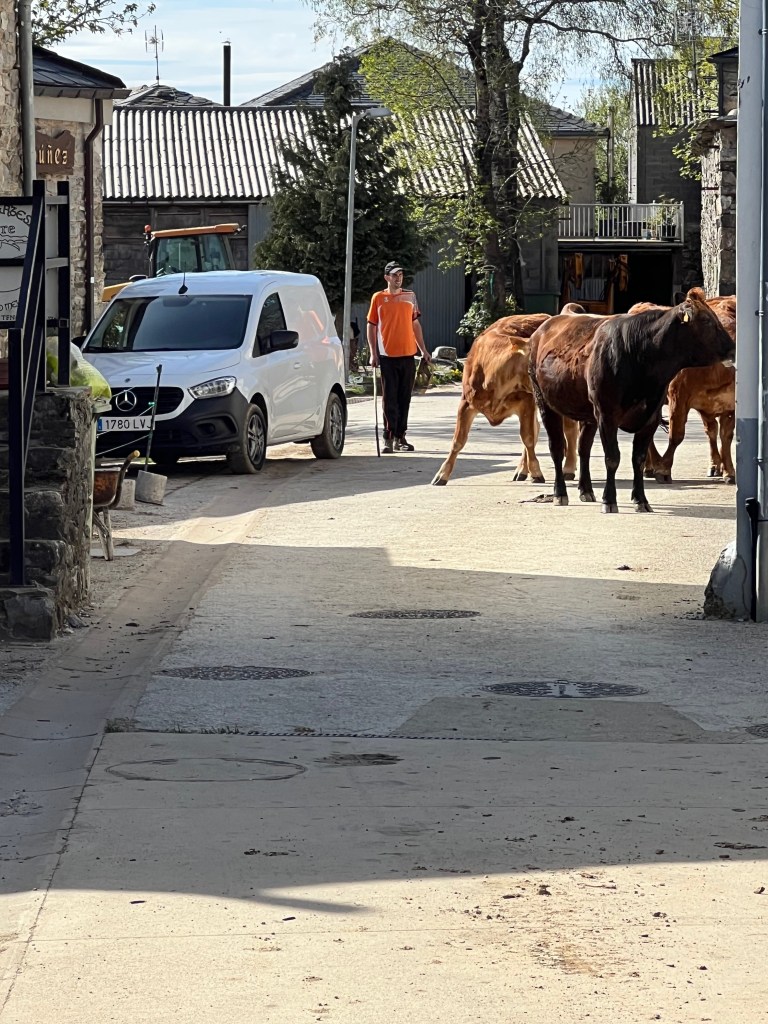
Coming into the village of Triacastela, I encountered cows coming the other way. I heard the man calling the animals back into the barn, and was somehow expecting that he would have individual, endearing names for his charges. However he was simply shouting “Vacas!” (Cows) which, while accurate, seemed rather generic.
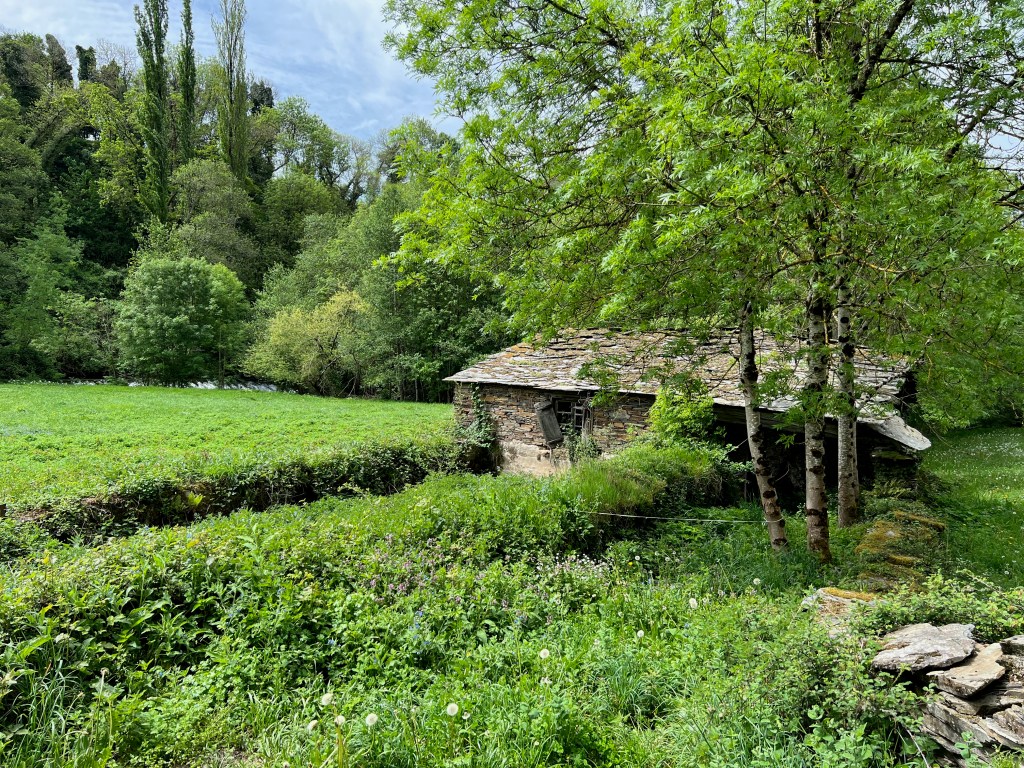
As the way descended, the landscape became more densely forested, with gently rolling hills, and isolated farmhouses and hamlets appearing through the lush green vegetation. Reminding me of the Shire in The Lord of the Rings.

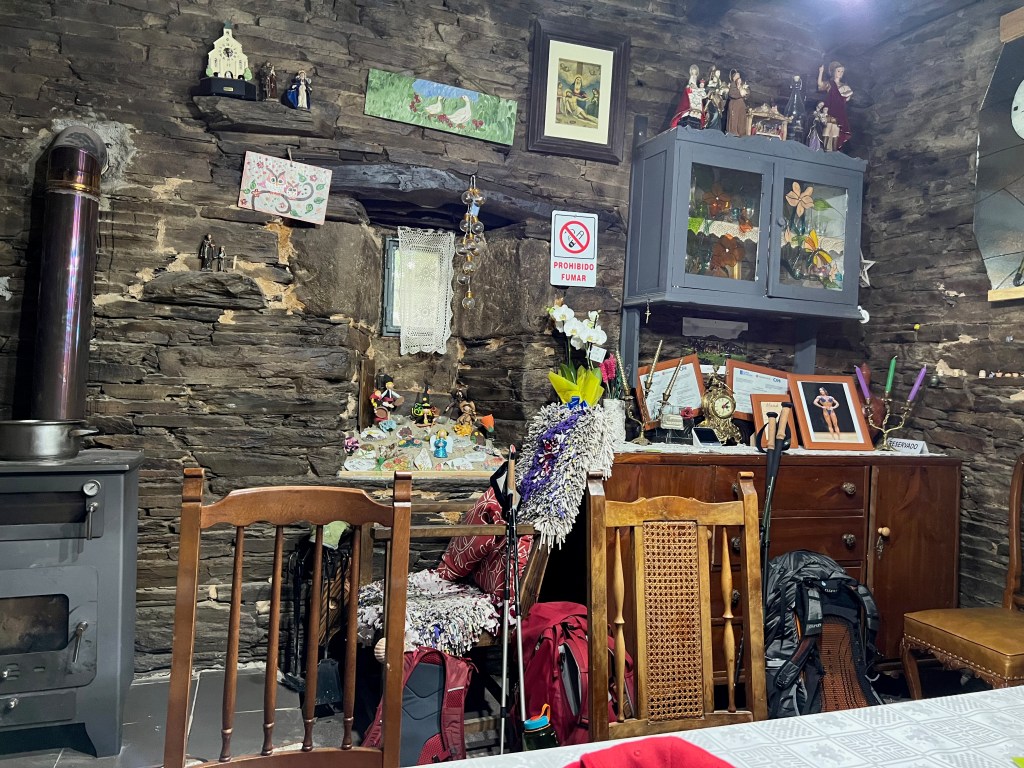
We stopped to have breakfast in a farmhouse off to the side of the path. Just so that you can have an idea of what it could look like inside one of these .
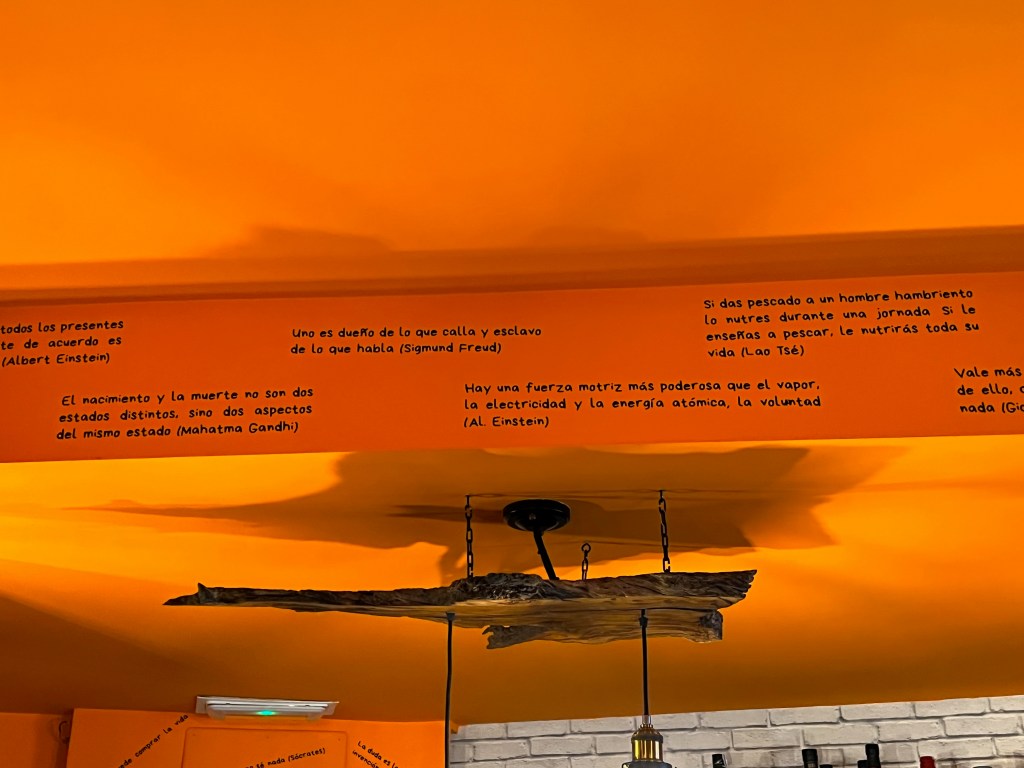
At a restaurant in Sarria before we went our separate ways, our little group passed the time when waiting for food, by attempting to translate the quotations on the walls.
Then a group of Galician musicians arrived for a family celebration in the back of the restaurant. Through the din of bagipipes and language barrier, I found that one pilgrim was going not only to Santiago, but to Lourdes and Fatima as well. He had a strong belief that this could help with a family health issue.

 Along the Way