The place I stayed in Riego de Ambros was a centuries old house
which had been retrofitted to function as albergue. That meant that the ground floor was subdivided into a warren of cubicles with bunk beds, with meager light coming from the few windows. The floor was of wood and thin, and over a basement, such that even when we pilgrims walked as quietly as possible, we produced magnificently impressive booming sounds.
Having exhausted the rhythmically expressive possibilities of our albergue floor, it was time to continue in the mountains of Léon.
Leaving Riego de Ambros, the way led steeply downward under an overcast sky, with rocks and wildflowers, downward to the pretty town of Molinaseca.


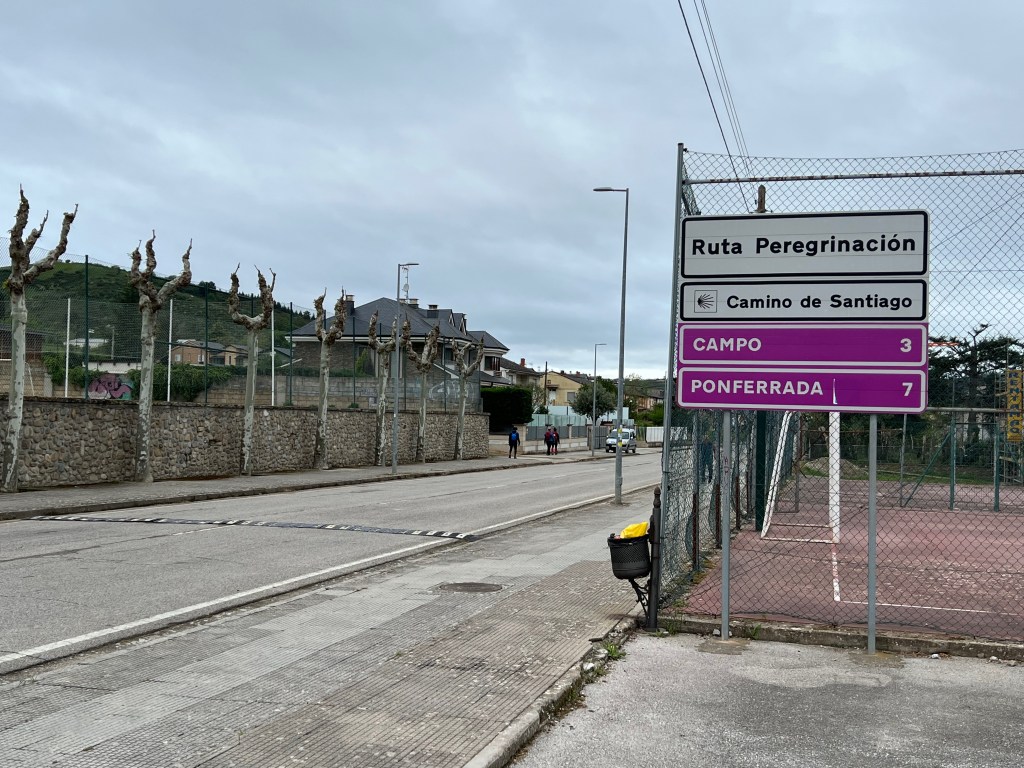
Leaving Molinaseca was not as picturesque, as you can see. I took this photo because, as always, I was excited to see official-looking Camino signage like this, placed by some level of the Spanish government.
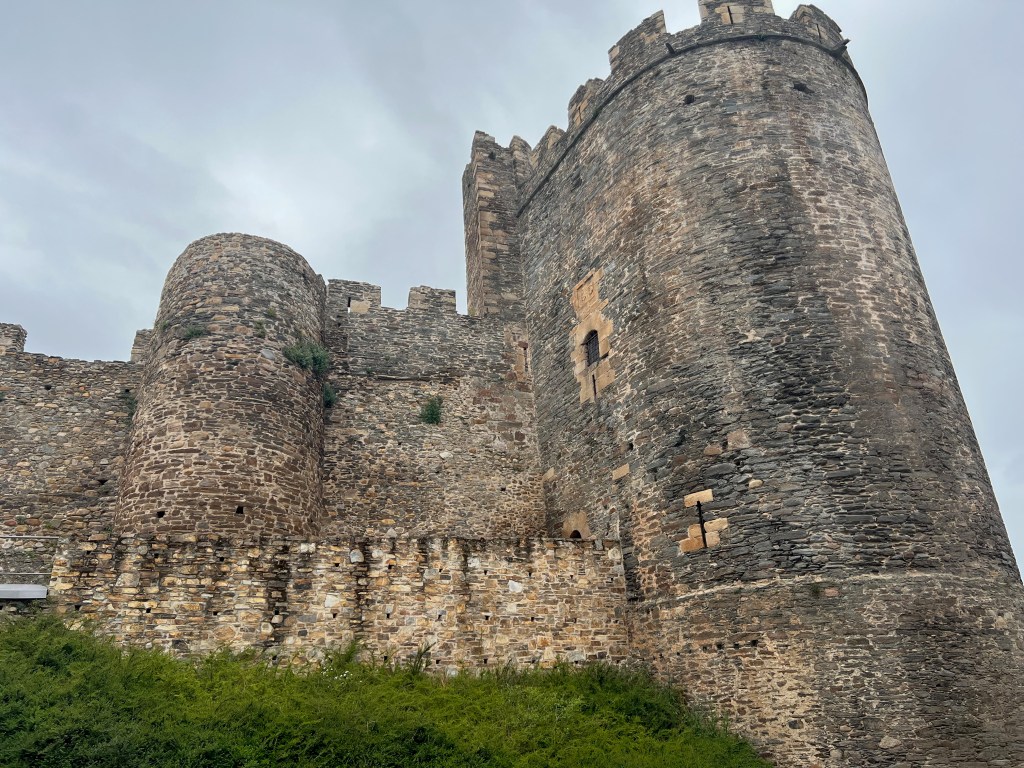
The landscape leveled out into a valley which contains the town of Ponferrada. I walked on my own because I wanted to be able to stop and have a look at places on the way, such as the massive crusader-style castle in the town center of Ponferrada, built by the Knights Templar. The Knights controlled the town during the twelfth and thirteenth centuries, and from there, provided protection to pilgrims on the Camino. The castle features hidden access to water from the nearby river Sil, clearly useful during potential sieges.

After passing through Ponferrada, the way opened out into a softly undulating valley of vineyards, under a clearing sky adorned with filigreed cirrus, and drifting cumulus clouds.
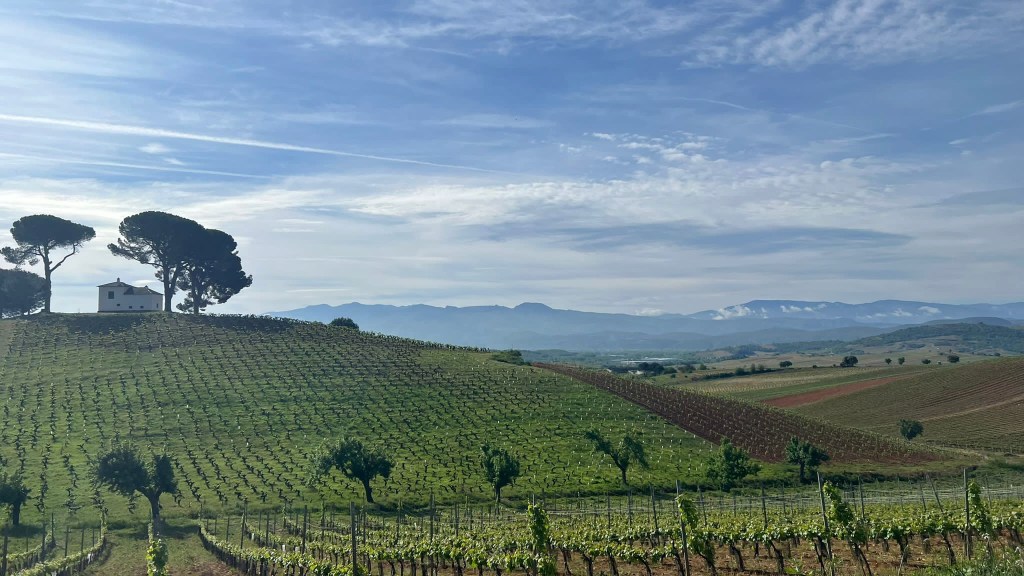
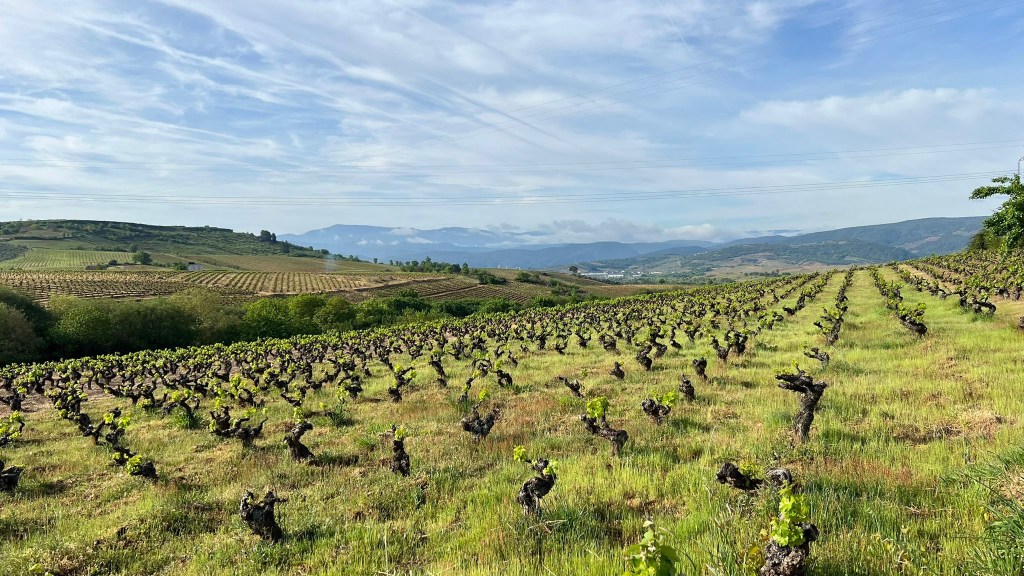
This part of the province of Léon is known as El Bierzo. It is known for a red wine made from grapes of the varietal called Mencia. Our small pilgrim group sampled some of the Mencia at the town of Camponaraya.
Link to location: (as well as a general map of the Camino Frances) :

At dinner at the albergue, we met someone from Korea (L.) who is on a long trek, planning also to walk to Fatima and Lourdes. He had more of a story as well which I only found out days later, down the road. He could speak Spanish as well as some English. We invited him to walk with our little group.
We came to the town of Villafranca del Bierzo and stayed at a former convent, now converted into an albergue, which was very large and somewhat impersonal. We invited pretty much whoever ended up in our dormitory room, down to the town square to have dinner. One pilgrim could speak good Spanish, at least with the waiter, and when asked how, went on and on about how great Duolingo was for learning. It then transpired that his mother was a native speaker of Spanish.
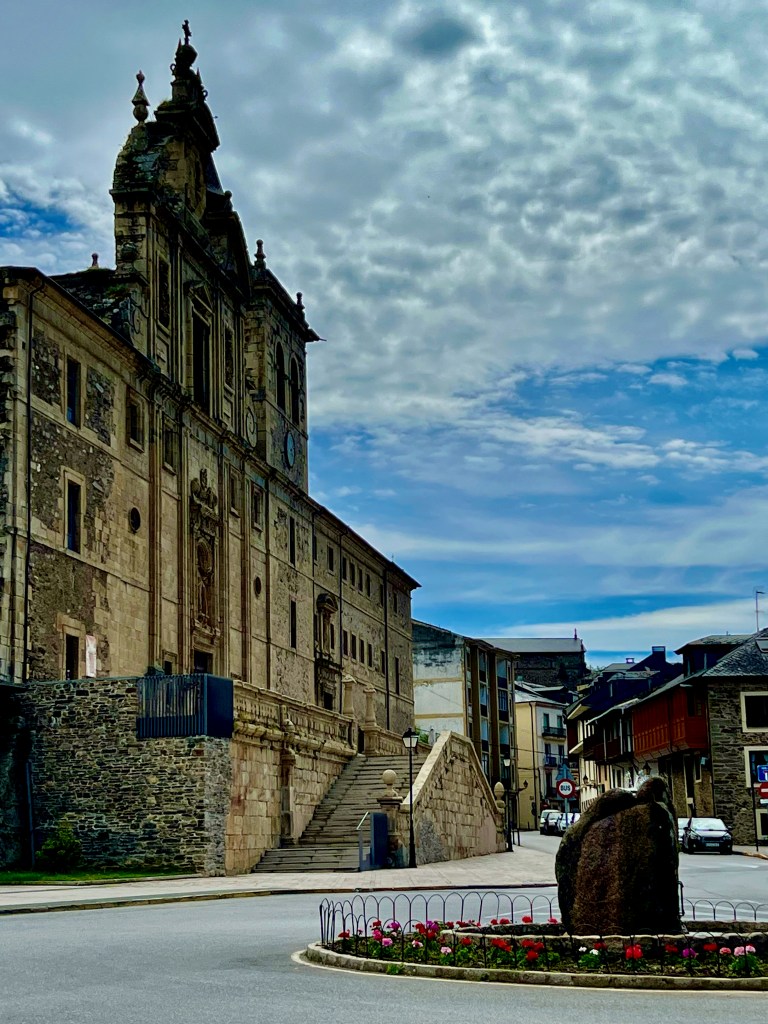
Leaving VillaFranca before sunrise, we came to a crossroads. Pilgrims have a choice of either 1) a possibly fatally dangerous walk along an autoroute through a narrow valley or 2) a potentially cardiac-arrest-inducing climb up out of the valley. We could only hope to have the wisdom to choose correctly.
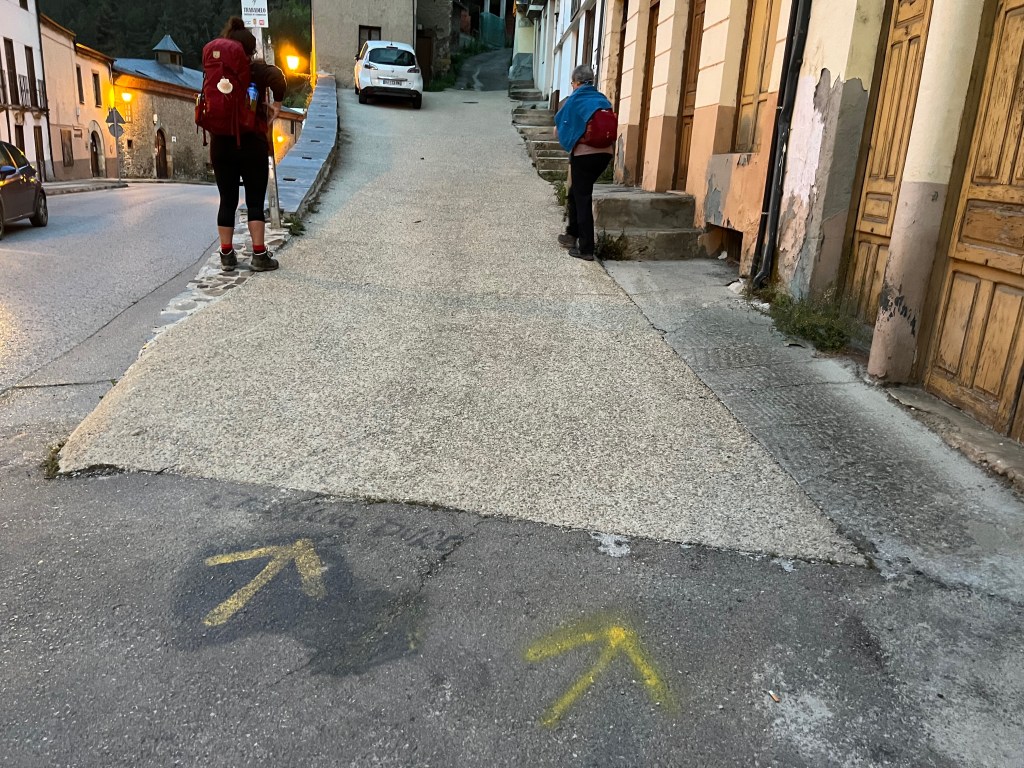
We took the climbing option, called Camino Duro (Hard Way). The road was initially of concrete, through the outskirts of town. I had never encountered a road that steep, that was not actually stairs. However to someone familiar with the Sierra Nevada or the Alps, it is probably not that shocking. And the insanely steep section was not very long. Before long, one is high enough to see Villafranca in the distance behind, and broader vistas of the mountains of Léon which we had passed through days before.

(Note by way: The route along the highway through the valley coming out of Villafranca is said to be improved in terms of pilgrim safety, since Hape Kerkeling’s walk and the hair-raising account in his book.)

Taking the Camino Duro did give us the opportunity to get somewhat lost, which we took advantage of right away. In a combination of poor signage, overconfidence that we knew where we were going, and just plain not paying attention, we found ourselves on a path taking us further and further away from the valley which effectively determines the camino route. Our path did have expansive views and fringed with forest, and eventually brought us to the town of Pradela. Being at this town, only just off the track, immediately had a different feel or vibe to me from the other towns that I had been passing through. For one thing, there was no sign of Camino “infrastructure” such as special accomodation or restaurants for pilgrims. For another, I could see a farmer ploughing a field using a donkey, as in previous centuries. A local working in his garden clued us in as to how to get back to the Camino.

The stopping place for this day is called Herrerias, a small village at a point where the way starts to ascend again toward another high point. In the albergue I met someone from the Netherlands who is volunteering there. This person had walked the Camino and then decided quit their job, to come back and volunteer at various places and essentially stay and work on the Camino full-time. Discussing books by Thích Nhất Hạnh, a quotation in one of the books came up … instead of the phrase “time is money” , Nhất Hạnh has – “time is life” .
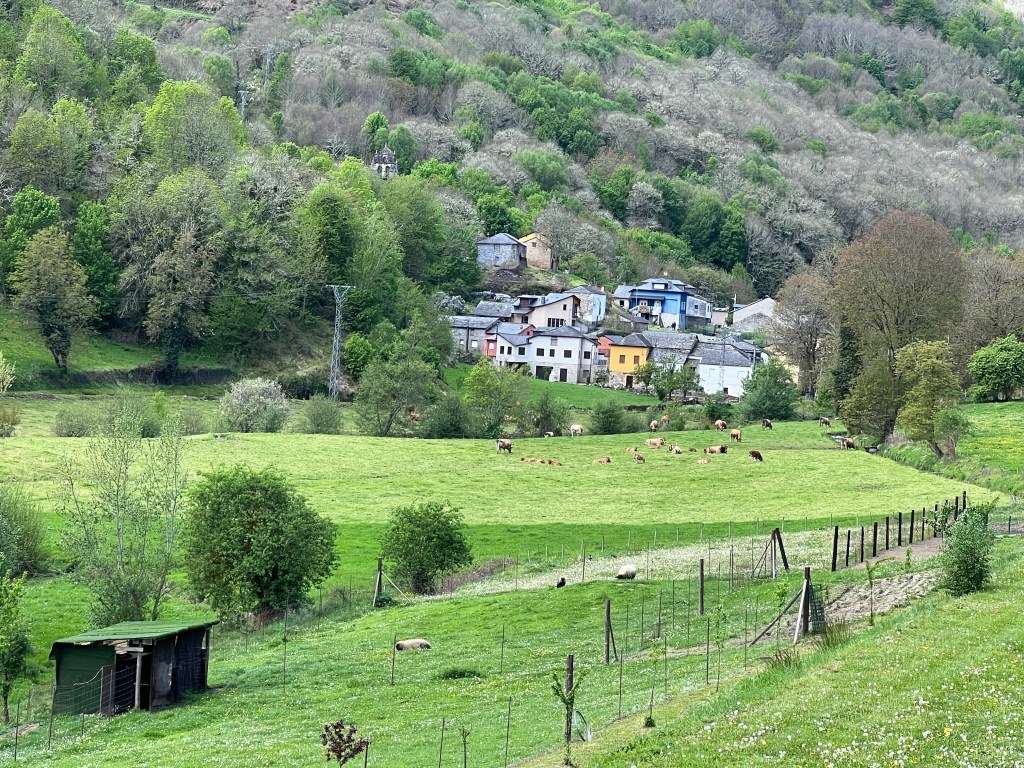

 Along the Way