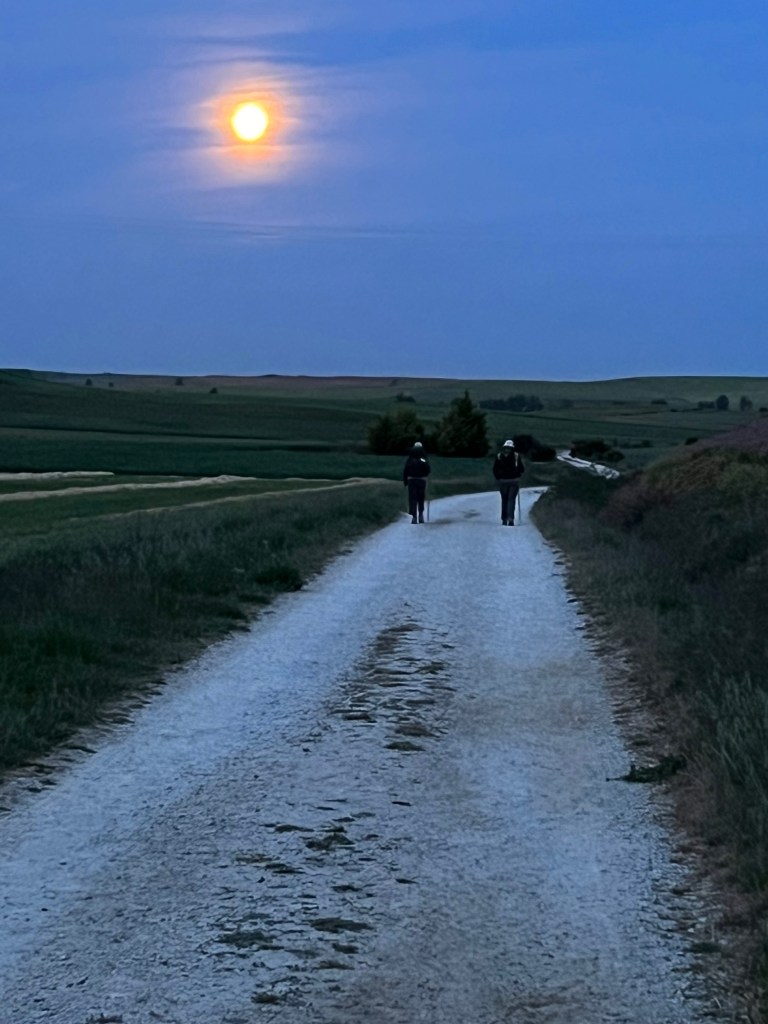
The path today is again straight, flat or gently rolling, though wheat fields and occasional small towns.
In one such town I run directly into L. and E. – because the camino runs directly past a cafe that they are sitting outside of, having breakfast and cigarettes. I join them but immediately go inside to order something, because this cafe looks like it offers what has become my go-to breakfast here: Huevos fritos, which is literally, just two fried eggs on a piece of bread. As simple as that, but can be made quickly, and has protein.
After I come back outside L. asks me how I am feeling . I remark that it can be a bit disorienting to continually meet people on the way, have nice conversations with them over a couple of days, and then have them disappear as if the earth had swallowed them. L. thought for a moment and said, “that’s the Camino”.

I began to see curious caves dug into the sides of hills.

Passing through Sahagun, and a farmer’s market.
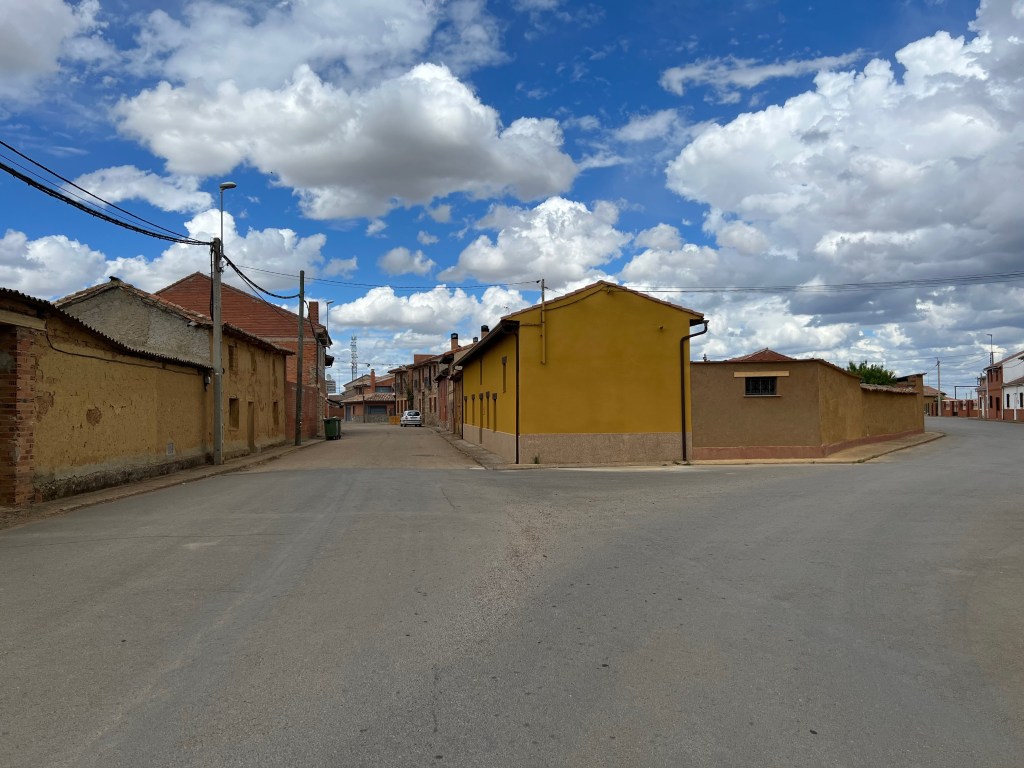
I arrive at the town with the albergue that I plan to stay at. The town is called Bercianos del Real Camino and looks impressively deserted even by Meseta standards.
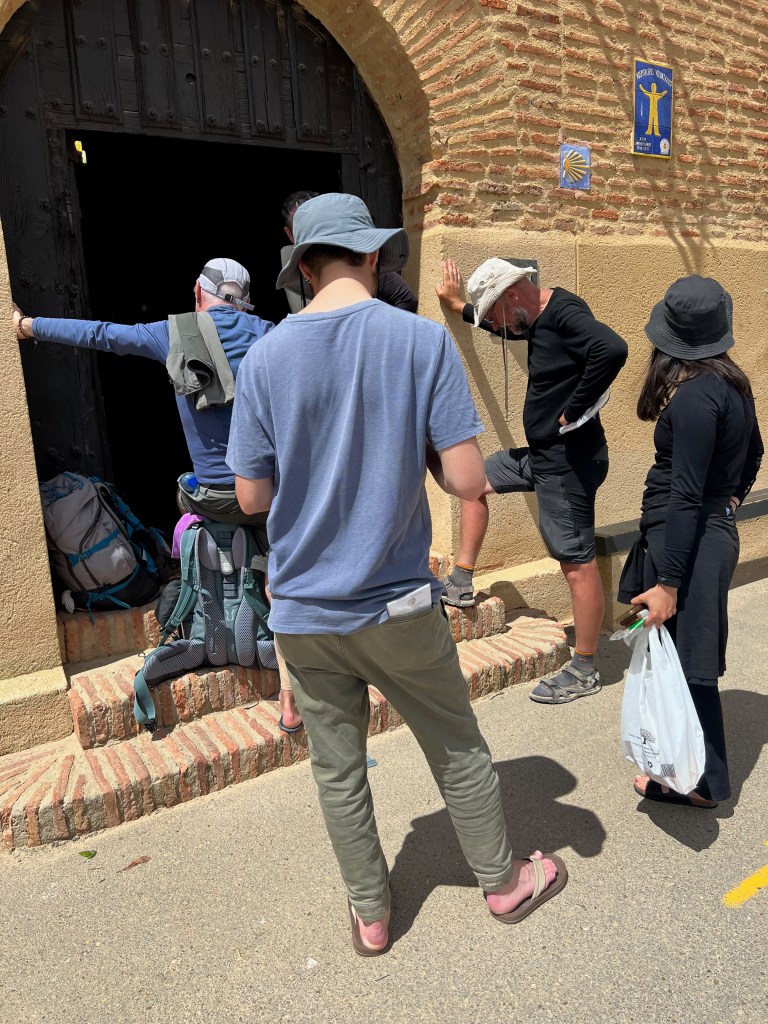
I have, as usual, no reservation at the albergue. There is a line outside to check in, but with only a few people, speaking French. I see a man walking up to the door with two dogs, and find enough French to express my surprise at this, because dogs are not allowed in albergues. One of the French people in line asks me where I am from and when I reply, he switches to English and asks “do you know the American (K.) ?”
On the face of it, it seems unlikely that I would have, because pilgrims are stretched out at random places over (at this point) at least 400km of road, without any organisation or common plan, coordination or communication. But this being the Camino, as it happens I actually had met K. (I had walked with her for a few kms while she regaled me with descriptions of her marathons, ultra-runs, and other feats of endurance.) He then remarks “I slept with her last night!” . I was momentarily taken aback by this, until I realized that, English not being his first language, he simply meant that he had stayed in the same albergue.
Entering the albergue, still in line, I already feel a strong Camino vibe. The place is run by a couple of friendly, older guys who are volunteers. It’s a ‘donativo’ albergue – there is a box on the wall into which we later put whatever cash we feel is appropriate. There is also a photo on the wall indicating that the film crew for the beautiful documentary “Six Ways to Santiago” had stayed there. There is a room in the back with religious statues, for meditation and an optional sharing circle later.
As each pilgrim registers, they are asked where they started from. Most say something like “St. Jean” or “Pamplona”, but one man says “Geneva”. I find out later that he is doing the trek in (large) sections – Geneva to Le Puy-en-Velay, then to St. Jean, and now the Camino Frances in Spain. He is part of a small group of people from Switzerland and France. One (L.) turns out to speak 5 languages (French, Italian, Spanish, German and English).

I have learned that it is important to have some food with you in your pack at all times here on the Meseta – a source of calories such as bread or energy bars. Grocery stores and cafes are relatively scarce and are often closed. Hence I am keen to find a shop to buy some food for tomorrow’s walk. One is said to open at 5 PM, so I head to that location through empty streets. The sky has meanwhile turned dark and threatening rain, as I realize that I left behind my rain gear. There are already a few people waiting outside for the shop to open. As it opens, sprinkles of rain come down, and thunder rumbles. The shop is tiny and so narrow that two people can barely squeeze by each other. Most of the food is behind a counter with two ladies in attendance. Each person must therefore communicate what they want to have, the items retrieved and the bill added up with pencil and paper. This feels like a long process, and by the time I get out the door, there is a flash of lightning, a crack of thunder, and rain starts coming down in sheets.
I had not done any running on the Camino, but now seems like an appropriate time. The town is small, but the streets are random and mazelike, and I am not sure where I am going, as I try to find the albergue. After getting lost a bit, I see the albergue at the end of a street. The rain is still pouring down. I remember that I washed my clothes today, and many items of my clothing are hanging outside to dry. So before going in I retrieve them – how they will get dry now is not clear.
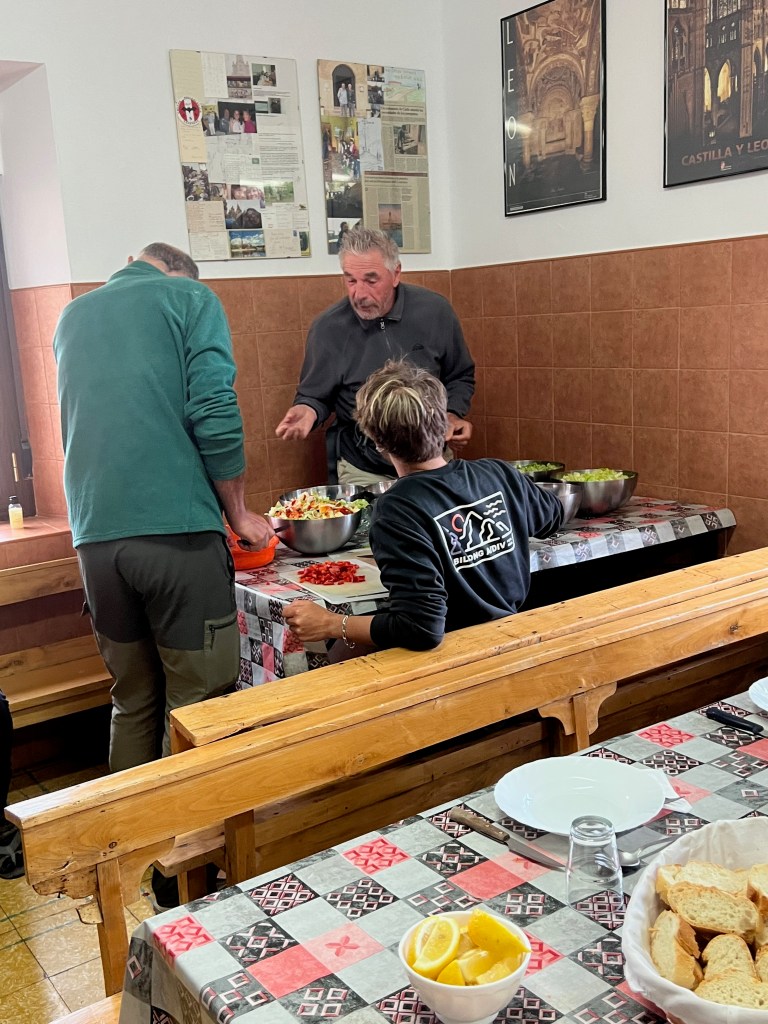
There is communal meal for dinner – with communal meal preparation also. It turns out that the guy who appeared with a backpack and two dogs, is the chef for the evening. The main course is to be a lentil soup. I volunteer myself and go into the kitchen. There aren’t many words exchanged or understood – it’s a noisy and polyglot atmosphere – but I do manage to cut up a large number of bell peppers for a salad. When there does not appear to be anything more that I can do, I sit down at a long table. The Swiss / French contigent arrives, with all the others. There is some discussion about who should sit where. Perhaps because I had said a few simple sentences in French earlier, everyone is OK with my sitting at a table where they are speaking French.
There get to be enough people speaking simultaneously in different languages in the same room, that it gets to be almost impossible for me to discern what anyone one at the table is saying. A couple of times the Swiss/French stand up with wine and enthusiastically propose a toast, but what the toast is for and to whom, I could not say. But the people at the table are sympathetic, L. helps with translation, and we can communicate a little in basic French and English. L. says that the Camino in France is different – ther are fewer people on the way, and the accomodations are smaller, less dormitory-like, with more locals.

After dinner, everyone (including the two dogs) goes outside, up a small hill, to view the sunset. I chat with a New Zealander, who is doing some writing, about his strategies for learning Spanish.
 Along the Way