I am up early, packed and ready to go by 6:15 AM. The afternoon before I had mistakenly agreed to pay for a breakfast, when the albergue owner had impatiently demanded an answer about that. I didn’t think it through well enough, because I now realize it will not available until 7AM, and I do not feel like waiting around.
So off into the predawn darkness. I see dim figures of pilgrims ahead and behind, in ones and twos in the yellow light of streetlamps. I use my headlamp, but quickly lose my way anyway by missing a yellow arrow on a building, and have to retrace my steps. I make frequent recourse to an app with GPS (called Camino Ninja).
Once finally out of town, with the sun coming up, I start walking long, straight, flat stretches of road.
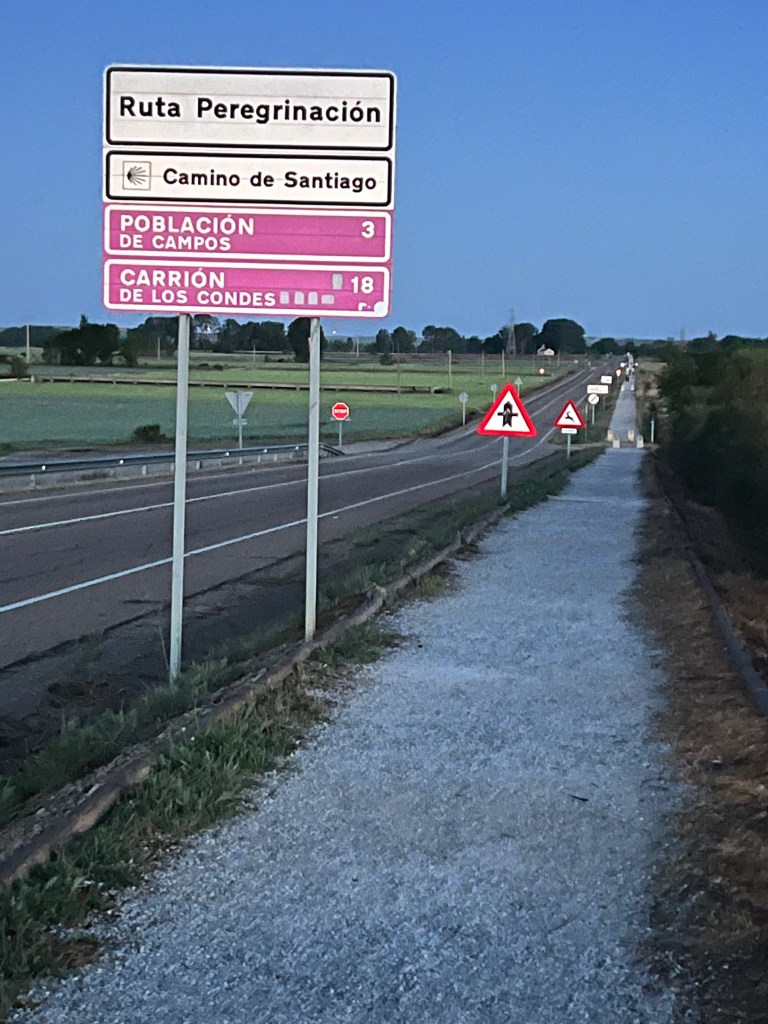
I pass through some small villages, hoping / expecting that I will pass by a cafe in one of them . Walking through the third without success I realize that there may not be one open directly on the Camino path, and so go into the town and start asking around. I finally find an open cafe on the Plaza Major.
The small towns on the Meseta can appear remarkably deserted. I saw one village, a bit off the Camino, which even appeared to be completely abandoned. Why this is so can be explained by recent Spanish history. Francisco Franco had an vision for Spanish society in which most people would be living in the countryside, on farms or in small towns. This bucolic ideal was not shared by the actual population, so as soon as Franco died in 1975 there was a migration of millions of people to suburbs outside the large cities like Madrid, in search of industrial jobs.
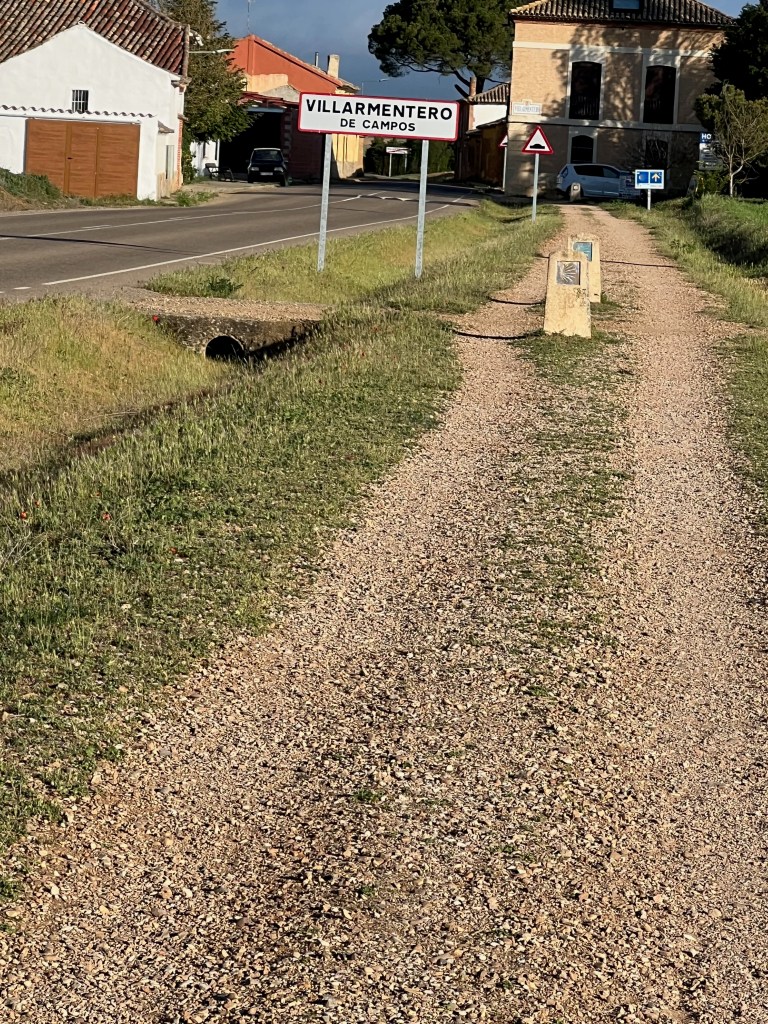
This town is so small that I could capture the signs for “entering” and “leaving” town, in the same photo.
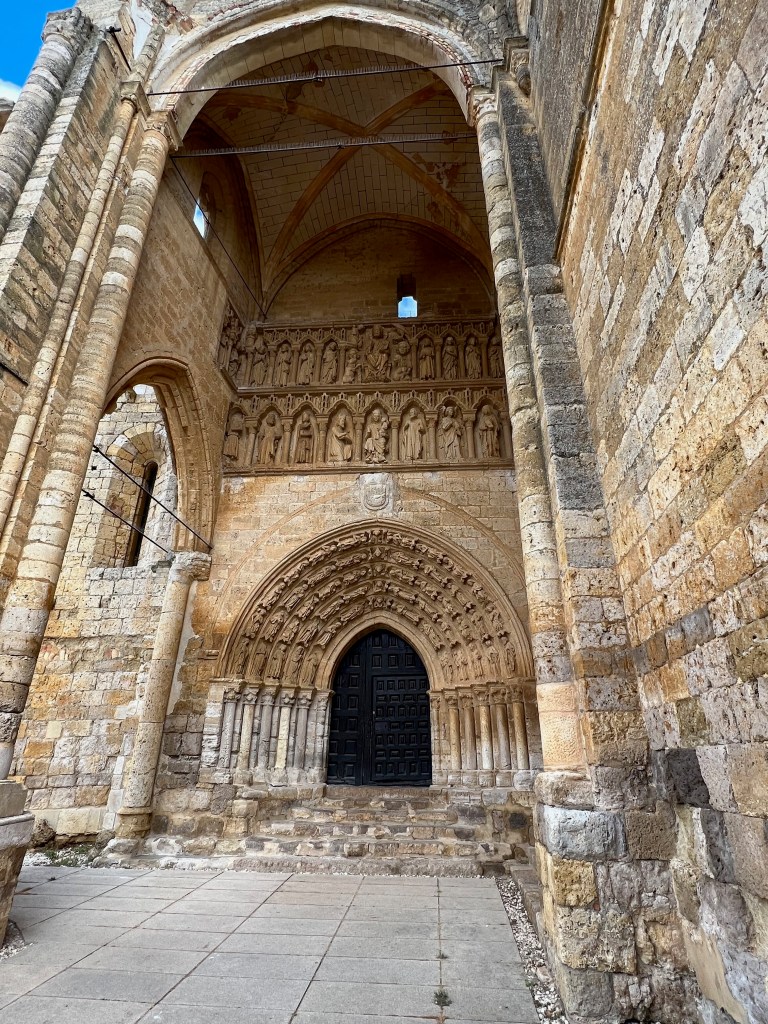
It was worth walking into the town center to see this beautiful Romanesque church.
Meanwhile on the way, the wind caused rippling waves across the wheat fields.
The name of my destination town today, Carrión de los Condes, begs for some explanation. Condes refers to some long-forgotten counts, but Carrión? I was not able to find out if this has any relation to the English word carrion. The reason may be lost to history. The town was founded by Romans, then settled by Visigoths, after all. I did keep my eye out for any “Ask a Visigoth” visitor information.
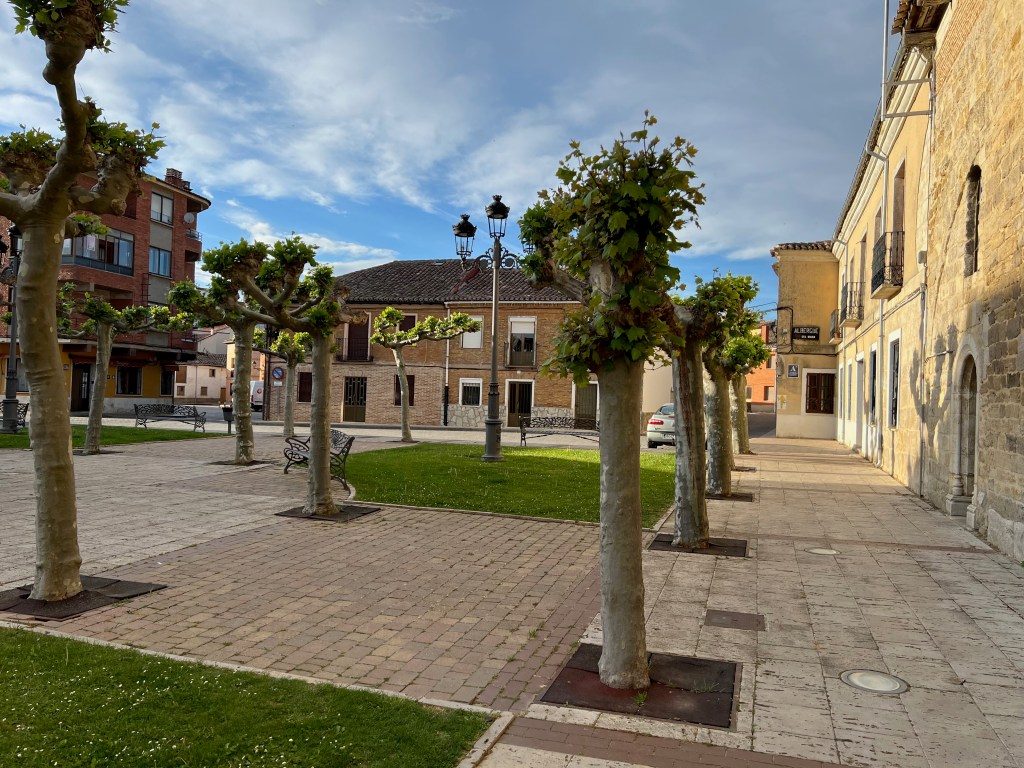
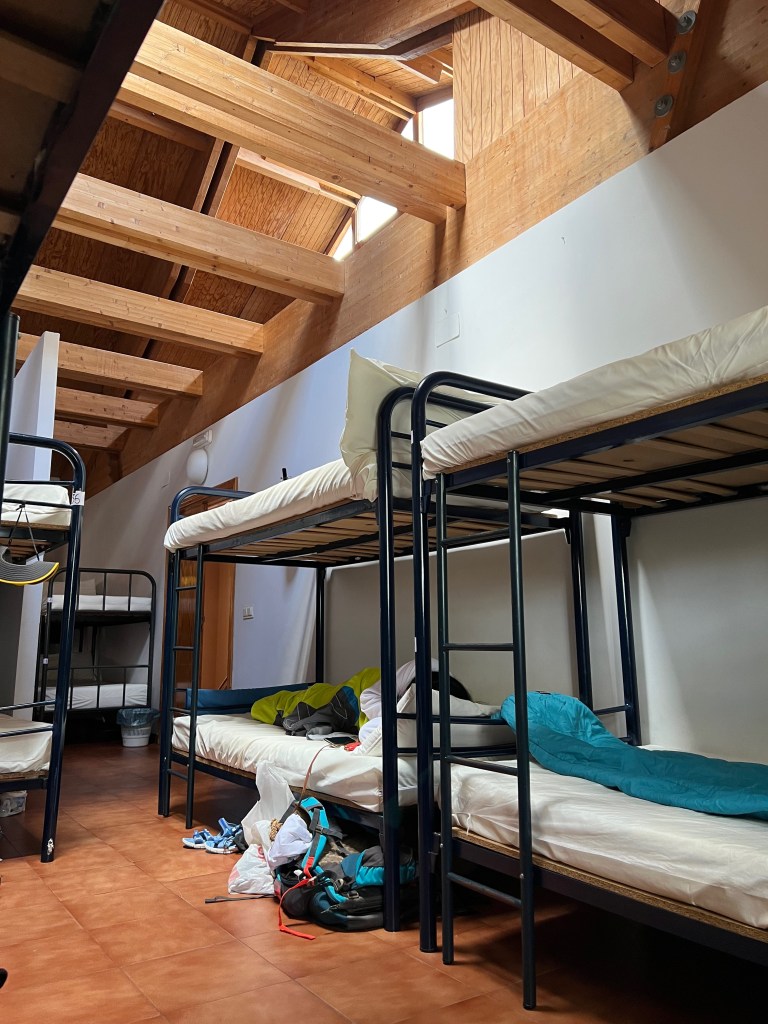
In fact Carrión turns out to be a medium-sized and lively town. There is a street market going on in the center of town when I arrive, which is interesting but results in such a confusion of market stalls and people, that I initially can’t locate the albergue which I am looking for. I do eventually find the place where I plan to stay. This is run by friendly group of four Augustine nuns. The place is relatively spacious and has a large kitchen – I go food shopping at a supermarket and make my own dinner of pasta, as several others are doing.
The albergues almost always have an area where you can do hand washing of a few clothes. I usually hand-wash mine because so much is merino wool. It’s easy to meet people at the washing station, because (as here) there are multiple sinks, but only a few people, and there are ready-made conversation topics (is there any soap? is there hot water?) I meet F. from La Rochelle in France, now living in Paris.
Outside in the garden there is a sharing circle event at 6 PM with the sisters and the people staying here. People introduce themselves and offer religious and folk songs and poems. T. from Germany brings his ukelele and sings a somewhat unexpected but heartfelt version of Frank Sinatra’s “My Way” .
There is also a pilgrims service in the church next door. I feel a bit of imposter syndrome and am somewhat reluctant to go to this, but it turns out to be relaxed with no expectations of religious belief. There are two Brazilian ladies who I have seen on the way, who wear T shirts from their church group back home. They are very much affected by a certain special statue of Mary in the church, and start crying.

 Along the Way